Flint Nurse Attorney for Emergency Room Injuries

Our nurse attorney in Flint works from our office at 432 N. Saginaw Street, downtown. Emergency rooms are where nursing decisions happen fastest, and a rushed call at triage or discharge can change a life. Eileen E. Kroll, RN, JD, reviews those decisions for Genesee County patients and families who were hurt after an ER visit.
If a Flint emergency room visit left you or your child worse off, contact us for a free consultation or call 1-866-MICH-LAW anytime, 24/7.
When Emergency Care Goes Wrong in Genesee County
Emergency departments are busy, loud, and short on time. Most visits go well. When they don’t, the problem usually traces back to one of a few moments: how urgent the patient was judged to be, whether anyone acted on changes, and whether the patient was truly safe to go home.
Triage Mistakes
Triage is the first nursing assessment in the ER. It decides who is seen first. Most U.S. emergency departments use a five-level scale called the Emergency Severity Index, where level 1 needs immediate lifesaving care and level 5 can safely wait. Under-triage happens when a patient is scored as less urgent than they really are. A person with early sepsis, a heart attack, or a stroke may then sit in the waiting room while the damage grows.
Changes Nobody Acted On
Once a patient is in a room, nurses recheck vital signs and watch for decline. Trouble starts when:
- Vital signs are not rechecked on schedule
- A rising heart rate, falling blood pressure, or dropping oxygen level is charted but not reported to the physician.
- A nurse raises a concern but does not use the chain of command when the physician does not respond.
Safety researchers call this “failure to rescue,” and the federal Patient Safety Network’s overview of failure to rescue explains why early recognition matters so much.
Sent Home Too Soon
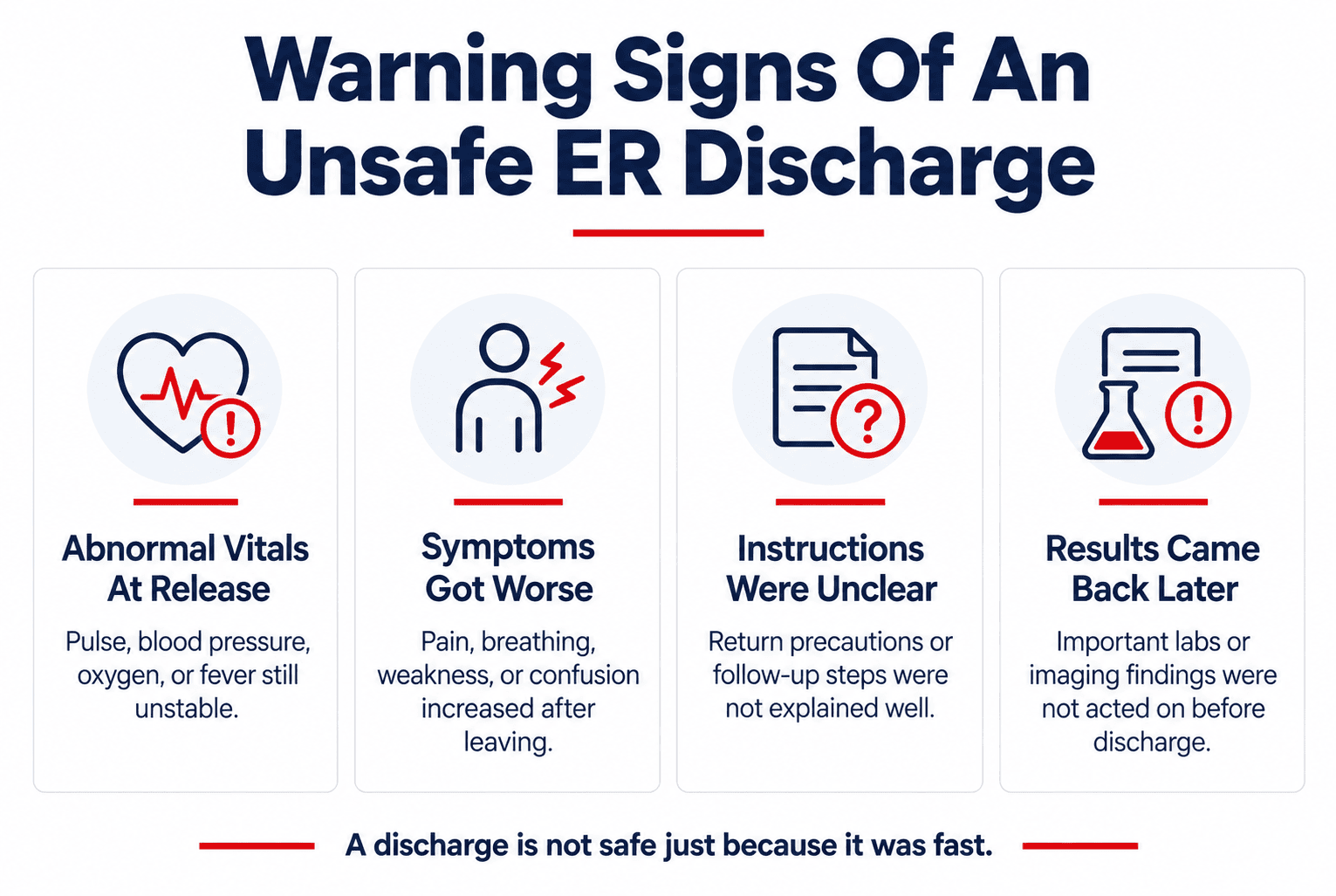
Being discharged from the ER does not always mean you were safe to leave. Unsafe discharges often involve abnormal vital signs at the time of release, test results that came back after the patient left, or instructions that were unclear about when to return. Warning signs that a discharge may have been premature include:
- Symptoms that return within hours or a day
- Discharge vital signs that were still abnormal
- No clear diagnosis or follow-up plan
- Tests that were ordered but never reviewed
The Patient Safety Network’s discussion of adverse events after discharge shows how often problems surface in the days after patients leave care.
How a Nurse Attorney Rebuilds an ER Visit Minute by Minute

ER records are packed with time stamps. Eileen pieces together the triage notes, nursing reassessments, physician orders, lab times, and the electronic health record’s audit trail, which logs who opened the chart and when. Lined up minute by minute, those records show how long a patient waited, what staff knew at each point, and when someone should have acted. Our page on emergency room malpractice covers these claims in more depth.
A Flint Emergency Room Result
Cochran, Kroll secured a $930,000 result in a Flint emergency center malpractice case. A seven-week-old baby was sent home from the emergency room without any tests or treatment and later died from dehydration. Cases like this often turn on what staff should have recognized before sending a patient home. More outcomes are on our verdicts page.
Past results do not guarantee a similar outcome in any future case.
Children in the ER: Why Pediatric Cases Need a Closer Look
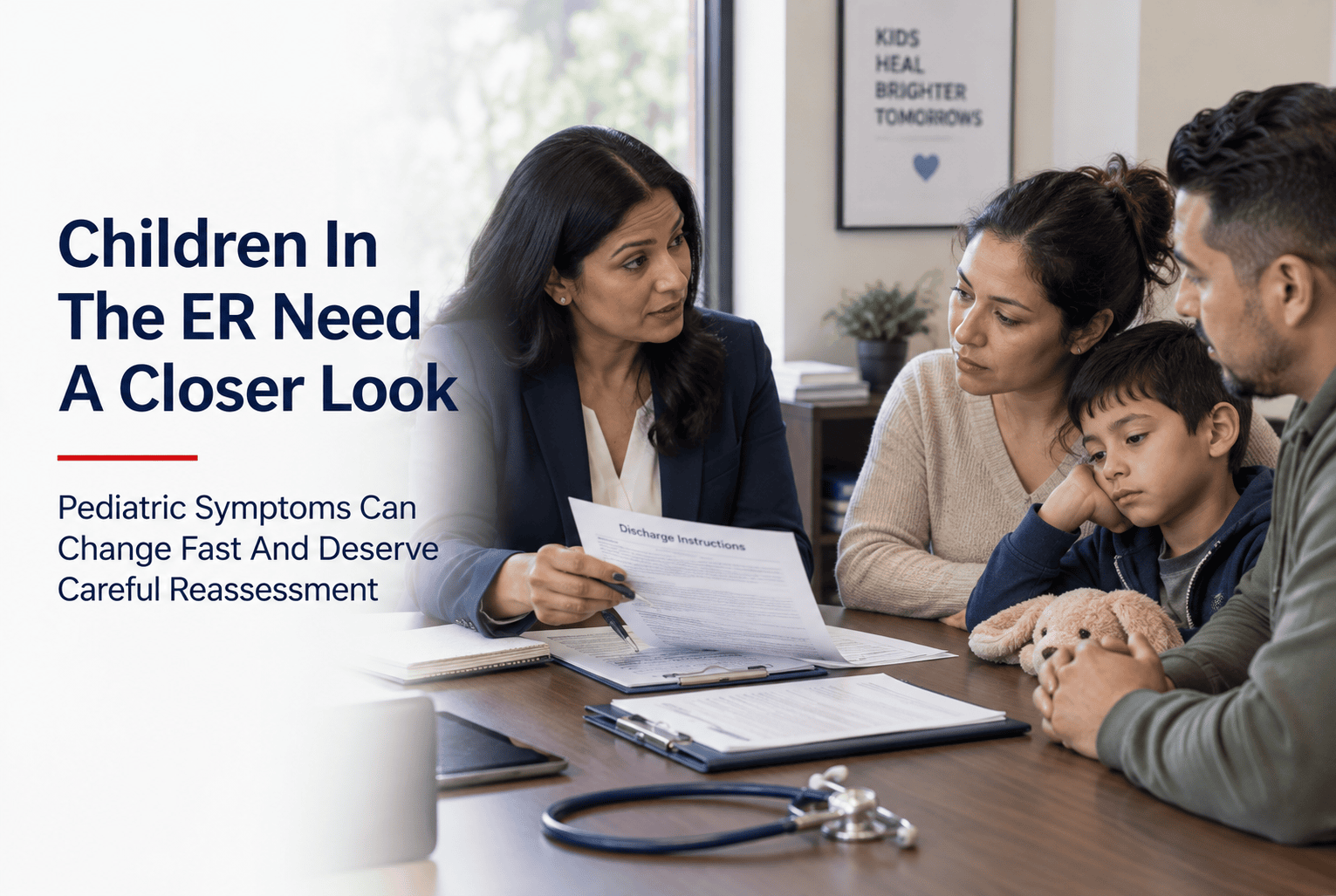
Infants and young children cannot explain how they feel, and they can go downhill faster than adults. In a busy ER, early signs are easy to miss. Warning signs of dehydration in babies include:
- Fewer wet diapers than usual
- No tears when crying
- A sunken soft spot on the head
- Unusual sleepiness or trouble waking
- Dry mouth and lips
Children also need medication doses based on their weight, which adds another place for errors. Michigan gives injured children some extra time to bring a claim, but the rules are specific and have limits. The full deadline rules are listed on our main Michigan nurse attorney page. If the error involved a drug or dose, our Warren nurse attorney page explains how medication mistakes are traced.
What Makes an ER Nursing Case Different
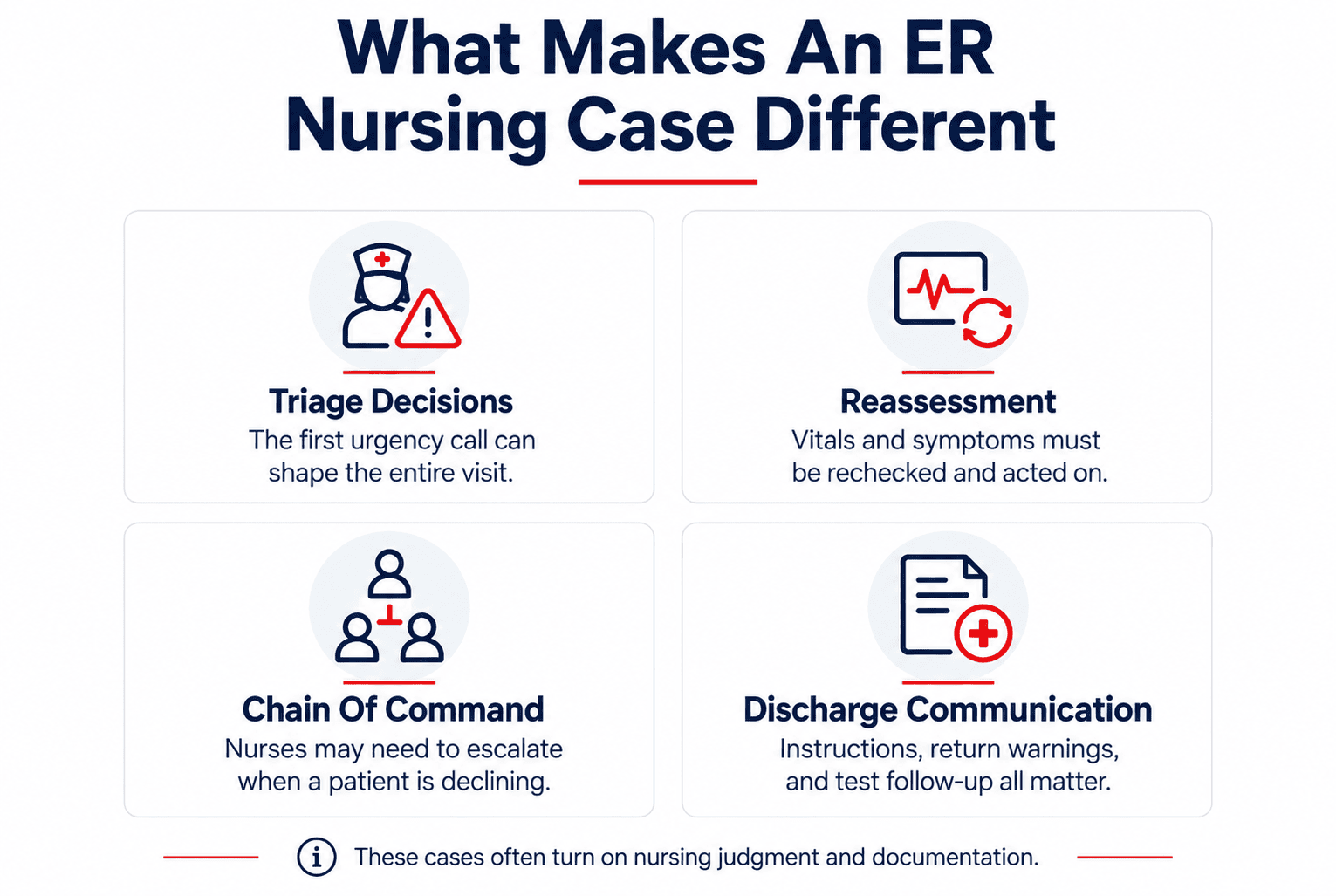
Emergency room claims share the same Michigan rules as other malpractice cases, but a few features set them apart.
First, federal law shapes what an ER must do. The Emergency Medical Treatment and Labor Act requires hospitals with emergency departments to give anyone who arrives a medical screening exam and to stabilize an emergency condition before discharge or transfer, regardless of insurance or ability to pay. The CMS overview of EMTALA explains those duties.
Second, the people treating you may work for different employers. ER physicians are often part of an outside physician group, while the nurses are usually hospital employees. Figuring out who employed whom decides which parties receive a Notice of Intent, and a missed party can drop out of the case.
Third, ER decisions are made fast and with limited information. The law does not expect perfection. It expects the care a reasonable ER nurse or physician would have given with the information available at the time. That is why the minute-by-minute timeline matters so much: it shows what staff actually knew, and when.
Flint-Area Hospitals, Nursing Schools and Court
Most Flint-area ER visits happen at one of three hospitals:
- Hurley Medical Center, the city’s public teaching hospital, home to a Level I trauma center
- McLaren Flint, on the city’s west side
- Henry Ford Genesys Hospital in Grand Blanc Township, formerly Ascension Genesys
The University of Michigan-Flint School of Nursing and Mott Community College train many of the nurses who go on to work in the region’s hospitals.
Malpractice lawsuits over care given in Genesee County are usually filed in the Genesee County 7th Judicial Circuit Court, located at 900 S. Saginaw Street in Flint. Hurley’s status as a publicly owned hospital can raise extra questions, which we cover in the FAQ below.
What to Do After a Bad ER Visit in Flint
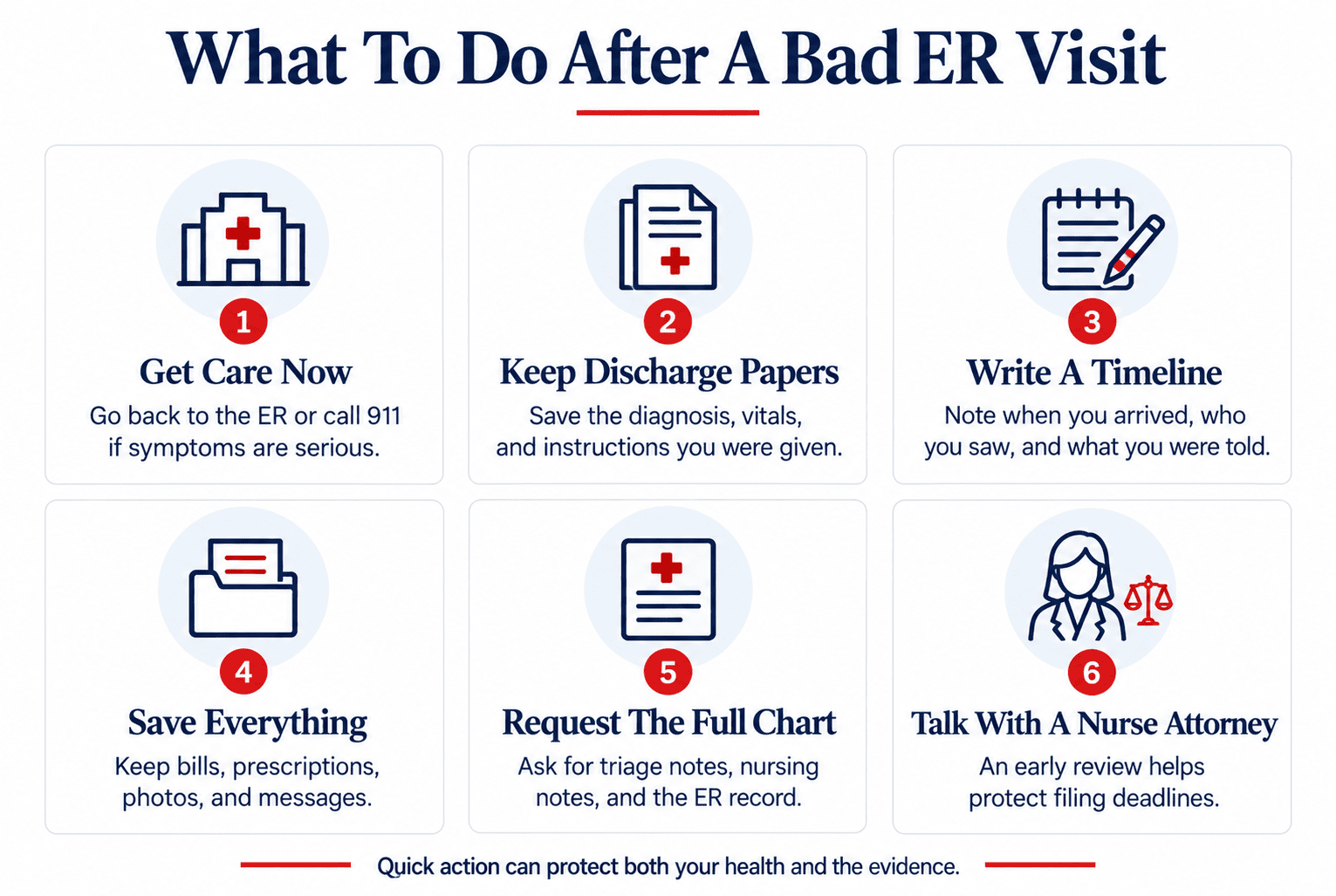
If you or your child got worse after leaving a Flint ER, take these steps:
1. Get care now. Go back to an emergency room or call 911 if symptoms are serious. Your health comes first.
2. Keep the discharge papers. They show your diagnosis, vital signs, and the instructions you were given.
3. Write a timeline. Note when you arrived, how long you waited, who you spoke with, and what you were told.
4. Save everything. Keep prescriptions, bills, photos, and any messages from the hospital.
5. Request your records. Ask for the full ER chart, including triage and nursing notes.
6. Talk with a nurse attorney. An early review helps protect Michigan’s filing deadlines.
Visiting Our Office: A Nurse Attorney in Flint
Our Metro Flint office sits in the heart of downtown:
- Address: 432 N. Saginaw St., Suite 445, Flint, MI 48502
- Phone: 866-642-4529, toll-free and answered 24 hours
Having an office in Flint means Genesee County clients do not have to drive to Metro Detroit to sit down with us. You can bring your paperwork downtown, ask questions face to face, and meet the team working on your case. When a Genesee County case moves into litigation, the courthouse is a short trip down Saginaw Street from our office.
We also meet clients from Genesee, Lapeer, Shiawassee, and Saginaw counties by phone or video when travel is hard. Learn more about the space on our Metro Flint office page, or read about the firm’s broader personal injury work in Flint. Eileen’s full background is on the profile of Eileen E. Kroll, RN, JD.
Your consultation is free. We work on a contingency fee, so there is no attorney fee unless we recover compensation for you.
Contact Our Emergency Room Malpractice Lawyers in Flint
ER records hold the answers, but hospitals and their insurers won’t hand those answers over on their own. One phone call can get the review started.
Contact us at Cochran, Kroll & Associates, P.C. for a free consultation. We’ll request the chart, review the triage and discharge decisions, and map out the strongest path forward. Remember, we don’t get paid unless you win.
Call us at 1-866-MICH-LAW anytime, 24/7, to schedule a free case evaluation.
Frequently Asked Questions
Can I bring a claim against Hurley Medical Center if it is a public hospital?
Often, yes. Michigan’s governmental immunity law generally protects public agencies from lawsuits, but it contains an exception for the operation of a hospital and for medical care given to patients (MCL 691.1407(4)). The same Michigan malpractice notice and expert rules still apply.
Will Eileen meet me at the Flint office?
Consultations can be scheduled at our Flint office on North Saginaw Street. Tell us when you call that you prefer to meet in Flint, and we will set it up. Phone and video meetings are also available.
Is a long wait in the ER malpractice by itself?
Not usually. Waits are common, and a long wait alone rarely supports a claim. It becomes a problem when a patient was under-triaged, meaning their symptoms called for faster care, and the delay caused harm that quicker treatment would likely have prevented.
The ER sent my child home, and my child got worse. What should I do first?
Get your child care right away, either back in the ER or by calling 911. Once your child is safe, keep the discharge papers and write down what happened and when. Then call us so we can review whether the discharge met the standard of care.
Do I need to live in Flint to use your Flint office?
No. The Flint office serves clients across Genesee County and surrounding areas, and we represent Michigan residents statewide. Clients who live closer to Metro Detroit can meet at our Livonia office instead.