Nurse Attorney in Lansing, Home of Michigan’s Nursing Board

A nurse attorney in Lansing helps patients through a choice many don’t know they have. Every Michigan nurse’s license is overseen from the capital, where the Board of Nursing reviews complaints about nursing care. A complaint and a malpractice lawsuit do very different things. Eileen E. Kroll, RN, JD, helps Lansing patients and families decide which path, or both, fits what happened.
Weighing a Board of Nursing complaint against a lawsuit? Contact us for a free consultation, or call 1-866-MICH-LAW anytime, 24/7.
Why Lansing Matters to Patients Across Michigan
Lansing is where Michigan decides who may practice nursing. The Department of Licensing and Regulatory Affairs (LARA), through its Bureau of Professional Licensing, handles complaints against licensed nurses, and the Michigan Board of Nursing sets standards and decides discipline. Both work out of the Ottawa Building downtown. The state’s administrative hearing office sits in the same building.
| Office |
What It Does |
Location |
| LARA, Bureau of Professional Licensing |
Receives and investigates complaints about licensed health professionals |
611 W. Ottawa St., Lansing |
| Michigan Board of Nursing |
Sets nursing standards and decides discipline through its Disciplinary Subcommittee |
611 W. Ottawa St., Lansing |
| Michigan Office of Administrative Hearings and Rules (MOAHR) |
Holds hearings before administrative law judges |
Ottawa Building, 611 W. Ottawa St., Lansing |
Contact details for the hearing office are listed on MOAHR’s contact page. For a patient anywhere in Michigan, including Detroit, Grand Rapids, or the Upper Peninsula, a complaint about a nurse ends up here.
For Patients: A LARA Complaint or a Malpractice Lawsuit?
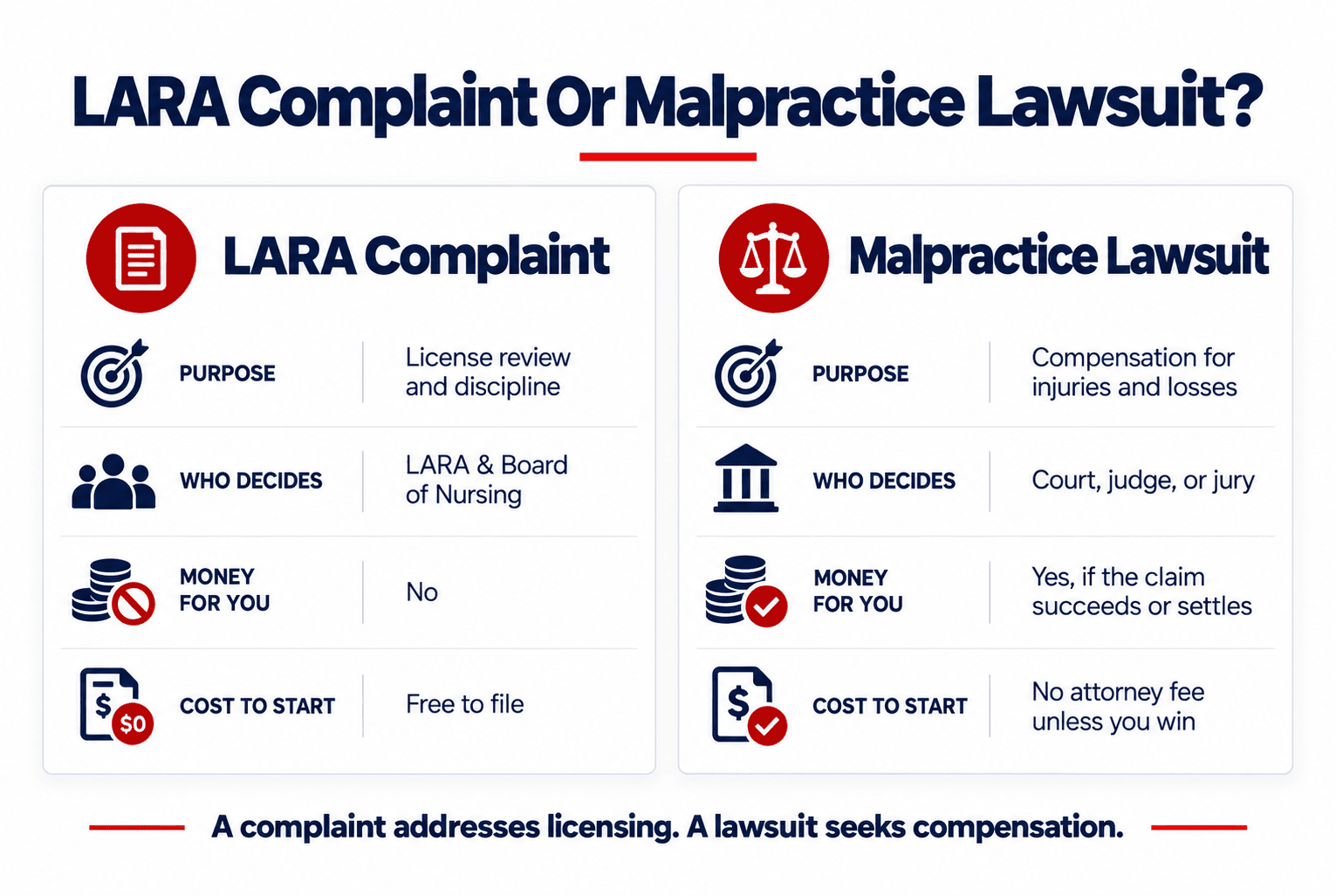
These two paths are often confused, but they serve different purposes. A complaint asks the state to look at a nurse’s license. A lawsuit asks a court to make you whole for your losses.
| Question |
LARA Complaint |
Malpractice Lawsuit |
| Purpose |
Review the nurse’s license and decide whether discipline is needed |
Compensation for your injuries and losses |
| Who decides |
LARA and the Board of Nursing |
A circuit court judge or jury |
| Money for you |
No |
Yes, if the case succeeds or settles |
| Cost to file |
Free |
No up-front fee with our contingency agreement |
| Lawyer needed? |
Not required |
Strongly recommended, because of Michigan’s strict pre-suit rules |
The biggest surprise for many families is the third row. LARA’s process focuses on the professional’s license. It cannot order the nurse or hospital to pay you, cover your medical bills, or replace lost wages. If you need compensation, a malpractice claim is the path that can provide it.
Timing differs too. A malpractice lawsuit averages about 18 to 24 months, and medical malpractice cases can take longer because of Michigan’s required notice and expert reviews. A LARA complaint follows its own schedule, which the patient doesn’t control, and the outcome may not be shared in detail. Families who need help with medical bills or lost income soon usually can’t wait on a licensing decision to get it.
That doesn’t make a complaint pointless. Some families file because they want the state to know, or because they want to help protect the next patient. Those are real reasons, and a complaint can sit alongside a claim.
How a Patient Complaint Against a Nurse Works
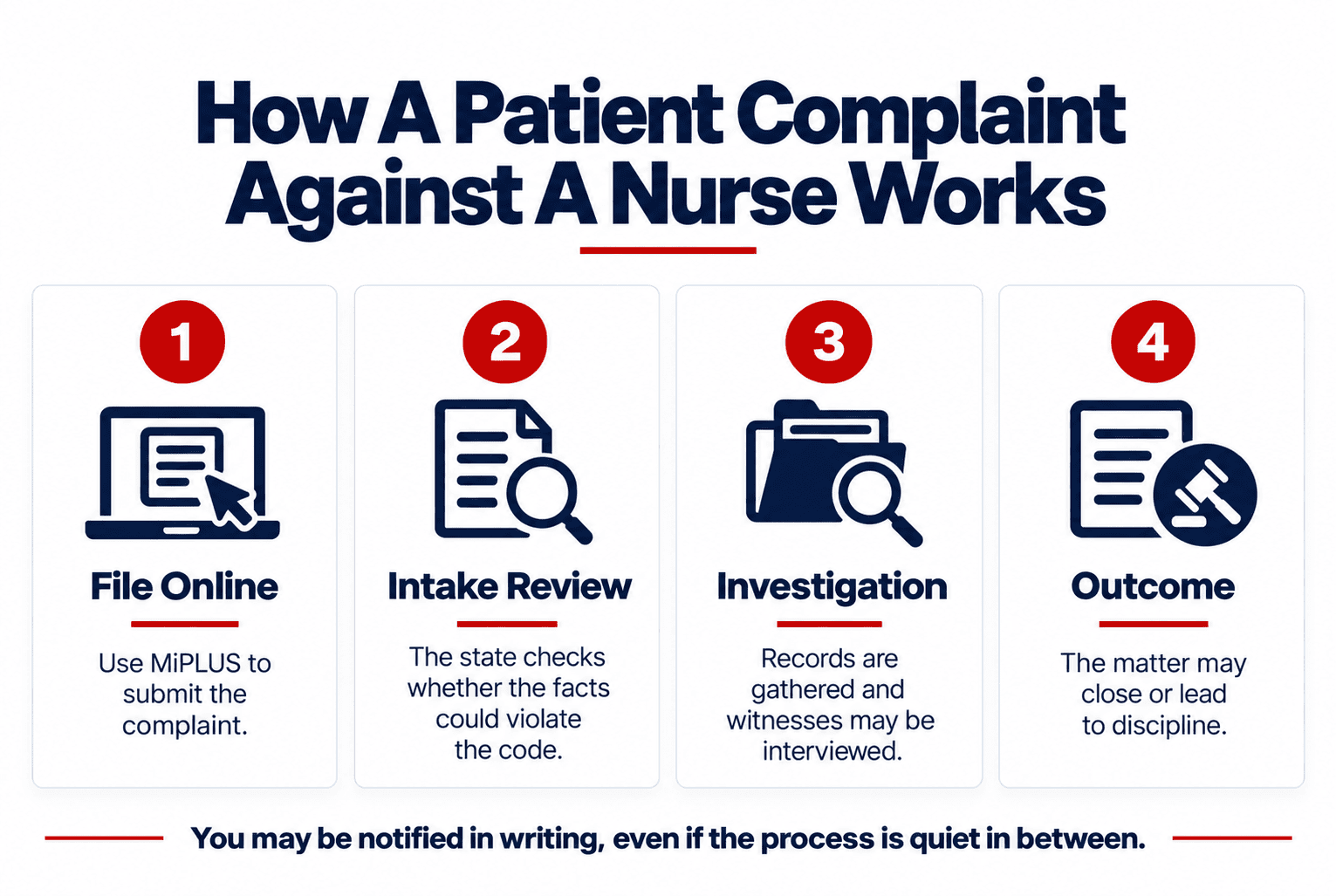
Filing a complaint does not require a lawyer, and it costs nothing. The general steps look like this:
1. File online. Complaints about most licensed health professionals are filed through LARA’s online licensing system, MiPLUS. The Bureau of Professional Licensing complaint page links to the system and to a citizen’s guide.
2. Intake review. LARA’s complaint intake staff decide whether the allegation, if true, would break the Public Health Code. Some complaints are closed at this stage.
3. Investigation. If the complaint moves forward, an investigator may interview you, the nurse, and other witnesses, and gather records.
4. Outcome. The state may close the matter or pursue discipline such as fines, probation, limits on practice, suspension, or revocation. LARA explains these steps on its page about what happens after a complaint is filed.
You will generally be notified in writing if your complaint is closed. You may not hear much in between, which can feel frustrating. That silence is normal for the process.
Tips From a Nurse Attorney in Lansing for a Clearer Complaint
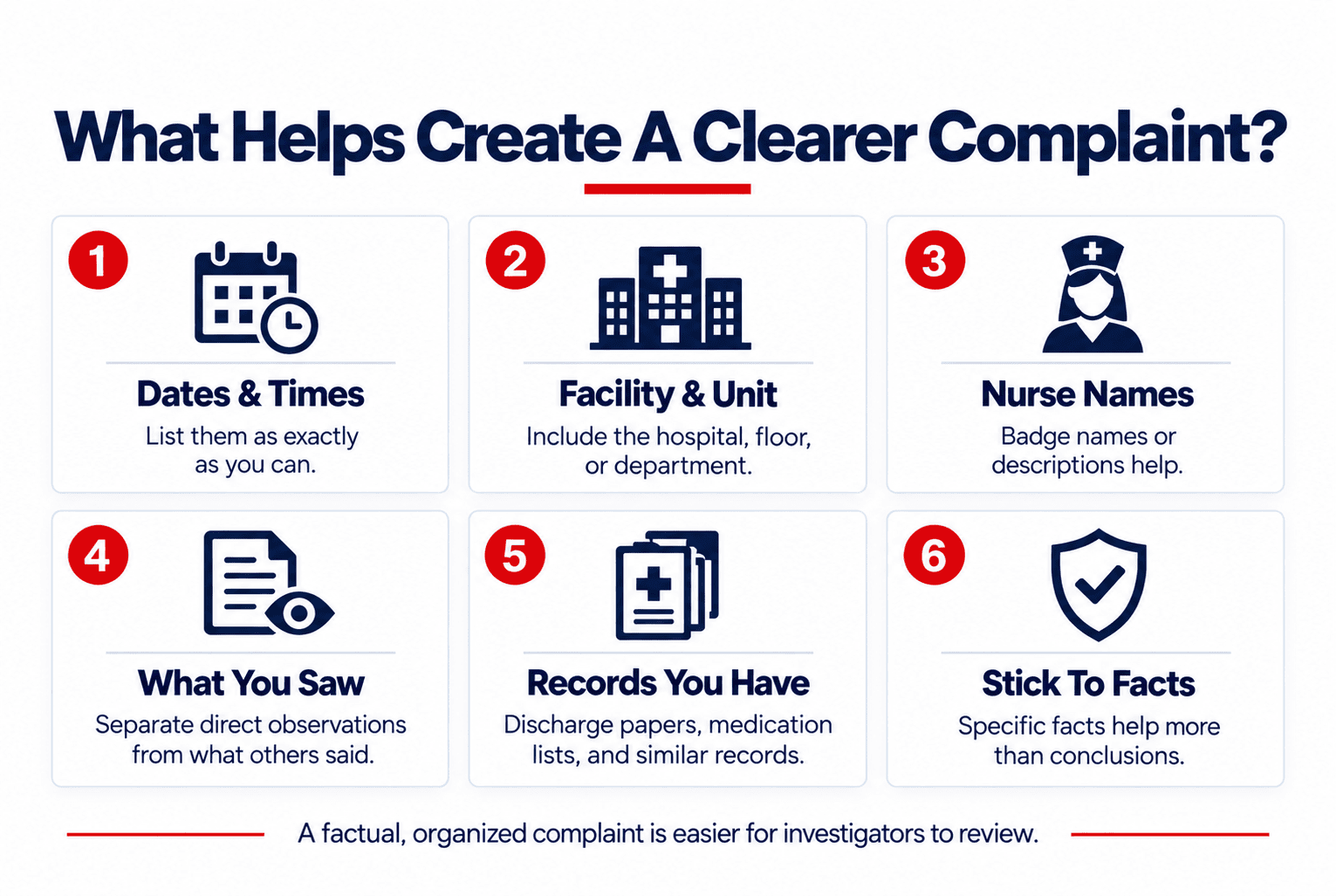
State investigators review a large number of complaints. A clear, factual one is easier to act on. Before you file, gather:
- Dates and times of the care you are concerned about, as exactly as you can
- The facility and unit, such as the hospital name and floor or department
- Names or descriptions of the nurses involved, including badge names if you saw them
- What you personally saw or heard, kept separate from what you were told by others
- Copies of records you already have, such as discharge papers or medication lists
Stick to facts rather than conclusions. “The nurse didn’t check on my father from 10 p.m. to 4 a.m.” is more useful than “the nurse was careless.” If you plan to pursue a malpractice claim too, it helps to have a lawyer review your draft first.
Filing Both: How to Keep a Complaint From Hurting Your Claim
You can usually pursue a complaint and a lawsuit at the same time, but the order and wording matter. A few cautions:
- Your statements become part of a record. What you write in a complaint or tell an investigator may be seen later. Details that are vague or inconsistent can be used against you.
- The lawsuit clock keeps running. Filing a complaint does not pause Michigan’s malpractice deadlines.
- A complaint result does not decide your lawsuit. The Board might take no action, and you could still have a valid malpractice claim, or the reverse.
- Records you gather help both. Getting the full chart, including nursing notes and the medication administration record, supports either path.
Talking with a lawyer before you file lets you tell your story once, clearly, in a way that protects both options. Our article on 4 Michigan nursing board cases shows the kinds of conduct the board has reviewed in the past.
Lansing Hospitals, Nursing Schools and Court
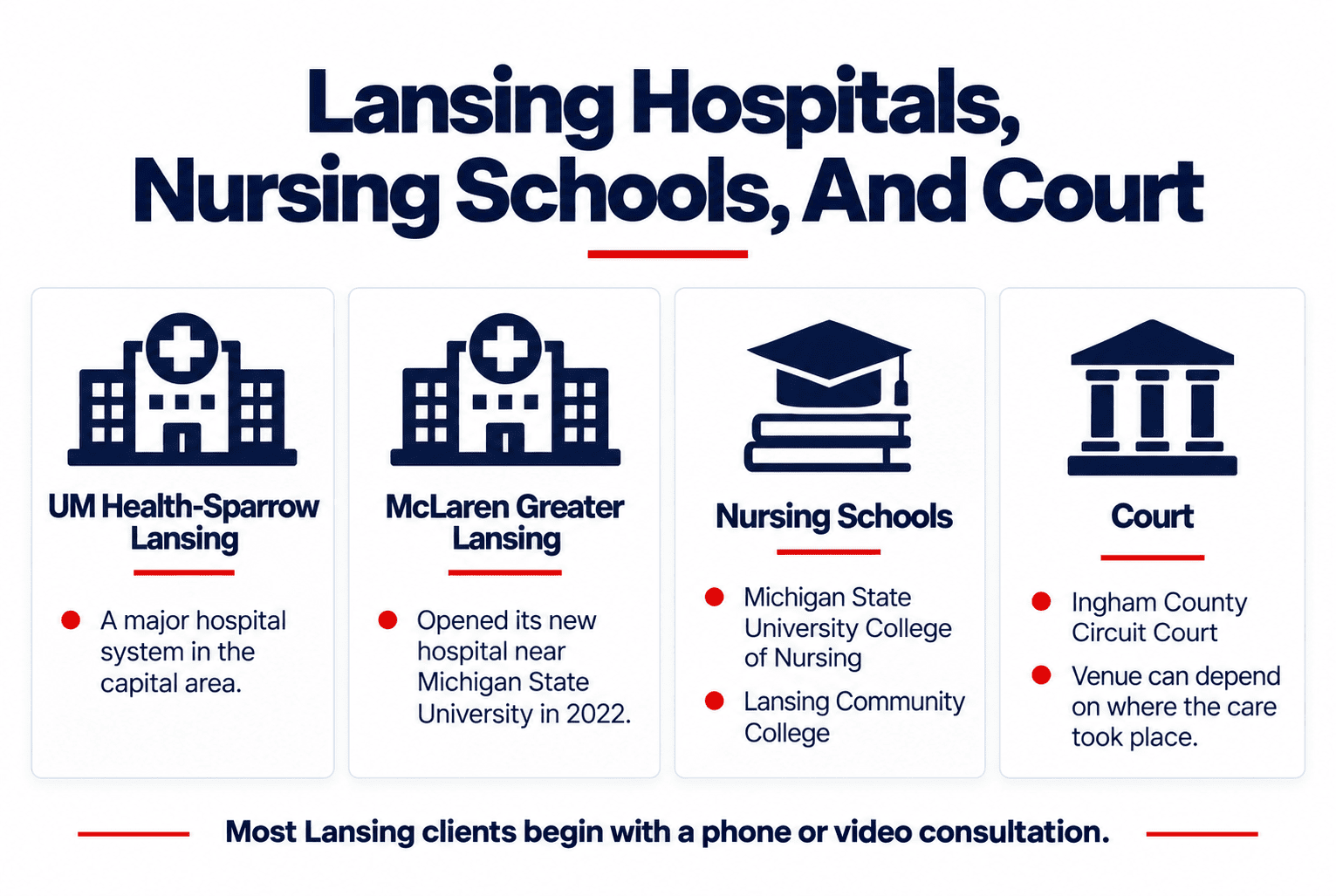
Most hospital care in the capital area happens at two systems:
- UM Health-Sparrow Lansing, the region’s largest hospital, which took on the University of Michigan Health name in 2024 (UM Health-Sparrow)
- McLaren Greater Lansing, which opened its new hospital near Michigan State University in 2022
Future nurses train at the Michigan State University College of Nursing in East Lansing and at Lansing Community College.
Malpractice lawsuits over care given in Lansing are usually filed in the Ingham County Circuit Court (30th Circuit) at the Veterans Memorial Courthouse, 313 W. Kalamazoo St. Parts of Lansing extend into Eaton and Clinton counties, so the right court can depend on where the care took place.
Our Flint office is about 55 minutes from Lansing, and our Livonia office is about an hour and 15 minutes. Most Lansing clients start with a phone or video consultation. For broader malpractice cases in the area, see our Lansing medical malpractice lawyer page. Eileen’s background as a registered nurse and trial lawyer is on the profile of Eileen E. Kroll, RN, JD, and our Michigan nurse attorney page lists the state’s full malpractice deadlines.
We handle patient claims on a contingency fee, so you owe no attorney fee unless we recover compensation for you.
Not Sure Whether to File a Complaint or a Claim? Ask Us
Choosing the wrong path first can cost time you can’t get back. A short conversation can sort out which step makes sense for your situation.
Contact us at Cochran, Kroll & Associates, P.C. for a free consultation. We’ll review what happened, explain how a complaint and a claim would work together, and help you choose your next move. Remember, we don’t get paid unless you win.
Call us at 1-866-MICH-LAW anytime, 24/7, to schedule a free case evaluation.
Frequently Asked Questions
Will filing a complaint with LARA get me compensation?
No. LARA’s process can discipline a nurse’s license, but it cannot award you money for medical bills, lost income, or pain and suffering. Compensation comes through a malpractice claim, which is handled in court or through a settlement.
Will the nurse know I filed the complaint?
Often, yes, because an investigation usually requires sharing the details of what happened with the nurse so they can respond. If you are worried about this, talk with us before you file.
Do I have to travel to Lansing for a malpractice case?
Usually not. A malpractice lawsuit is filed in the county where the care happened, not in Lansing. Only Lansing-area cases would be heard at the Ingham County courthouse, and many steps happen by phone, video, or in our offices.
Can I complain about a nurse if I live outside the Lansing area?
Yes. The Board of Nursing oversees nurses licensed anywhere in Michigan, and complaints are filed online. You never need to visit the Ottawa Building to file.
Does a Board of Nursing decision help my lawsuit?
It can provide useful background, but it does not decide your case. A court looks at its own evidence and at expert testimony about the standard of care. Your claim can succeed even if the Board takes no action.