Nurse Attorney in Canton, Michigan

As a nurse attorney in Canton, Eileen E. Kroll, RN, JD, often sees injuries that happen outside a hospital. Much of Canton’s care takes place in surgery centers, urgent care clinics, and living rooms during home health visits. Our main office in Livonia is a short drive north, so help with these cases is close by.
Hurt after outpatient surgery, urgent care, or a home health visit near Canton? Contact us for a free review, or call 1-866-MICH-LAW anytime, 24/7.
Care Outside the Hospital: Where Canton Patients Get Hurt

More procedures and follow-up care now happen outside traditional hospitals. That is convenient, but it also means fewer staff, faster discharges, and less monitoring once you leave. When something goes wrong in these settings, the records are spread across more places, and the rules can differ from a hospital case.
Outpatient Surgery Centers
Ambulatory surgery centers handle procedures from cataract surgery to joint scopes, and patients usually go home the same day. The nurses who monitor you in recovery play a big role in keeping that safe. Problems we review include:
- Recovery room monitoring gaps after anesthesia, when breathing or oxygen levels drop, and no one responds fast enough
- Discharging a patient too early, before they can breathe, walk, or manage pain safely
- Burns and positioning injuries that happen while the patient is asleep on the table
Operating room burns are covered on our surgical burns injury page. Surgery centers that bill Medicare must meet federal conditions for coverage, described on the CMS ambulatory surgical centers page.
Urgent Care Clinics
At urgent care, a nurse’s triage decision often decides whether a patient is seen quickly, sent to the ER, or sent home. When warning signs like chest pain or stroke symptoms are underrated, the delay can be serious; missed diagnoses are covered in depth on our Grand Rapids nurse attorney page.
Home Health Nursing
Home health nurses visit patients after surgery or during long illnesses. They handle wound care, set up medications, check for fall hazards, and watch for signs of infection. Because no one else is watching between visits, a missed visit or a missed warning sign can go unnoticed for days. Common problems include:
- Wound care that is skipped or done incorrectly, leading to infection
- Pill organizers filled with the wrong medications or doses
- Fall risks at home that were never addressed
- Missed or shortened visits that the agency still billed for
Responsibility usually starts with the home health agency that employs or contracts the nurse. The agency is expected to train, schedule, and supervise its staff, and its visit notes become key evidence. For Medicare-covered home health, care must follow a written plan of care set up and reviewed by a physician or other allowed practitioner, as explained on Medicare’s home health services page. When visits drift away from that plan, the gap shows in the records.
Why the Setting Changes the Claim
A case against a surgery center or home health agency is not built the same way as a hospital case. The records sit with different providers, and many patients see several of them in a single week. Michigan requires a separate Notice of Intent to each provider you plan to sue, so we have to identify every one of them early. Missing one can mean that provider falls outside the claim.
Which Hospitals Canton Residents Use, and Why It Matters
Canton Township has emergency and outpatient centers run by larger health systems, but no full inpatient hospital of its own. When residents need a hospital stay, they commonly go to:
- Trinity Health Livonia Hospital, to the north
- Corewell Health Wayne Hospital, to the east
- Hospitals in the Ann Arbor area, to the west
This matters for a claim in two ways. First, where the care happened decides which records we request and from whom. A patient treated at a Canton outpatient center and then admitted in Livonia may have two separate charts. Second, location decides where a lawsuit is filed. Care given in Wayne County is generally litigated in the Third Judicial Circuit Court of Michigan in Detroit.
A Wayne County Surgical Result
Cochran, Kroll secured a $1.9 million settlement for a middle-aged woman in Wayne County who suffered severe, disfiguring facial burns during what should have been a simple surgical procedure. Burns like these often involve a combination of oxygen, a heat source such as a cautery tool, and flammable materials near the patient’s face, which is why operating room teams follow strict fire-prevention steps. Details of the setting are not included here. Other outcomes appear on our verdicts and settlements page.
Past results do not guarantee a similar outcome in any future case.
Questions to Ask Before Outpatient Surgery or Home Care Starts
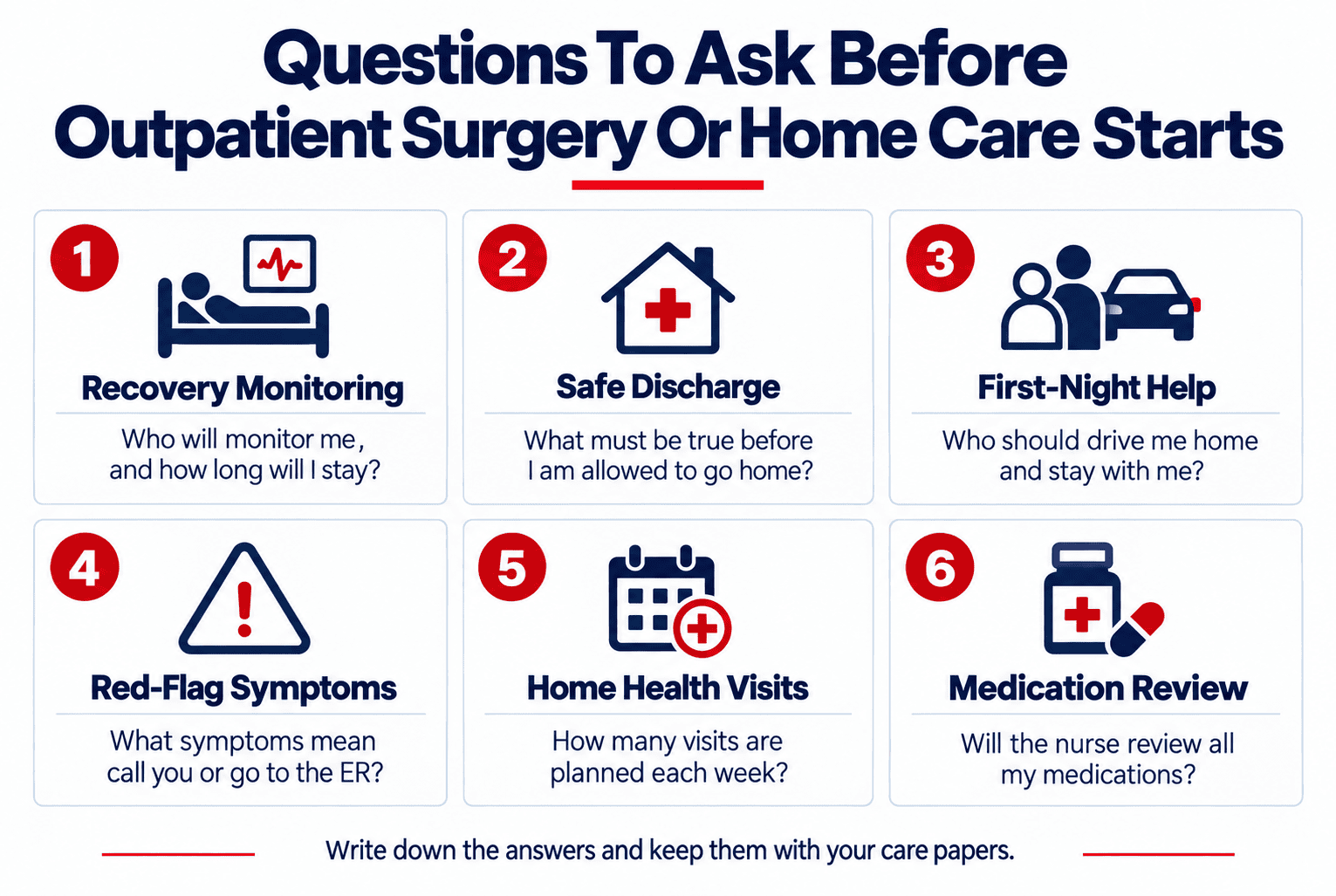
Asking a few questions up front can prevent problems and, if something goes wrong later, create a record of what you were told:
- Who will monitor me in recovery, and how long will I stay?
- What has to be true before I am allowed to go home?
- Who should drive me home and stay with me the first night?
- Which symptoms mean I should call you, and which mean I should go to the ER?
- For home health: how many visits are planned each week, and who do I call if a nurse does not show up?
- Will the home health nurse review all my medications, including ones from other doctors?
Write down the answers, or ask for them in writing. If the answers you received turn out to be wrong or incomplete, that can matter in a later claim.
Warning Signs After Outpatient Care or a Home Visit
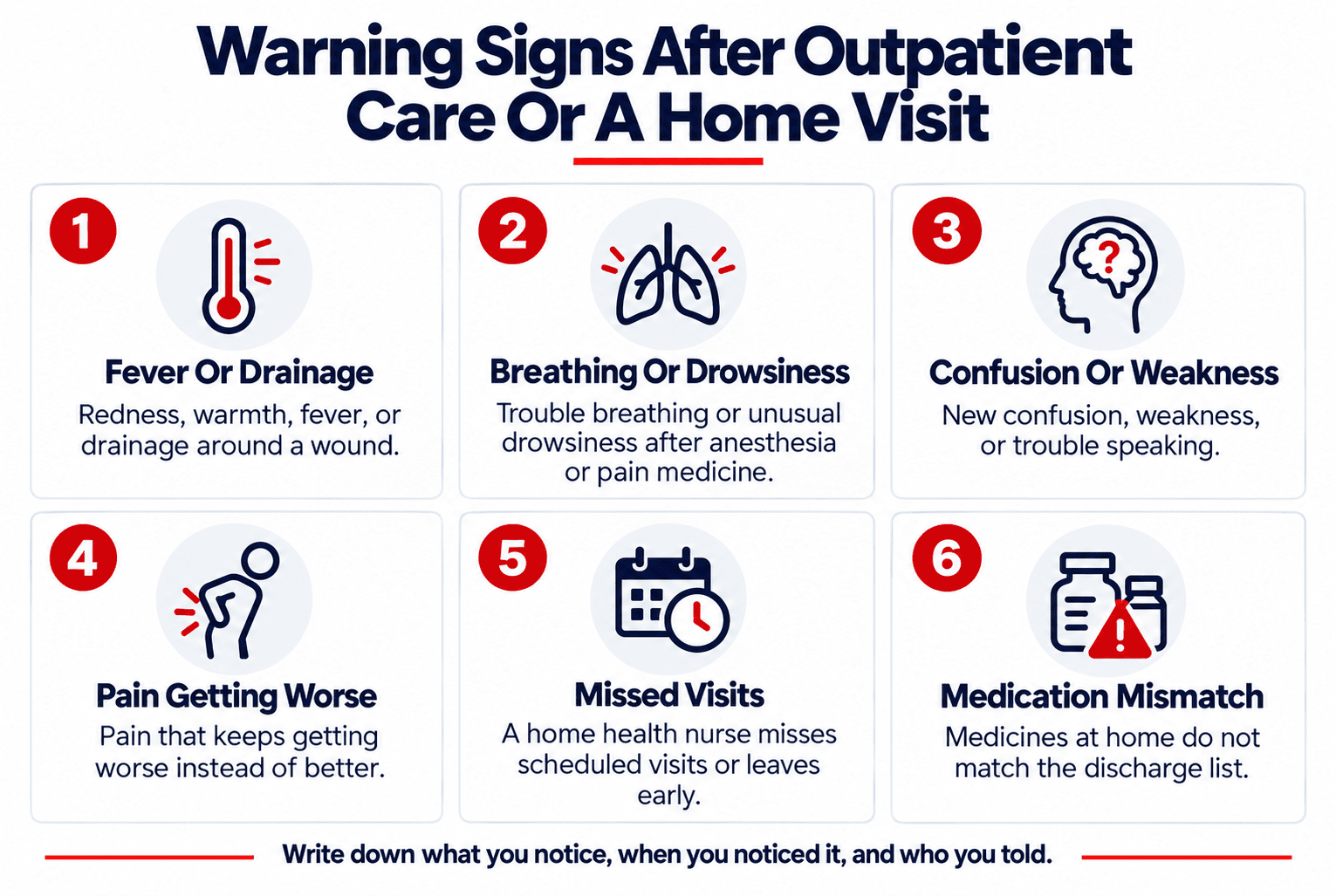
Outpatient patients recover at home, so families often notice problems first. Call your provider right away, and seek emergency care when needed, if you see:
- Fever, spreading redness, warmth, or drainage around a wound
- Trouble breathing or unusual drowsiness after anesthesia or pain medicine
- New confusion, weakness, or trouble speaking
- Pain that gets worse instead of better
- A home health nurse who misses scheduled visits or leaves early
- Medications at home that do not match the discharge list
Write down what you notice, when you noticed it, and who you told. The federal Patient Safety Network’s review of safety in ambulatory care explains why follow-up after outpatient care is such a common gap.
Records to Request From Each Type of Provider
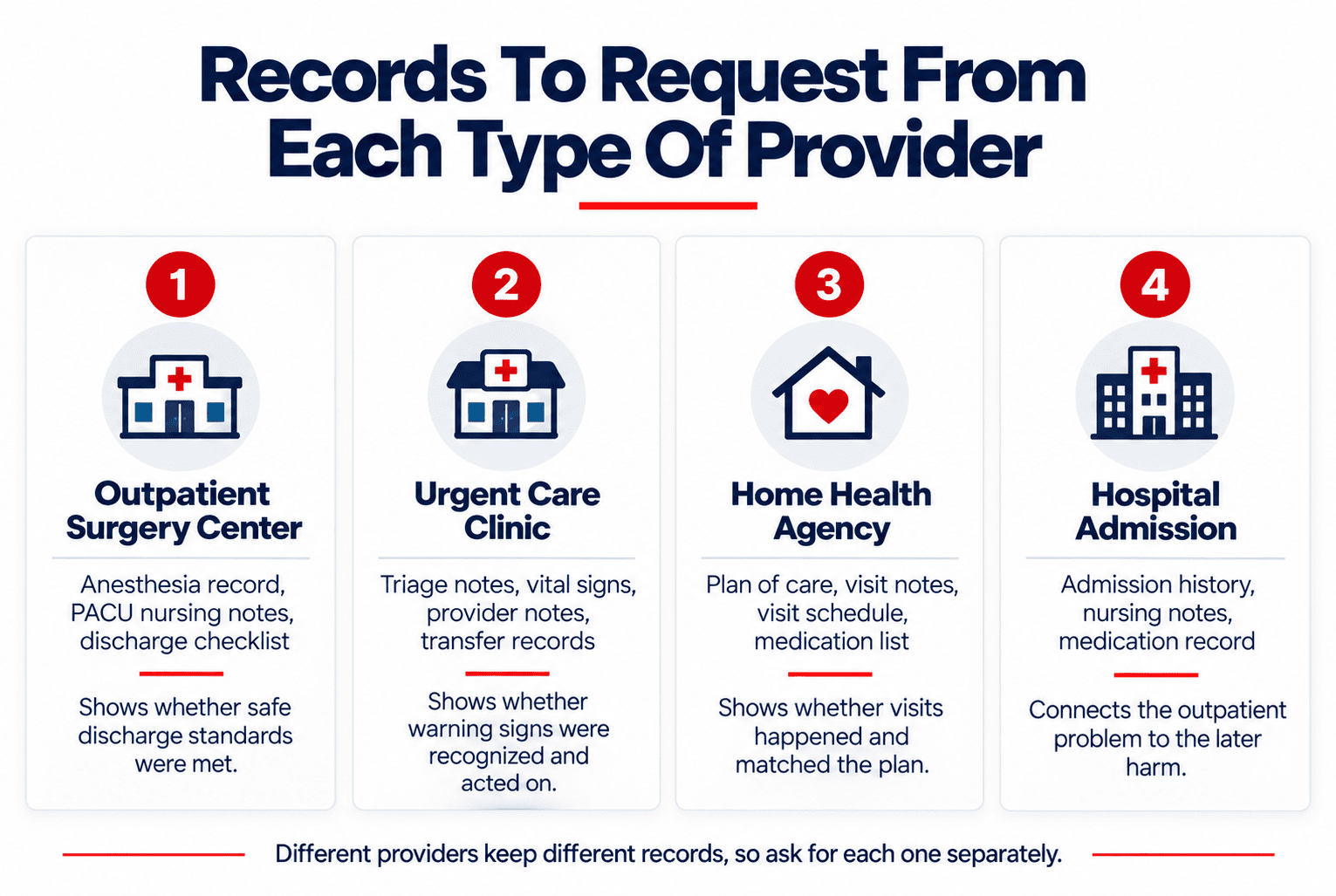
Different providers keep different records. Knowing what to ask for speeds up the review.
| Provider |
Key Records to Request |
Why They Matter |
| Outpatient surgery center |
Anesthesia record, recovery (PACU) nursing notes, discharge criteria checklist |
Show whether you met safe discharge standards before leaving |
| Urgent care clinic |
Triage notes, vital signs, provider notes, referral or transfer records |
Show whether warning signs were recognized and acted on |
| Home health agency |
Plan of care, visit notes, visit schedule, medication list, nurse assignment records |
Show whether visits happened and care matched the plan |
| Hospital (if admitted later) |
Admission history, nursing notes, medication administration record |
Connect the outpatient problem to the harm that followed |
You can compare home health agencies and many other providers on Medicare’s Care Compare, which lists quality ratings and patient survey results.
Working With a Nurse Attorney in Canton From Our Livonia Office

Our main office at 32398 Five Mile Road in Livonia is about 10 miles north of Canton, with easy access from I-275. Most Canton clients meet us there. If an injury makes travel hard, we can meet by phone or video, and we may be able to arrange a visit closer to you. Our Livonia nurse attorney page explains what to bring to the first meeting.
Eileen trained as a nurse at Madonna College in Livonia and spent years in a Detroit surgical ICU before earning her law degree. Her profile, Eileen E. Kroll, RN, JD, covers her full background, and our statewide nurse attorney page sets out Michigan’s filing deadlines.
The consultation is free, and we work on a contingency fee. You owe no attorney fee unless we recover compensation for you.
Contact Our Nurse Attorney Serving Canton Township
Our Livonia office is a short drive up I-275, and a phone or video meeting works too. Either way, the first conversation costs you nothing.
Contact us at Cochran, Kroll & Associates, P.C. for a free consultation. We’ll listen to what happened, review the key dates, and tell you honestly whether you have a claim. Remember, we don’t get paid unless you win.
Call us at 1-866-MICH-LAW anytime, 24/7, to schedule a free case evaluation.
Frequently Asked Questions
Can I bring a claim against a home health agency instead of the individual nurse?
Yes, and that is usually where the claim starts. Agencies are generally responsible for the nurses they employ, and they are also responsible for their own scheduling, training, and supervision. If an agency sent an unqualified nurse or skipped visits, the agency itself may be at fault.
Do surgery centers follow the same pre-suit notice rules as hospitals?
In most cases, yes. Michigan’s Notice of Intent and affidavit of merit rules apply to licensed health facilities and professionals, which generally includes outpatient surgery centers and their staff. The 182-day notice period still applies, so early action matters.
My parent was sent home after outpatient surgery and fell that night. Is that a case?
It may be. We would look at whether your parent met the center’s discharge criteria, whether fall risk was assessed, and whether you received clear instructions about help at home. A fall alone is not enough; the question is whether a safe discharge process was skipped.
Can an urgent care be responsible for not sending me to the ER?
Yes, if the clinic missed clear warning signs that a reasonable provider would have caught. Urgent care staff are expected to recognize symptoms that need emergency care and transfer the patient promptly. The triage notes and vital signs usually show what they knew.
Do I have to live in Canton to work with your firm?
No. We represent Michigan residents across the state. Canton residents are a short drive from our Livonia office, and we also meet clients by phone or video.