Nurse Attorney in Ann Arbor

A nurse attorney in Ann Arbor can help parents understand what happened during a difficult birth. In labor and delivery, nurses watch the fetal monitor minute by minute and decide when to call the doctor. In Ann Arbor’s teaching hospitals, residents, students, and advanced practice nurses share that work too. Eileen E. Kroll, RN, JD, helps families sort out where care went wrong.
Have questions about what happened during your baby’s delivery? Contact us for a free birth injury review, or call 1-866-MICH-LAW anytime, 24/7.
Labor and Delivery: The Nurse’s Role in a Safe Birth

Most of the moment-to-moment watching during labor falls to labor and delivery nurses. They track the baby’s heart rate, the mother’s contractions and vital signs, and they are the ones expected to raise the alarm. Birth trauma is a core part of Eileen’s malpractice practice, and her largest verdict, $15.8 million, came from a birth injury case.
Reading the Fetal Heart Monitor and Calling the Doctor
The fetal heart monitor prints a running tracing of the baby’s heart rate alongside the mother’s contractions. Certain patterns, such as repeated drops in heart rate after contractions or a flat, unchanging line, can signal the baby isn’t getting enough oxygen. Nurses are trained to recognize these patterns using standard categories described by the American College of Obstetricians and Gynecologists’ guidance on fetal heart rate monitoring. When a worrying pattern appears, the nurse should take steps such as repositioning the mother and must alert the doctor or midwife promptly.
Labor-Inducing Drugs
Pitocin, a synthetic form of oxytocin, is often used to start or strengthen labor. Too much can cause contractions that come too close together, which gives the baby less time to recover between them. Nurses are responsible for adjusting the drip according to protocol and for turning it down or off when contractions become too frequent, or the baby’s heart rate shows stress.
When a C-Section Is Delayed
Sometimes a cesarean delivery is the safest option. Delays can happen when a nurse doesn’t report warning signs in time, when the doctor is slow to respond, or when an operating room team isn’t ready. Every minute can matter when a baby is short on oxygen, so we look closely at when the decision was made and when the baby was actually delivered.
The First Days After Birth
Nursing care doesn’t end at delivery. Newborns need checks for feeding, blood sugar, breathing, and jaundice. Low blood sugar that goes untreated or jaundice that climbs without follow-up can cause lasting brain injury. Nurses are expected to monitor these signs and report them to the pediatric team. Mothers need close watching too. Heavy bleeding after delivery, a severe headache, or rising blood pressure can signal hemorrhage or preeclampsia, and postpartum nurses are often the first to see those changes.
Special Deadlines for Injured Children
Michigan gives more time to children injured by medical malpractice. When a child is injured before their 8th birthday, a claim can often be filed any time before the child’s 10th birthday, or within the regular deadline if that is later (MCL 600.5851).
For example, if a baby suffers a brain injury at birth in 2026 but the effects aren’t fully understood until the child struggles in school at age six, the family may still be able to file before the child turns 10. Waiting that long is rarely wise, though. Records and memories fade, and some related claims, such as a parent’s own claim for medical bills, may follow different timelines. Our birth injury page explains more about these cases.
Late-Appearing Birth Injuries: What a Nurse Attorney in Ann Arbor Watches For
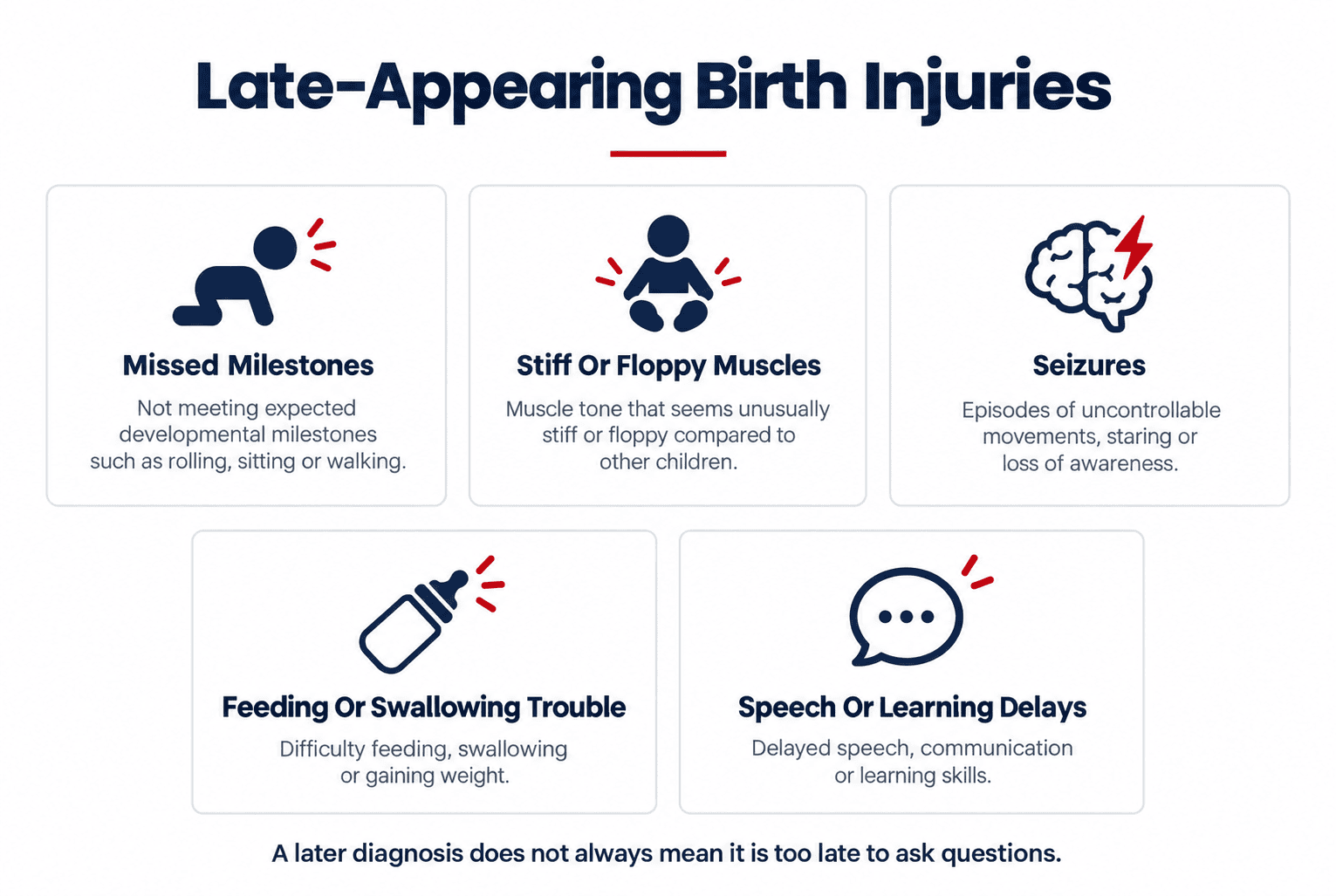
Some birth injuries are obvious at delivery. Others become clear only months or years later. Parents sometimes notice:
- Missed milestones, such as late sitting, crawling, or walking
- Stiff or floppy muscles, or favoring one side of the body
- Seizures in the newborn period or later
- Trouble feeding, swallowing, or sucking
- Delays in speech or learning
A diagnosis such as cerebral palsy may come long after the birth. If you have a new diagnosis and questions about the delivery, it is not too late to ask. The special deadline for children exists for exactly this reason. The federal Patient Safety Network’s overview of maternal safety also describes risks to mothers during and after delivery.
A Birth Trauma Settlement in Southern Michigan
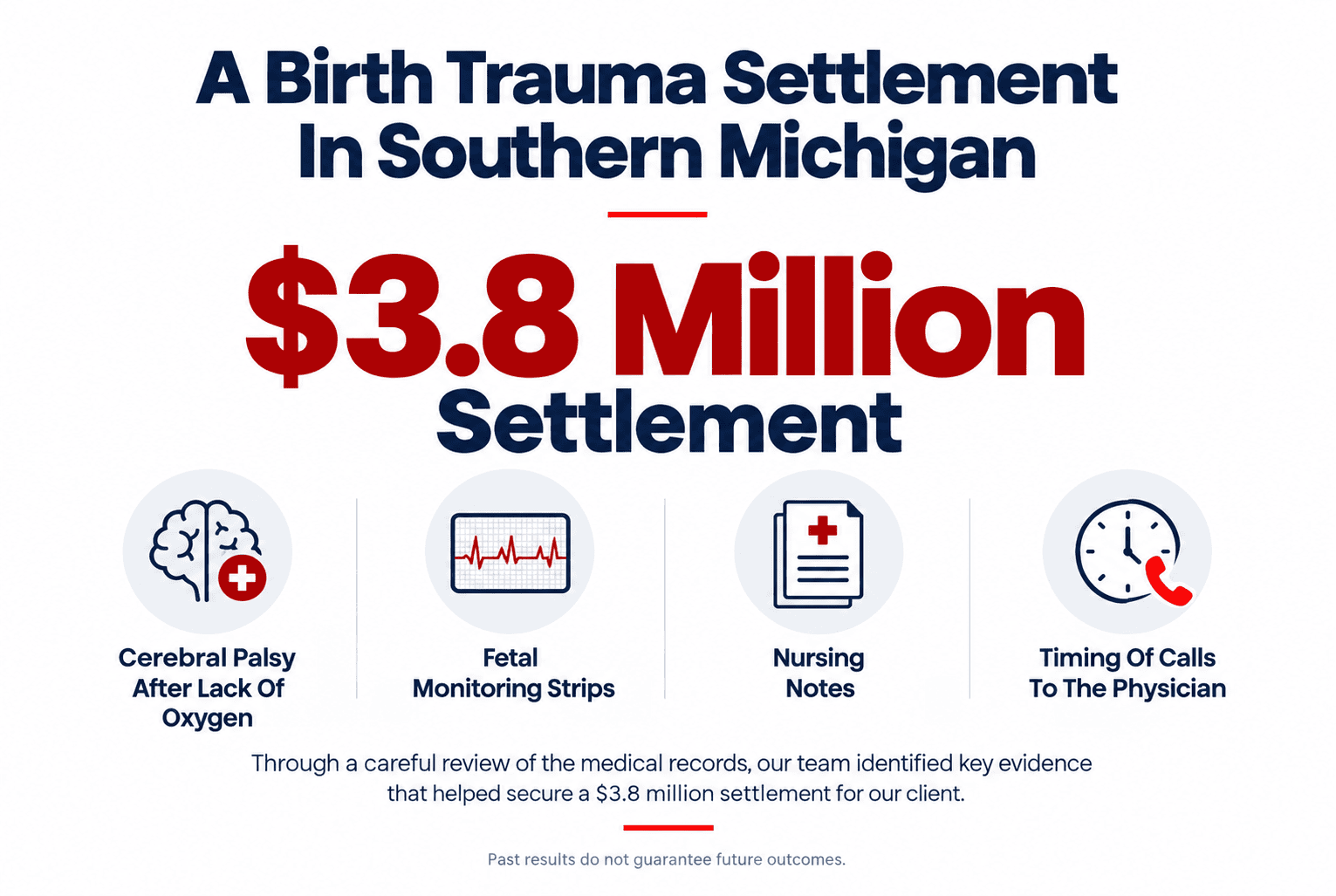
Cochran, Kroll secured a $3.8 million settlement for a southern Michigan family whose child developed cerebral palsy after a lack of oxygen during delivery. Cases like this rest on a careful reading of fetal monitoring strips, nursing notes, and the timing of each call to the physician. More outcomes appear on our verdicts page.
Past results do not guarantee a similar outcome in any future case.
Teaching Hospitals: Residents, Students and Nurses
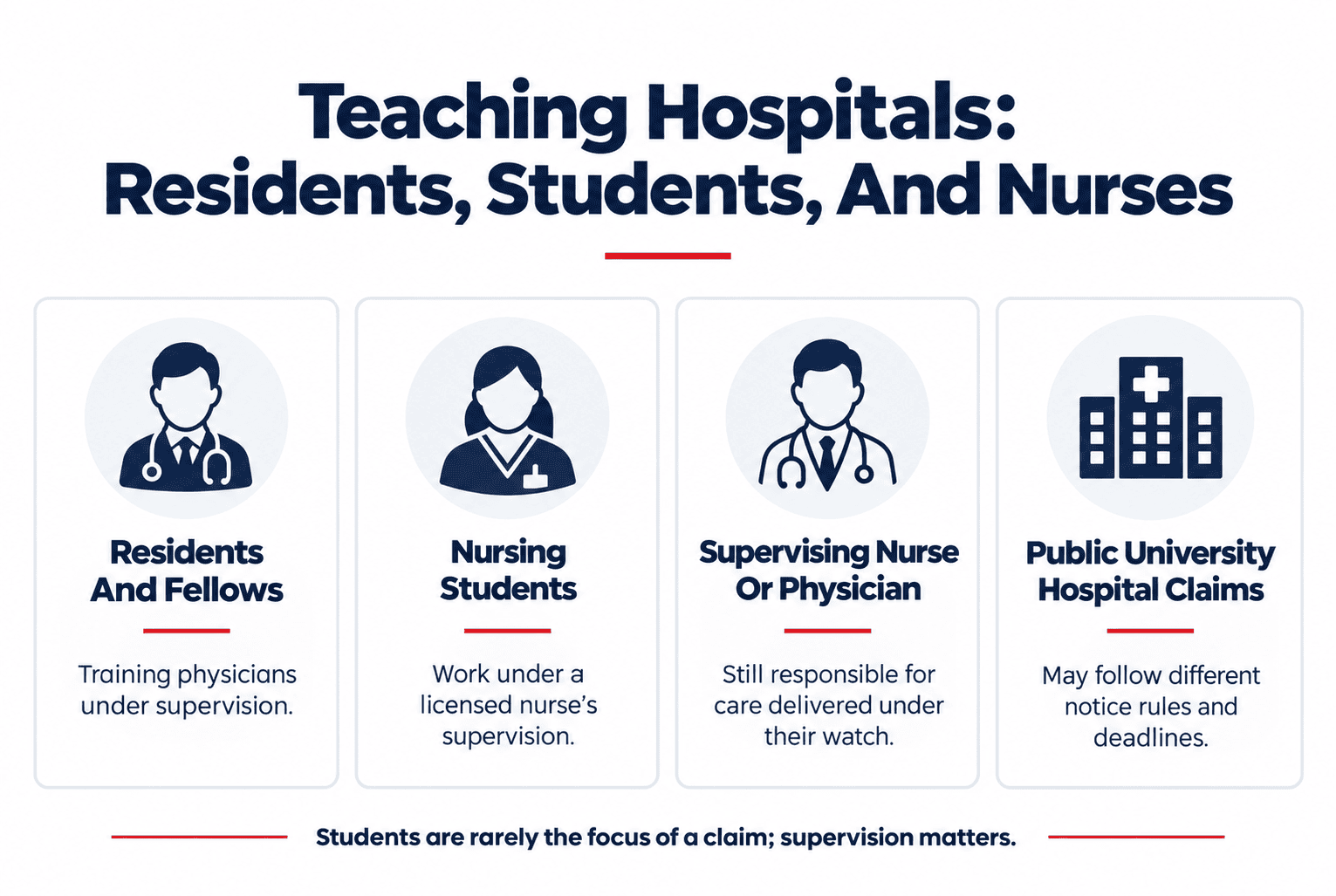
Ann Arbor’s hospitals train the next generation of clinicians. The city is home to Michigan Medicine (University of Michigan Health) and Trinity Health Ann Arbor Hospital, formerly St. Joseph Mercy Ann Arbor (Trinity Health Ann Arbor).
In a teaching hospital, your care team may include residents, fellows, and nursing students working under supervision. That can make responsibility harder to trace. The hospital is generally responsible for the residents and staff it trains and employs, and supervising physicians and nurses remain responsible for the care delivered under their watch. Students work under a licensed nurse’s supervision and are rarely the focus of a claim.
Claims Involving a Public University Hospital
Claims involving a public university hospital may follow different rules than claims against a private hospital. Some claims against state institutions must be filed in the Michigan Court of Claims, and a written notice may be required within a shorter period than the usual malpractice deadline (MCL 600.6431). Because missing that notice can end a claim, families should talk with a lawyer quickly if care happened at a public university hospital.
Many local nurses train at the University of Michigan School of Nursing, Eastern Michigan University in Ypsilanti, and Washtenaw Community College. Malpractice lawsuits over care given in Ann Arbor, when they go to circuit court, are generally filed in the Washtenaw County Trial Court (22nd Circuit) at 101 E. Huron St., described on Washtenaw County’s Trial Court page.
Midwives, Nurse Practitioners and CRNAs on Your Care Team
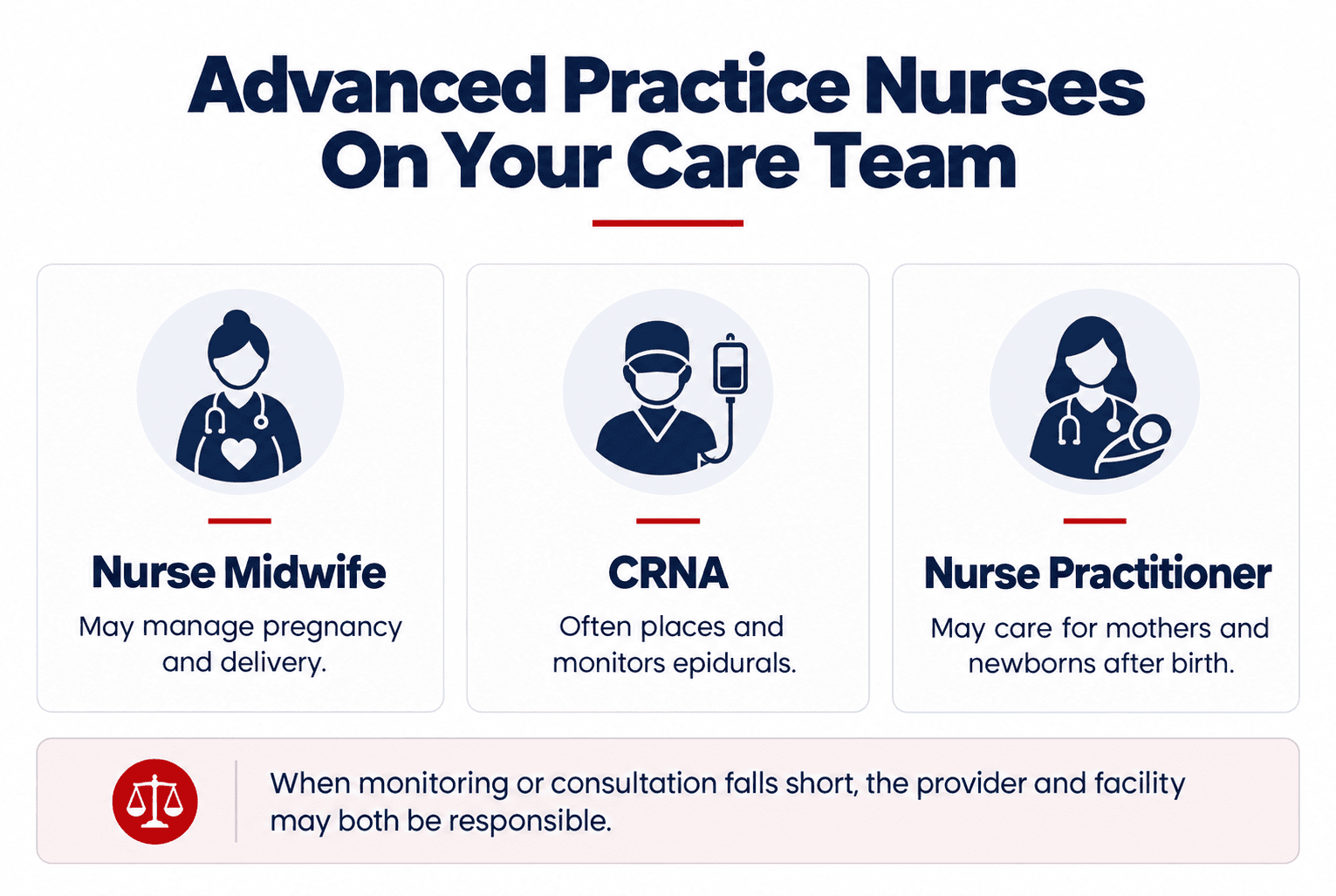
Advanced practice nurses play a big role in labor and delivery. Certified nurse midwives may manage a pregnancy and delivery, certified registered nurse anesthetists (CRNAs) often place and manage epidurals, and nurse practitioners may care for mothers and newborns after birth.
These nurses have advanced training and a wider scope of practice than registered nurses. Under Michigan law, the expert who evaluates their care generally must share their profession and specialty (MCL 600.2169), so a midwife’s care is usually reviewed by a qualified midwife. When a midwife should have consulted an obstetrician, or a CRNA’s monitoring fell short, both the individual provider and the facility or practice may be responsible.
Eileen’s nursing background helps sort out who did what on a busy labor unit. Her profile, Eileen E. Kroll, RN, JD, covers her full career, and our statewide Michigan nurse attorney page lists the state’s malpractice deadlines. Families weighing a state complaint against a provider can read about that choice on our Lansing nurse attorney page.
Our Livonia office is about 25 minutes from Ann Arbor, and we also meet by phone or video. We work on a contingency fee, so you pay no attorney fee unless we recover compensation for your family.
Questions About Your Child’s Birth? Get a Free Review
Fetal monitoring strips and labor records are the heart of a birth injury case. Requesting them early helps make sure nothing is missing.
Contact us at Cochran, Kroll & Associates, P.C. for a free consultation. We’ll request the labor and newborn records, review them with a nurse’s eye, and explain whether the care met the standard. Remember, we don’t get paid unless you win.
Call us at 1-866-MICH-LAW anytime, 24/7, to schedule a free case evaluation.
Frequently Asked Questions
Is a nurse midwife held to the same standard as an obstetrician?
Not exactly. A certified nurse midwife is generally judged against what a reasonable nurse midwife would have done, not an obstetrician. But a midwife is also expected to recognize when a pregnancy becomes high-risk and bring in a physician. Failing to do that can be a breach of the midwife’s own standard.
Can a nursing student be named in a malpractice claim?
It is rare. Nursing students work under the supervision of licensed nurses and instructors, and the hospital and supervising staff are usually responsible for the care. We focus on the parties who controlled and supervised the care.
Can the mother bring a claim for her own injuries too?
Yes. A birth can injure both mother and baby, for example through severe tearing, hemorrhage, or a delayed response to high blood pressure. The mother’s claim is separate from the child’s and usually follows the regular adult deadlines, not the longer rule for children, so it may need attention sooner.
Should I ask for the fetal monitoring strips?
Yes. The strips are often the most important evidence in a labor and delivery case. When you request your records, ask specifically for the fetal heart monitoring strips, the labor flowsheet, nursing notes, and medication records, including any Pitocin rates. We can also request them for you.
My child is six and was just diagnosed with cerebral palsy. Is it too late?
Maybe not. Michigan’s special rule for young children often allows a claim until the child’s 10th birthday when the injury happened before age 8. Because related claims may have different deadlines, it is best to call soon so we can check the dates for your family.