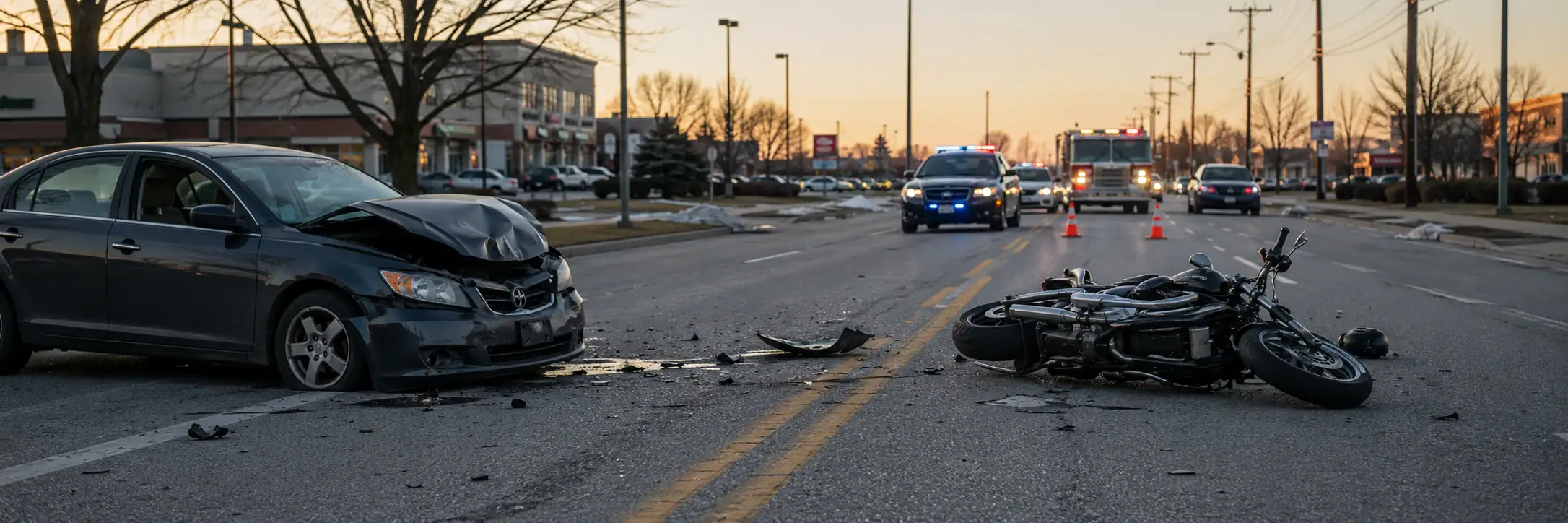
Motorcycle Accident Lawyer in Sterling Heights, MI

A motorcycle accident lawyer in Sterling Heights, MI can protect the one thing most riders lose in the first weeks after a crash: the medical coverage they assume is automatic and usually is not. At Cochran, Kroll & Associates, P.C., we help injured Michigan riders and their families sort out who pays, who is at fault, and what to do next. Free 24/7 consultation. No fee unless we win.
Call now: 1-866-MICH-LAW
Or request your free case evaluation online.
Michigan Auto Accident Statistics
Michigan recorded roughly 3,187 motorcycle-involved crashes in 2024, with about 168 motorcyclists killed and around 2,460 seriously injured, according to Michigan Traffic Crash Facts. In Macomb County, which contains Sterling Heights, motorcycles made up just 0.5 percent of vehicles in reported crashes yet were involved in 11.8 percent of the county’s fatal crashes. That gap is the whole story of motorcycle risk in one statistic.
| Metric |
Michigan Statewide (2024) |
Macomb County (2024) |
| Motorcycle-involved crashes |
3,187 |
216 |
| Motorcyclist fatalities |
168 |
14 |
| Motorcyclist serious injuries |
2,460 |
41 |
Figures are drawn from the 2024 Michigan Traffic Crash Facts statewide and Macomb County reports. Update to the latest reporting year before publishing.
Common Causes of Motorcycle Crashes in Sterling Heights
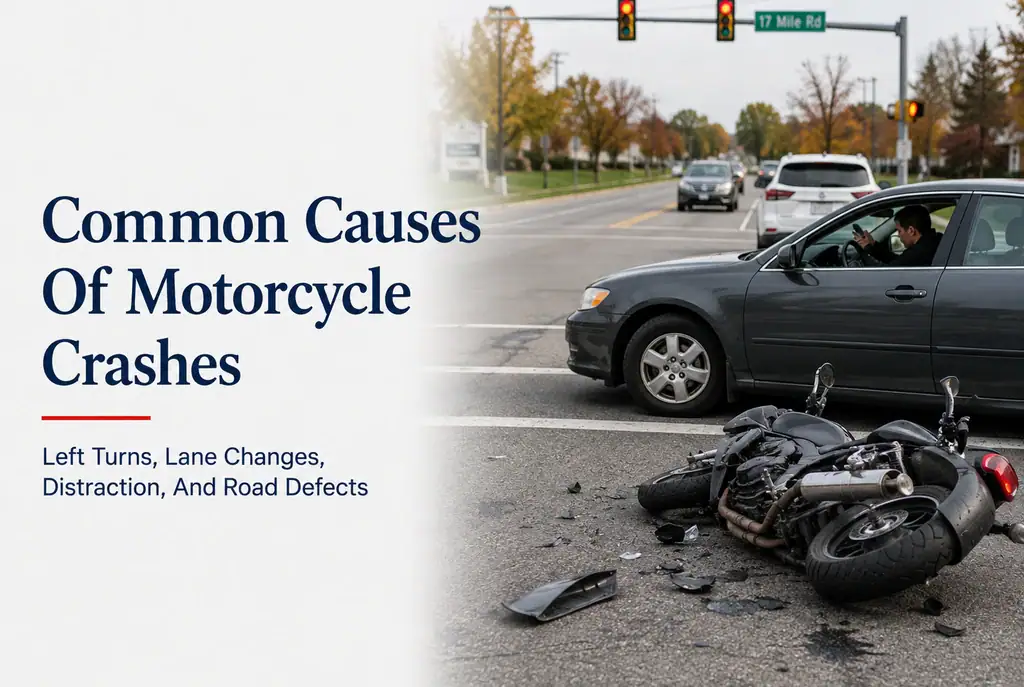
Most Sterling Heights motorcycle crashes fall into one of three groups: crashes caused by another driver, crashes caused by roadway conditions, and crashes involving the motorcycle itself. Sorting your crash into the right group is the first step toward knowing who is responsible and what evidence to preserve.
Crashes Caused by Other Drivers
- Left-turn crashes. A driver turns left across the path of an oncoming rider, common at M-59 intersections, the Van Dyke / M-53 junctions, and Mound Road cross-streets. Nationally, this is the single most common car-versus-motorcycle crash type.
- Failure-to-see lane changes and merges. Drivers who change lanes without a shoulder check, frequent on M-59 and I-696.
- Distracted driving. Phones, in-car screens, food and drink; a top contributor identified by NHTSA.
- Rear-end crashes at stops. A rider stopped at a light on Hall Road or Mound Road is struck by a following driver who does not stop in time.
- Driving under the influence. Under Michigan dram shop liability (MCL 436.1801), a bar or restaurant that overserved the at-fault driver can be added as a defendant.
- Aggressive driving and road rage. Unsafe passes, cutting off, and tailgating.
Crashes Caused by Roadway and Road Conditions
- Potholes and pavement defects. A minor annoyance in a car and a serious crash risk on two wheels. Municipal liability for road defects exists in Michigan but is tightly limited by governmental immunity.
- Gravel, debris, and painted-line slickness. Especially after rain on crosswalk paint, manhole covers, and bridge deck seams, including the I-696 overpasses.
- Poor lane markings or worn signage at complex intersections.
- Construction zones. Narrowed lanes, uneven pavement transitions, and equipment on the shoulder create outsized risk for riders.
Crashes Involving the Motorcycle Itself
- Manufacturer defects. Tire failure, brake failure, or a sticking throttle can support a product-liability claim alongside a negligence claim.
- Improper maintenance or aftermarket parts. A common defense insurers raise; addressing it directly keeps a claim credible.
- Single-vehicle rider-error crashes. A rider partly at fault can still recover under Michigan modified comparative fault (MCL 600.2959), as long as their share of fault is 50 percent or less.
The Michigan No-Fault Rule Motorcyclists Almost Always Learn Too Late
In Michigan, a motorcyclist injured in a crash does not automatically receive no-fault PIP medical benefits from their own motorcycle insurance, because a motorcycle is not a motor vehicle under the no-fault act. Instead, PIP benefits follow an order of priority set by MCL 500.3114. Most riders learn this only after the bills start arriving.
When a motor vehicle is involved in the crash, benefits generally come in this order:
- The no-fault insurer of the owner or registrant of the motor vehicle involved
- The no-fault insurer of the operator of the motor vehicle involved
- The motor-vehicle insurer of the motorcycle’s operator
- The motor-vehicle insurer of the motorcycle’s owner
If none of these apply, benefits may come through the Michigan Assigned Claims Facility (MCL 500.3172). The 2019 no-fault reform also lets riders address coverage through their own separately purchased options, which makes reviewing every available policy essential rather than optional.
Who Pays Your Sterling Heights Medical Bills and When
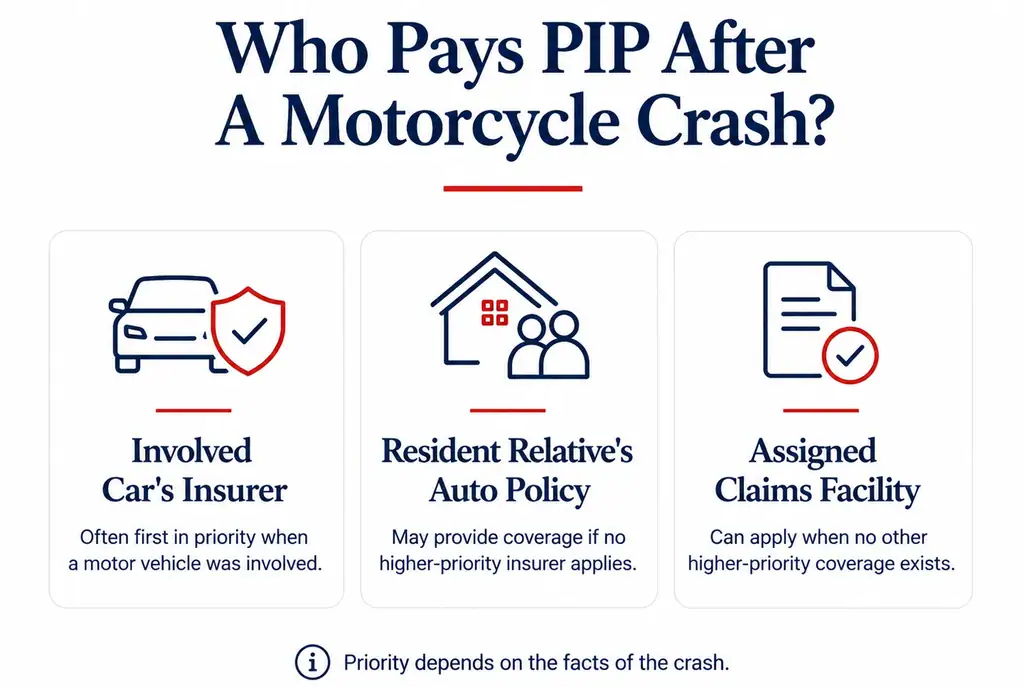
The priority rule looks abstract until you map it to a real crash. Here is who typically pays PIP medical benefits in the four situations Sterling Heights riders search for most.
| Your situation |
Who usually pays PIP |
Statute |
| Hit by an insured car |
The involved car’s no-fault insurer (owner first, then operator) |
MCL 500.3114(5) |
| Hit by an uninsured car or hit-and-run |
The Michigan Assigned Claims Facility if no other coverage applies |
MCL 500.3172 |
| Single-vehicle crash caused by a road defect |
A resident relative’s auto policy, your own motor-vehicle PIP, or the Assigned Claims Facility |
MCL 500.3114 / 500.3172 |
| Crash caused by another motorcyclist |
No motorcycle policy pays PIP automatically; look to a resident relative’s auto policy or the Assigned Claims Facility. |
MCL 500.3114(5) / 500.3172 |
How the Michigan Motorcycle Helmet Law Affects Your Claim
Since Michigan’s 2012 helmet-law change (Public Act 98 of 2012, amending MCL 257.658), riders 21 and older may ride without a helmet if they have held a motorcycle endorsement for at least two years or passed an approved safety course, and carry at least $20,000 in first-party medical coverage. Riding without a helmet lawfully does not end your claim, but it does change one part of it.
- It does not bar recovery. You can still pursue a claim against the at-fault driver.
- It can affect head-injury damages only. The defense may argue comparative fault for head and brain injuries specifically, not for your other injuries.
- It does not affect PIP entitlement. Your right to no-fault medical benefits is decided by the priority rules above, not by helmet use.
Sterling Heights Roads Where Motorcycle Crashes Concentrate
Crash risk for riders concentrates on the corridors where speed, turning traffic, and driveway conflicts overlap. These are the Sterling Heights roads that show up repeatedly in local motorcycle crashes.
| Road |
Typical hazard for riders |
Notes |
| M-59 / Hall Road |
High-speed arterial with dense retail turn-offs |
Left-turn and lane-change conflicts |
| M-53 / Van Dyke |
Long straight corridor with many driveways |
Driveway pull-outs and speed differences |
| Mound Road |
Industrial traffic mix and truck turns |
Heavy-vehicle blind spots |
| 15 Mile and 17 Mile |
Weekend routes toward lake destinations |
Higher weekend rider volume |
Crash location is not just background detail. It decides which agency investigated, whether traffic-camera footage exists, and whether a road-design or municipal factor belongs in the claim. County crash data comes from Michigan Traffic Crash Facts.
The “Reckless Rider” Bias Insurers Actually Use and How to Fight It
Insurers commonly argue that the rider was speeding, weaving, or riding without a helmet, all to shift fault onto the person who was hurt. The bias is real, and it is answered with evidence and process, not argument.
- Preserve dashcam and helmet-cam footage immediately, before it is recorded over.
- Retain an accident reconstruction expert early, while physical evidence still exists.
- Obtain an independent medical evaluation so injuries are documented by a neutral provider.
- Control the recorded-statement process; you are not required to give one on demand.
- Collect witness contacts at the scene, since neutral accounts undercut the reckless-rider narrative.
- Photograph the road, skid marks, and sightlines, which often show the driver, not the rider, failed to yield.
How Much Compensation You Can Recover After a Sterling Heights Motorcycle Crash
Michigan recognizes two categories of damages. Economic damages are available through no-fault and third-party claims; non-economic damages are available only in a third-party claim against the at-fault driver, and only when the serious-impairment threshold is met. Riders face a higher risk of catastrophic spinal cord and brain injuries, which is exactly why full future-care valuation matters.
| Economic damages |
Non-economic damages (third-party claim only) |
| Past and future medical care, including attendant care, rehabilitation, and home modifications |
Pain and suffering |
| Lost wages and lost earning capacity |
Permanent disfigurement and scarring |
| Replacement services under Michigan no-fault |
Loss of enjoyment of life |
| Property damage to the motorcycle |
Loss of consortium |
When a crash is fatal, the family may also bring a wrongful death claim under MCL 600.2922, covered next.
What Happens When Motorcycle Crashes Cause Death?
When a Sterling Heights motorcycle crash causes a rider’s death, Michigan treats the case differently from an injury claim. It becomes a wrongful death action under Michigan’s Wrongful Death Act (MCL 600.2922), brought by the estate’s personal representative on behalf of the surviving family rather than by the family members directly.
Who Can Bring the Claim
Only the personal representative of the deceased rider’s estate can file the wrongful death lawsuit in Michigan. This surprises most families, who expect a spouse or parent to file directly. The personal representative is appointed by the probate court, in this case the Macomb County Probate Court, through a grant of authority that gives one person legal power to act for the estate. That person is often, but not always, a close family member.
Who Benefits From the Recovery
The statutory beneficiaries under MCL 600.2922 include the surviving spouse, children (including adopted children), parents, and grandparents. The court apportions any recovery among the beneficiaries based on their relationship and actual losses; it does not split evenly by default, and some relatives may receive little or nothing.
The Filing Deadline
Michigan generally allows three years from the date of death to file a wrongful death claim. This is separate from the one-year no-fault PIP deadline covered later on this page. Both can apply to the same fatal crash, one governing benefits and the other governing the lawsuit itself.
What Has to Be Proved
The claim requires the same negligence elements as an injury case: duty, breach, causation, and damages, plus proof that the crash caused the death. When a rider survives in the hospital before dying, the causation question can become contested.
What Role the Criminal Case Plays
If the at-fault driver is charged criminally for impaired or reckless driving causing death, that case runs separately from the civil wrongful death claim. A conviction can help the civil case but is not required for it to succeed.
Can I Recover Compensation for Wrongful Death Damages in a Sterling Heights Motorcycle Crash?
Yes. Michigan’s Wrongful Death Act allows two categories of recovery: damages the rider would have recovered had they survived, known as survival damages, and the surviving family’s own losses. Keeping the two straight avoids confusion later.
Damages the Estate Can Recover on Behalf of the Deceased
- Medical bills incurred between the crash and the death, often significant after hospitalization.
- Lost wages and lost earning capacity between the crash and the death
- Conscious pain and suffering the rider experienced before death, recognized in Michigan even for short survival periods
- Funeral and burial expenses
- Property damage to the motorcycle and personal effects
Damages the Surviving Family Can Recover
- Loss of financial support the rider would have provided
- Loss of society and companionship
- Loss of household services, childcare, and home maintenance
- Loss of consortium for the surviving spouse
- The family’s grief and mental anguish, recognized under Michigan wrongful death law.
A judge in the Macomb County Probate Court apportions any settlement or verdict among the statutory beneficiaries based on their relationship to the rider and their actual losses, so shares are rarely equal. Motorcycle wrongful death cases also differ from car cases in one way: because riders are not automatically entitled to PIP, families can face an added fight over which policy pays the medical bills that accrued between the crash and the death.
| Estate (survival) damages |
Surviving family’s damages |
| Medical bills from crash to death |
Loss of financial support |
| Lost wages from crash to death |
Loss of society and companionship |
| Conscious pain and suffering before death |
Loss of household services |
| Funeral and burial expenses |
Loss of consortium and family grief |
The 1-Year PIP Trap and the 3-Year Lawsuit Deadline for a Motorcycle Crash
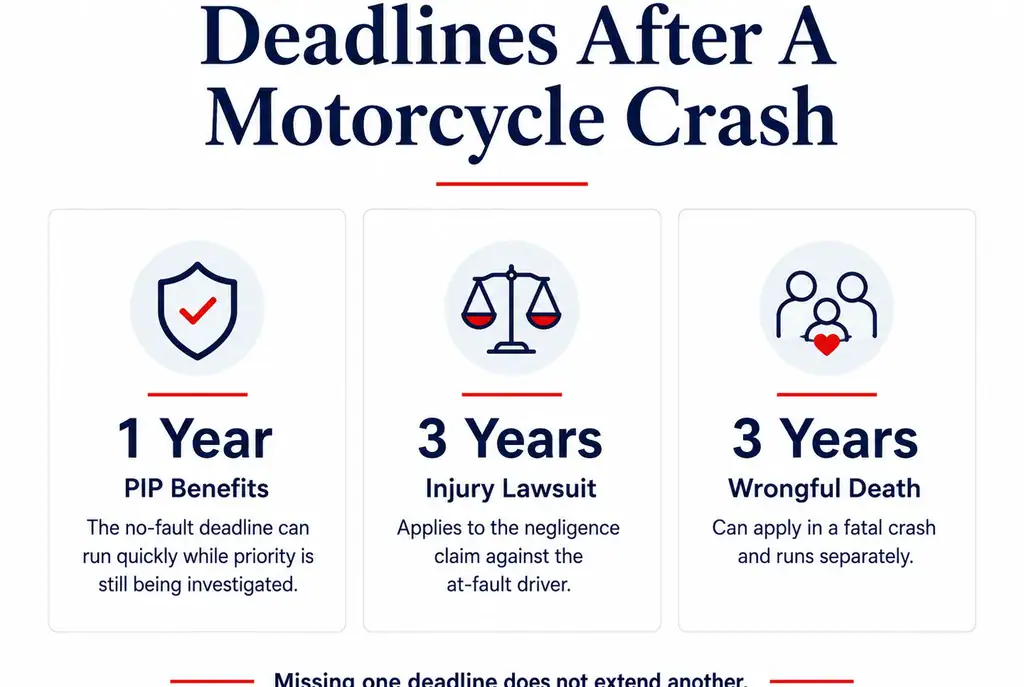
Two deadlines run at once after a motorcycle crash, and the shorter one is the trap. The one-year no-fault deadline is especially dangerous for riders because the PIP priority question can consume months of investigation while the clock keeps running.
| Deadline |
Statute |
Trigger |
Rider-specific risk |
| 1 year – no-fault PIP benefits |
MCL 500.3145 |
Date of crash or date expense incurred |
PIP priority investigation can eat months while the clock runs |
| 3 years – third-party injury lawsuit |
MCL 600.5805 |
Date of crash |
Governs the negligence claim against the at-fault driver |
| 3 years – wrongful death |
MCL 600.2922 |
Date of death |
Separate from the PIP deadline; both can apply to one fatal crash |
Why Cochran, Kroll & Associates for Sterling Heights Riders

Motorcycle claims turn on details other firms miss, and on credentials that hold up when a case has to be tried. Our senior attorneys bring both.
- Terry L. Cochran – recognized by Super Lawyers, rated Preeminent by Martindale-Hubbell, and highly rated on Avvo.
- Eileen E. Kroll – Martindale Preeminent and a Client Champion honoree, and a registered nurse as well as an attorney.
- Access when you are hurt. Livonia and Flint offices, roughly 40 minutes from Sterling Heights, with home and hospital visits for riders facing long recoveries.
- Language access. Arabic-speaking attorney Rula Aoun serves the broader metro area.
- No financial risk. No fee unless we win, and a free 24/7 consultation.
See our firm’s verdicts and case results for background on the outcomes we have achieved for Michigan injury victims, and our broader Michigan motorcycle accident practice for related help.
Contact Our Motorcycle Accident Lawyers in Sterling Heights
If you were injured in a motorcycle accident in Sterling Heights, the road to recovery can be physically and financially overwhelming. Motorcyclists are often unfairly blamed for accidents, and you need an attorney who will fight to make sure your side of the story is heard.
Contact us at Cochran, Kroll & Associates, P.C. for a free consultation. We’ll review your case, explain your options, and map out the strongest path forward. Remember, we don’t get paid unless you win.
Call us at 1-866-MICH-LAW anytime, 24/7, to schedule a free case evaluation.
Frequently Asked Questions
Does my motorcycle insurance cover my medical bills after a Sterling Heights crash?
Usually not on its own. In Michigan, a motorcycle is not a motor vehicle under the no-fault act, so PIP medical benefits come from the involved car’s insurer, a resident relative’s auto policy, or the Assigned Claims Facility under the priority rules of MCL 500.3114, not automatically from your motorcycle policy.
What happens to my claim if I was not wearing a helmet in the Sterling Heights crash?
Riding lawfully without a helmet does not bar your claim. Michigan law lets riders 21 and older go helmetless if they meet the endorsement or safety-course and insurance requirements. The defense may argue comparative fault for head injuries specifically, but not for your other injuries, and helmet use does not affect your PIP entitlement.
How long do I have to file a Sterling Heights motorcycle accident claim?
Generally, you have one year to claim no-fault PIP benefits under MCL 500.3145 and three years to file a third-party injury lawsuit under MCL 600.5805, both measured from the crash. A wrongful death claim generally allows three years from the date of death. The deadlines are not interchangeable, so missing one does not extend another.
Can I still recover if the driver who hit me had no insurance or fled?
Often yes. If an uninsured driver or a hit-and-run leaves you without a higher-priority insurer, the Michigan Assigned Claims Facility under MCL 500.3172 can provide no-fault benefits, and uninsured-motorist coverage may apply. Preserving evidence and reporting the crash promptly protects these options.