Construction Accident Lawyer in Michigan
A construction site injury can trigger workers’ compensation benefits, and in some situations, additional claims may exist if another company or party contributed to the hazard. Start with the basics: get medical care, document what happened, and protect your paper trail. A free case evaluation can help you understand what may apply in your situation.
If you were injured on a construction site or in a work-related accident in Michigan, then please call us today at 1-866-MICH-LAW. We work on a no win, no fee agreement, and our lawyers are specialists in helping people in Michigan claim construction accident compensation.
Key Takeaways
- Get medical care first, then document the scene and your injuries as soon as it’s safe.
- Many job-site injuries start with workers’ comp, but some involve other responsible parties, too.
- Early proof matters: photos, witnesses, and job-site records can disappear quickly.
- Be cautious with recorded statements and paperwork you don’t fully understand.
- You can start with a free, no-obligation case evaluation and contingency-fee representation.
If you’re looking for a construction accident lawyer in Michigan, protect your health and your evidence first. Cochran, Kroll & Associates, P.C. represents Michigan residents statewide, with offices in Livonia and Flint. Call 1-866-MICH-LAW or use our free case evaluation form to get started.
Do you have a case beyond workers’ compensation?
Workers’ comp is often the first (and fastest) path to benefits after a job-site injury.
But not every construction injury is “workers’ comp only.”
Here are three situations that can change the picture:
- Another company created the hazard (example: a subcontractor leaves an opening unguarded).
- A property owner or vendor contributed to unsafe conditions.
- Equipment or safety gear failed (example: a malfunctioning lift or defective tool).
A case evaluation looks at who controlled the hazard, what proof exists, and which claim paths may fit.
What facts usually change a “workers’ comp only” situation?
Look for details like:
- Multiple employers working in the same area
- A contractor controlling site safety (not just your direct employer)
- A tool, machine, or safety device that appears to have failed
- A hazardous condition that existed before you arrived on site
Who can be responsible for a multi-employer job site?
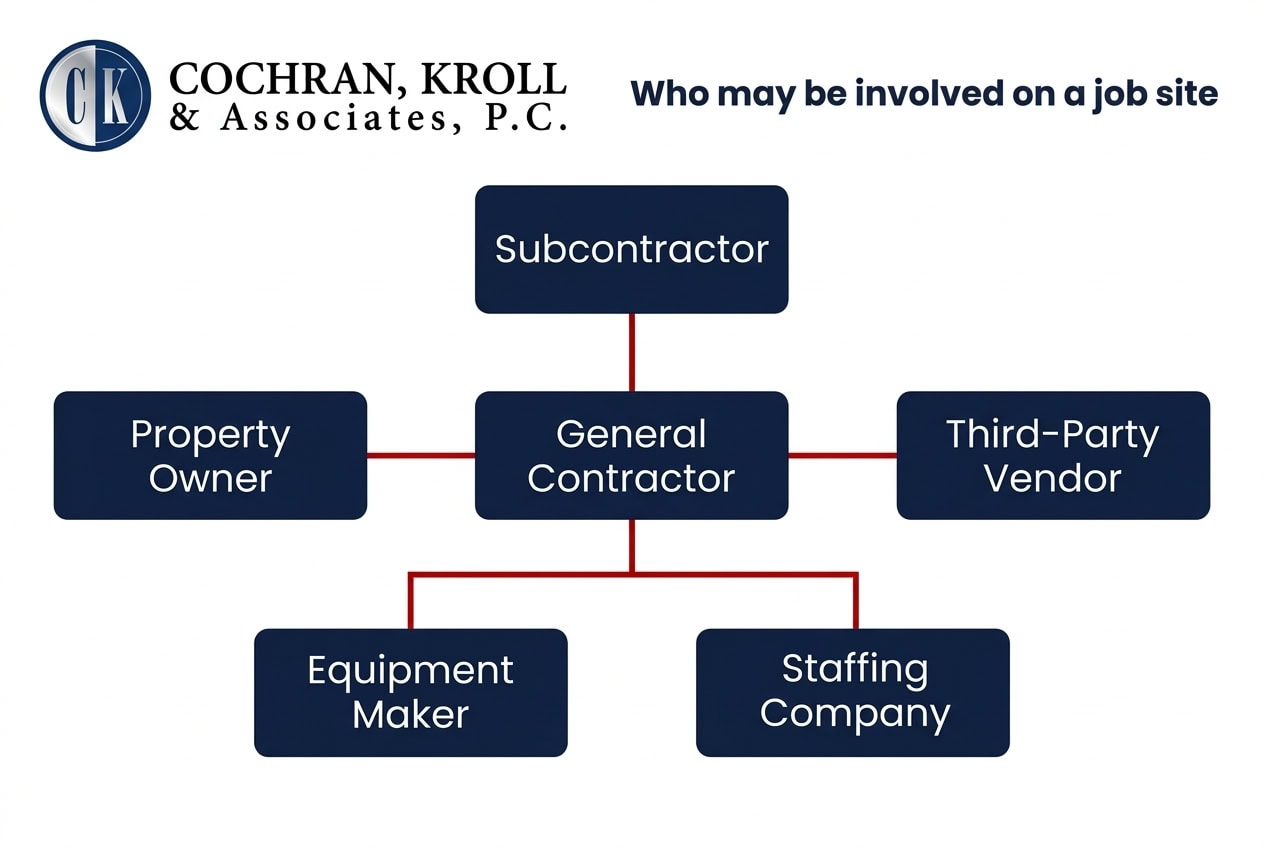
Construction sites often involve overlapping roles. Responsibility can depend on who:
- Controlled the work area
- Set or enforce safety procedures
- Provided equipment or supervision
- Created (or failed to fix) the condition that caused the injury
If you’re unsure, start with your baseline: our Michigan workplace accident lawyers can help you sort the facts.
What should you do in the first 48 hours after a job-site injury?
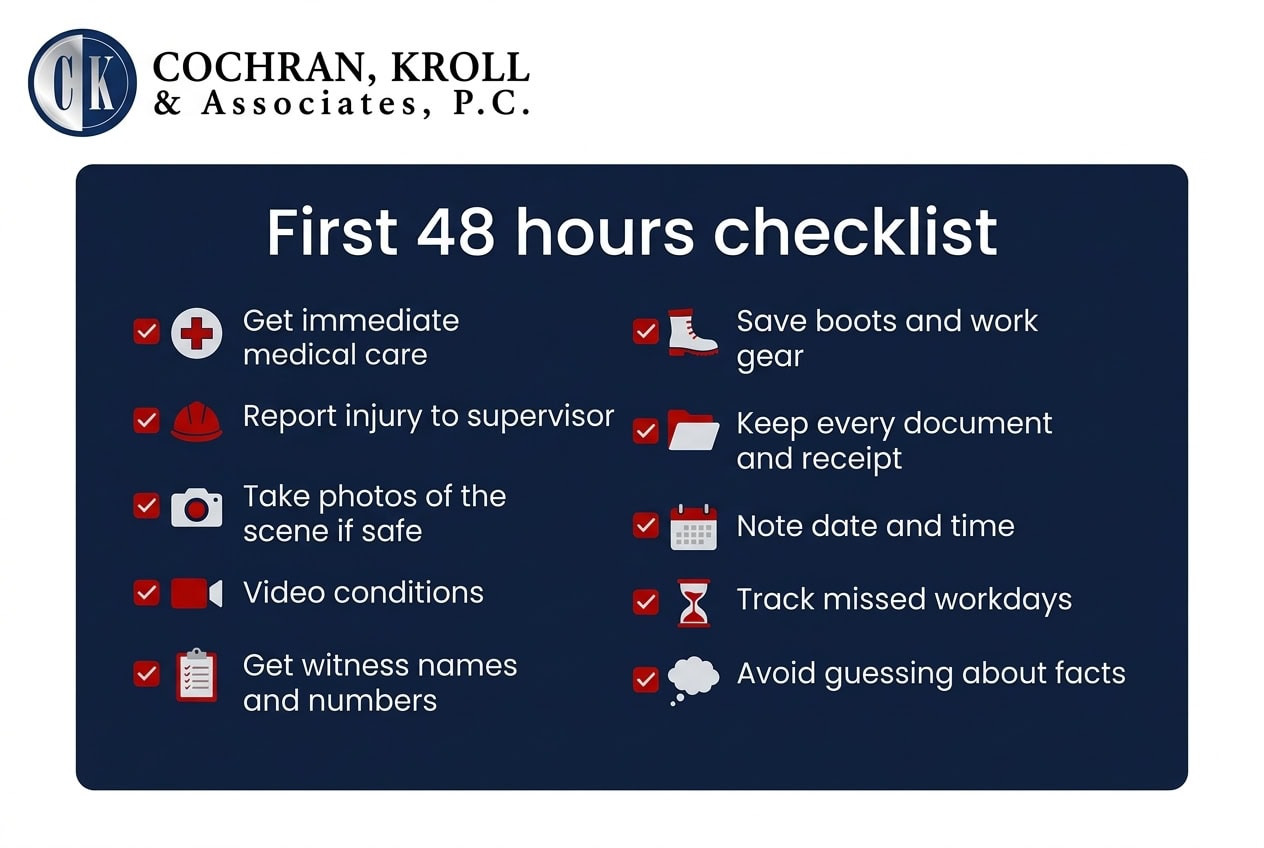
This is about two things: medical care and the paper trail.
First 48 hours checklist
- Obtain medical care and follow up if symptoms vary
- Report the injury through the proper work channel (ask for a copy)
- Take photos/video of the area, equipment, and visible injuries (if safe)
- Write down names and contact info for witnesses
- Save your boots, gloves, helmet, or gear involved (don’t alter it)
- Keep every document you receive (forms, letters, discharge papers)
- Track missed workdays and job restrictions
- Avoid guessing or filling gaps when describing what happened
Warning: common mistakes that can hurt a claim
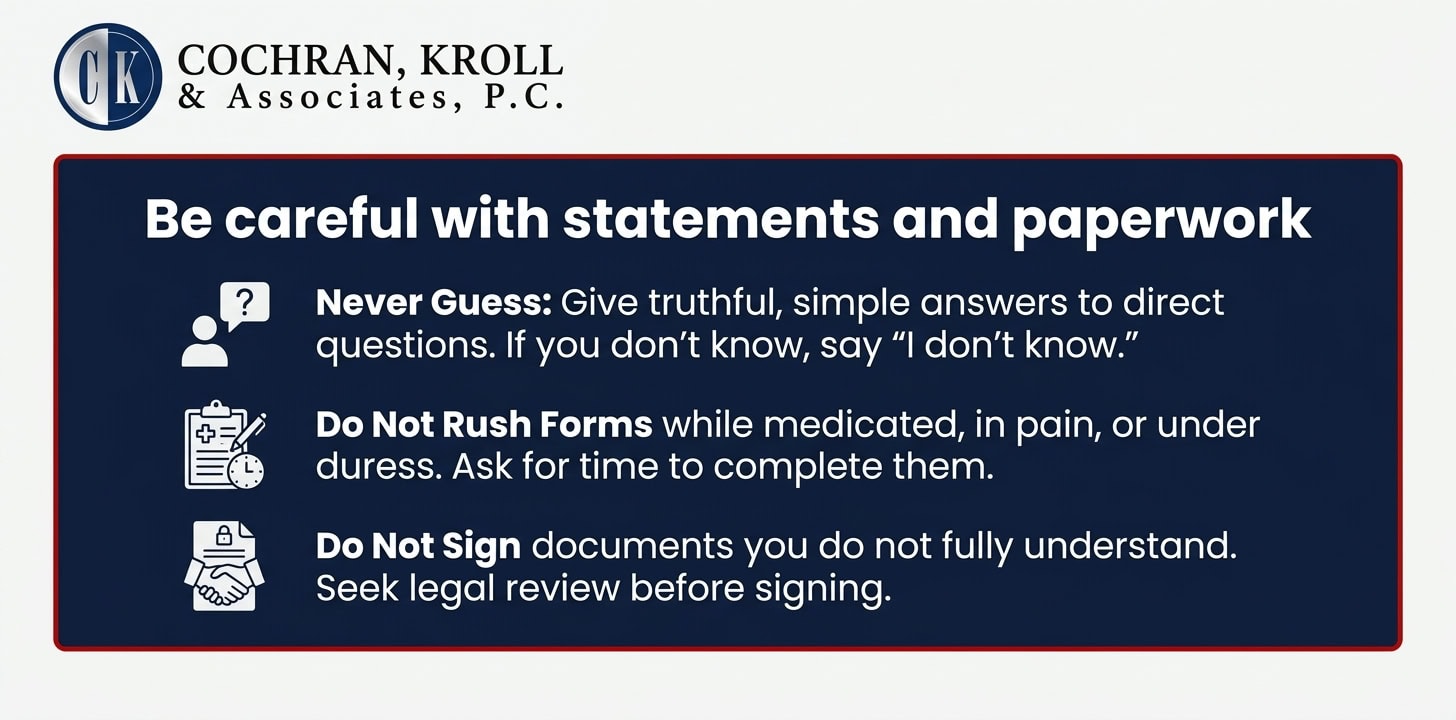
Don’t guess and don’t rush paperwork. If you’re asked for a detailed statement while you’re medicated, in pain, or still learning what happened, it’s easy to miss questions that often matter:
- Who was in charge of the area where you were injured?
- Were safety controls in place (guardrails, lockout/tagout, spotters, signage)?
- Who provided the equipment and training?
Property owners and third-party vendors
Sometimes hazards come from the condition of the premises or third-party activity.
That’s where a broader ‘personal injury claims in Michigan’ analysis may be needed.
Defective tools, machines, or safety gear
Keep the item if you can. Don’t repair or modify it.
Photos of model numbers, tags, and the condition of the equipment can help later.
What kinds of accidents do we handle?
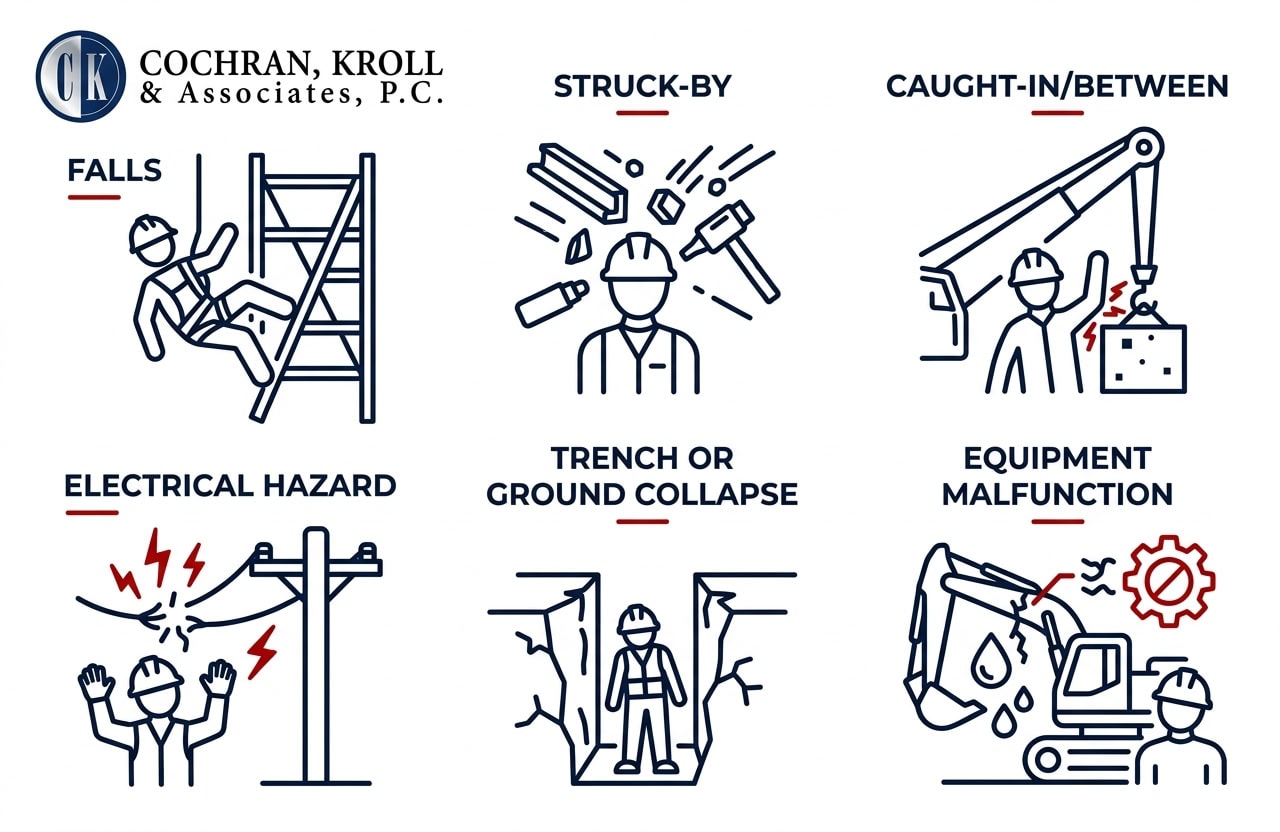
Construction injuries happen in many ways. Common categories include:
- Falls (ladders, scaffolding, roofs, openings)
- Struck-by incidents (falling materials, moving equipment)
- Caught-in/between incidents (pinch points, crush hazards)
- Electrical injuries (contact, arc flash, faulty wiring)
- Trench or structural hazards
- Equipment and machine incidents (lifts, forklifts, power tools)
Falls, scaffolds, and ladder incidents
Falls can look straightforward, but “who controlled the hazard” can be complicated.
Document guardrails, tie-off points, warnings, and the surface condition.
Struck-by and caught-in/between incidents
If something moved, dropped, swung, or pinned you, record:
- What object was involved
- Who was operating the nearby equipment
- Any site camera coverage you know about, plus witness names
Electrocution and trench/structural hazards
Electrical and trench incidents often involve multiple contractors and safety planning.
Early notes help clarify what was happening on site that day.
What injuries tend to create the biggest long-term problems?
Every injury is different, but these categories often lead to longer recoveries:
- Head/brain injuries and concussions
- Neck and back injuries; spinal injuries
- Crush injuries and complex fractures
- Burns and nerve injuries
- Amputations or loss of function
If the injury affects your ability to work long-term, you may also have questions about benefits and claims support. Our team handles disability benefits questions as part of broader workplace-injury guidance.
Head/brain injuries and spine injuries
Take symptoms seriously, even if they feel mild at first.
Keep medical visit notes and track changes in headaches, sleep, memory, balance, and pain.
Crush injuries, fractures, burns, and amputations
These injuries can mean repeated appointments and time off work.
Keep a simple timeline: dates, providers, restrictions, and missed days.
What compensation may be available in a Michigan construction injury case?
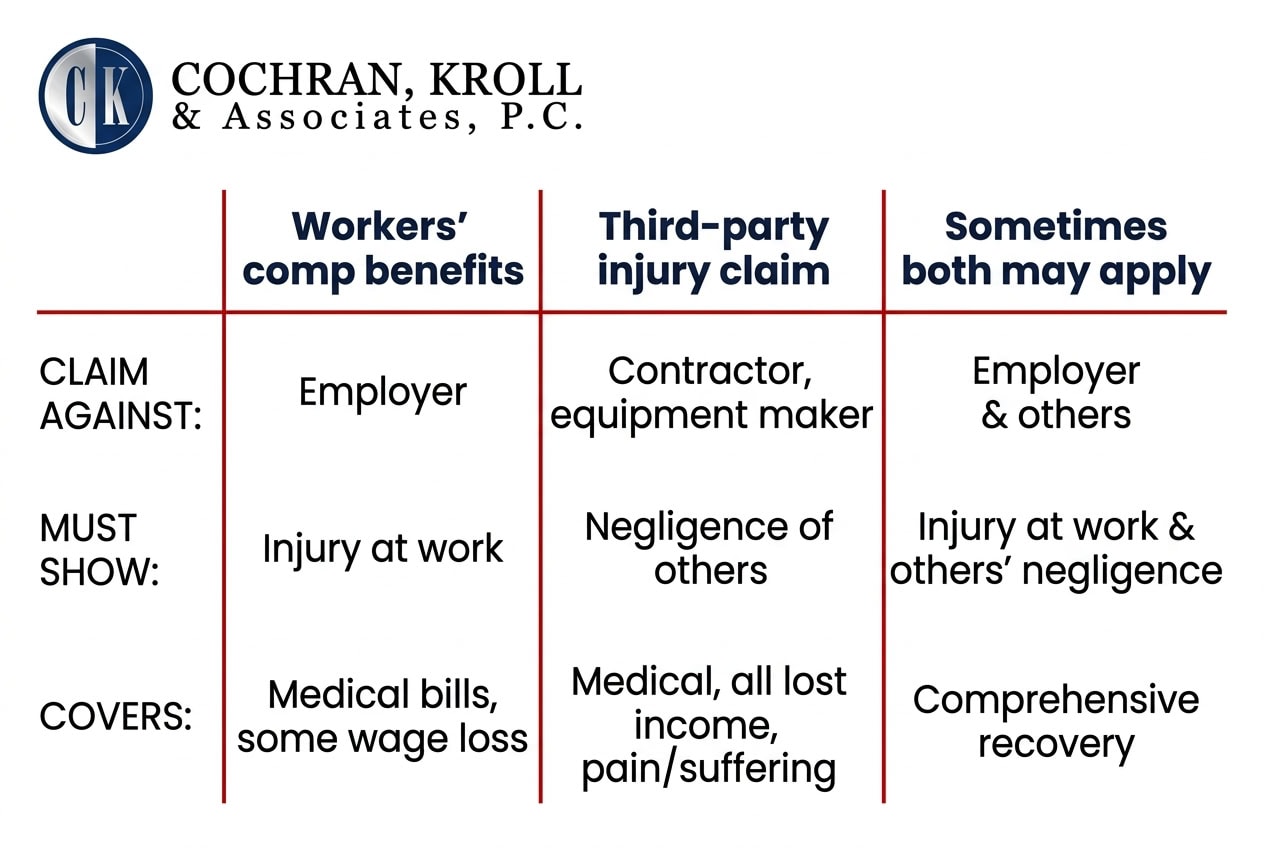
The right answer depends on which claim paths apply.
Here’s an overview.
Quick comparison: common claim paths
| Topic |
Workers’ comp benefits |
Third-party injury claim |
Sometimes both may apply |
| Who is it against |
Typically, your employer’s workers’ comp system |
A party outside your employer |
Workers’ comp + a separate claim |
| What you usually need |
An injury occurred in the course of work |
Proof of fault by another party |
Coordination matters |
| What it can cover |
Often medical care + wage-related benefits (varies) |
Broader damages may be claimed (fact-dependent) |
Case-specific |
This table is general. A case evaluation looks at your job role, the site structure, and who controlled the hazard.
Workers’ compensation benefits (baseline)
Workers’ comp is often the starting point after a job-site injury.
Details depend on your work situation and the injury.
Third-party injury claims (when negligence outside the employer is involved)
If another company contributed to the hazard, a separate claim may be possible.
That’s where evidence and job-site documentation matter most.
Wrongful death claims (when the injury is fatal)
If a loved one died after a job-site incident, families often need help fast to preserve proof and understand options. You can start with a free case evaluation and review our verdicts and settlements for examples of the kinds of cases our firm handles (past results do not guarantee future outcomes).
What evidence matters most in construction injury claims?
A lot of job-site proof disappears fast.
We focus on preserving what can still be obtained.
The proof checklist we try to preserve early
- Photos/video of the area, equipment, and warnings (or lack of them)
- Witness names and contact information
- Incident reports and employer communications
- Medical records and work restrictions
- Job-site documents that help show who controlled the work area (fact-dependent)
- Any tool, machine, or safety gear involved (kept in original condition)
If you want to see what other clients share about working with our team, visit what clients say about us.
Why photos, witnesses, and job-site records matter
They connect the injury to the condition that caused it.
They also reduce “it’s your word against theirs” problems later.
How does our firm help with construction injury cases?
We start with a free, no-obligation case evaluation to understand:
- What happened and where
- Who was involved on the site
- What documentation exists (or needs to be preserved)
- Which claim paths may apply based on the facts
You can also explore our broader firm background at Cochran, Kroll & Associates, P.C., and our approach across related injury matters, including truck crash injury help and other serious injury cases.
How contingency fees and costs usually work
Our firm offers a free case evaluation and works on a contingency fee basis.
That means you do not pay attorney fees unless a recovery is made.
Who might be responsible for a construction injury?
A job site can involve many layers. Depending on the facts, responsibility may involve:
- General contractors and site managers
- Subcontractors working near you
- Property owners
- Third-party vendors (deliveries, maintenance, temporary staffing)
- Manufacturers of tools, machines, or safety gear
Some job-site injuries also involve traffic or heavy vehicles. If that’s part of what happened, you may want to review our vehicle accident cases as well.
How long do I have to take action?
Deadlines can vary based on the type of claim and the parties involved.
Waiting can also hurt your case because evidence gets harder to find.
If you’re unsure, start the conversation early and bring what you have.
What’s the best next step if I’m not sure where my case fits?
Start simple. A short call can help you decide whether to:
- Focus on workers’ comp steps
- Preserve evidence for a possible third-party claim
- Get help coordinating both
What to bring to a free case evaluation
- Any incident report or paperwork you received
- Names/contact info of witnesses
- Photos/video from your phone
- Medical visit summaries and work restrictions
- Letters/forms from any insurer or employer
Contact Our Construction Accident Lawyer in Michigan
Construction injuries can involve workers’ comp plus potential third-party claims, depending on what happened and who was involved. A review can help clarify which paths may apply and what documentation to keep.
Contact us at Cochran, Kroll & Associates, P.C. for a free consultation. We’ll review your case, explain your options, and map out the strongest path forward. Remember, we don’t get paid unless you win.
Call us at 1-866-MICH-LAW anytime, 24/7, to schedule a free case evaluation.
FAQs
Is workers' compensation my only option after a construction injury?
Workers’ comp is often the starting point, but some situations may involve additional claims if another company or party outside your employer contributed to the hazard. A case evaluation reviews the facts so you understand what may apply to you.
Who can be responsible for a construction site injury?
Depending on the situation, responsibility may involve a contractor or subcontractor, a property owner, a third-party vendor, or a manufacturer of tools, machines, or safety gear. Identifying who controlled the hazard is usually a key step.
What should I do right after I get hurt on a job site?
Get medical care, report the incident, and document what you can safely document (photos, names of witnesses, and where it happened). Keep copies of paperwork and avoid signing releases you don’t understand.
How much does it cost to hire a job-site injury lawyer?
Cochran, Kroll & Associates, P.C. offers a free, no-obligation case evaluation and works on a contingency fee basis, meaning you do not pay attorney fees unless a recovery is made.
What evidence matters most in a construction injury claim?
Common examples include photos or videos of the scene, witness names, incident reports, medical records, and job-site documents that help show who controlled the work area. The right evidence depends on the facts.
What if my employer or an insurer asks for a recorded statement?
Be careful and don’t guess. It’s usually smart to understand the purpose of the request and get guidance before giving detailed statements, especially if you are still receiving treatment or learning what happened.
Can my family contact a lawyer if I’m hospitalized?
Yes. A family member can reach out to start gathering information, preserving evidence, and set up a case evaluation while you focus on medical care.
Does it matter if I was working for a subcontractor or as an independent contractor?
It can. Work status may affect which benefits or claims apply. A case evaluation can review your role, who hired you, and who controlled the site conditions.
How long do I have to take action after a construction injury in Michigan?
Deadlines can vary based on the type of claim and the parties involved. Acting quickly helps preserve evidence and protect your options, so it’s smart to get advice early.
What should I bring to a free case evaluation?
Bring any incident paperwork, contact information for witnesses, photos/video you took, medical visit summaries, and any letters or forms you received. If you don’t have everything, you can still start the conversation.