Grand Rapids Birth Injury Lawyers Fighting for Your Child’s Future
Grand Rapids Birth Injury Lawyers can help families navigate the aftermath of a serious delivery injury. When a baby is harmed during delivery, families are left with medical bills, a changed future, and a lot of unanswered questions about what went wrong. A birth injury attorney helps you find those answers—and pursue compensation when the harm traces back to a preventable medical mistake.
Cochran, Kroll & Associates represents families throughout Michigan in birth injury cases. The firm has tried these cases and won: a $15.8 million birth injury verdict, a $3.8 million cerebral palsy result. Consultations are free, and you pay nothing unless we win. Call 1-866-MICH-LAW or start your free case evaluation
The Difference Between Birth injury vs. Birth defect
This comes up in almost every initial call, and the distinction matters because it determines whether a legal claim exists.
A birth defect develops during pregnancy – genetic, chromosomal, or environmental in origin. A birth injury results from something that went wrong during delivery. Nerve damage from excessive traction is a birth injury. A chromosomal condition is not. Our attorneys can review your child’s records to help determine which applies.
How Birth Injuries Can Happen
Most follow a pattern of failures rather than one isolated mistake. Common causes:
Missed fetal distress.
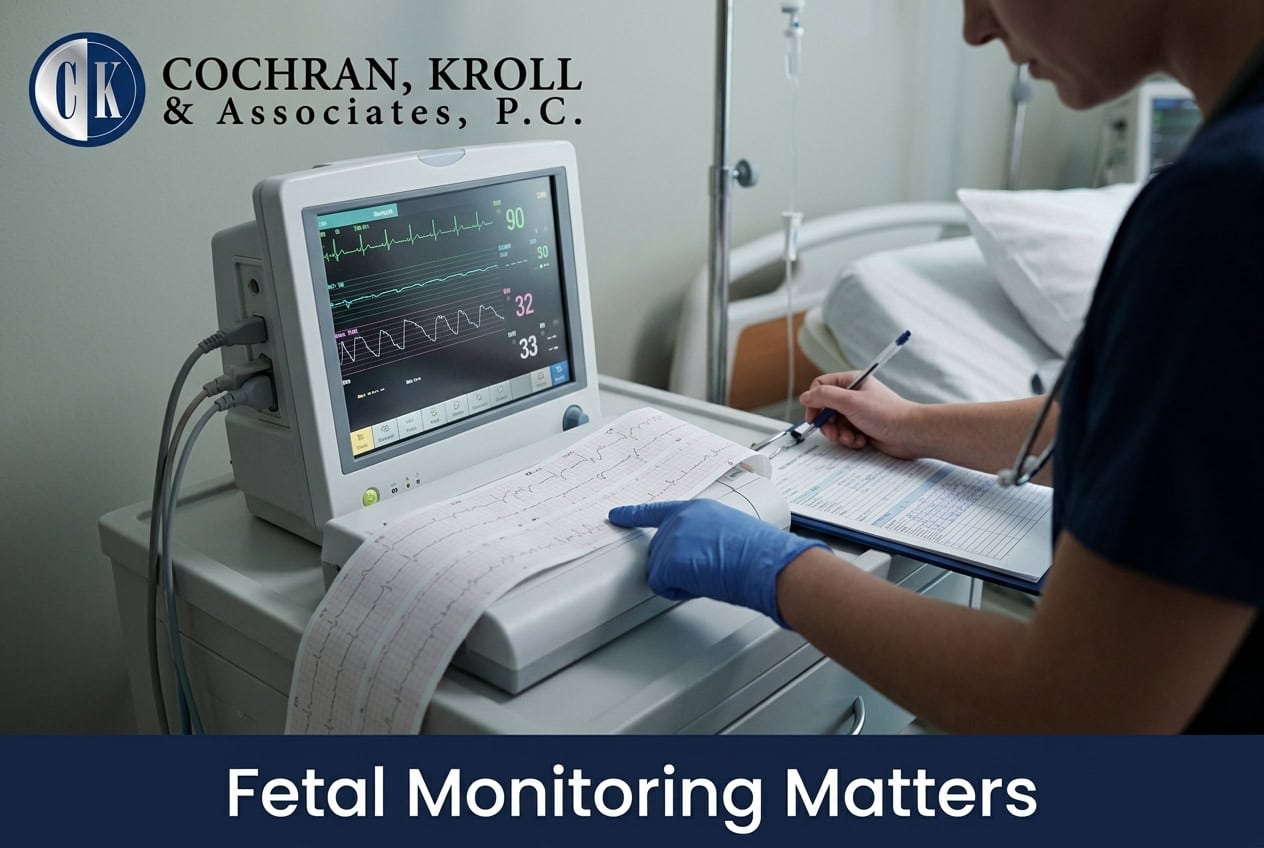
Abnormal heart rate patterns often appear on the monitor hours before an injury occurs. When nurses or doctors miss or misread those patterns, the baby can suffer oxygen deprivation that causes permanent brain damage.
Delayed C-section.
When labor stops progressing safely, delays in ordering or performing an emergency C-section can permanently deprive a baby’s brain of oxygen.
Misuse of forceps or vacuum extractors.
Assisted deliveries require judgment. Getting it wrong can cause skull fractures, nerve damage, or intracranial bleeding – injuries that are often avoidable with proper technique or a timely switch to C-section.
Medication errors.
Pitocin strengthens contractions, but continuing it when a baby is in distress can make things worse. Failing to adjust or stop the medication in response to warning signs is negligence.
Untreated infections.
Maternal or fetal infections that aren’t caught and treated promptly can escalate to sepsis or brain injury. Recognizing those signs is a basic standard of care.
Hospital-level failures.
Understaffing, training gaps, and breakdowns in communication between nurses and doctors can delay critical decisions. Hospitals themselves can be held liable for those problems.
Birth Injuries Cases That We Handle
Cerebral Palsy.
Frequently, the result of oxygen deprivation or untreated fetal distress during labor. Symptoms range from mild motor difficulties to total incapacitation. Our firm secured a $3.8 million CP verdict after proving oxygen deprivation during labor.
HIE (Hypoxic-Ischemic Encephalopathy).
One of the more serious birth injuries – oxygen and blood flow to the brain are disrupted during delivery. If your baby received cooling therapy (therapeutic hypothermia) after birth, a case review is worth having, because that treatment is used specifically when oxygen deprivation is suspected.
Erb’s Palsy and Brachial Plexus Injuries.
Caused by excessive traction on the baby’s head, neck, or shoulders. The brachial plexus – the nerve network controlling the arm and hand – is damaged, resulting in partial or complete paralysis. Frequently preventable.
Shoulder Dystocia Injuries.
When the baby’s shoulder gets lodged behind the mother’s pelvis, the emergency itself isn’t malpractice. How the provider responds to it can be.
We also handle skull fractures from instrument-assisted delivery, neonatal seizures, spinal cord injuries, facial nerve paralysis, placental abruption injuries, uterine rupture injuries, and umbilical cord compression brain damage.
Warning Signs Worth a Closer Look
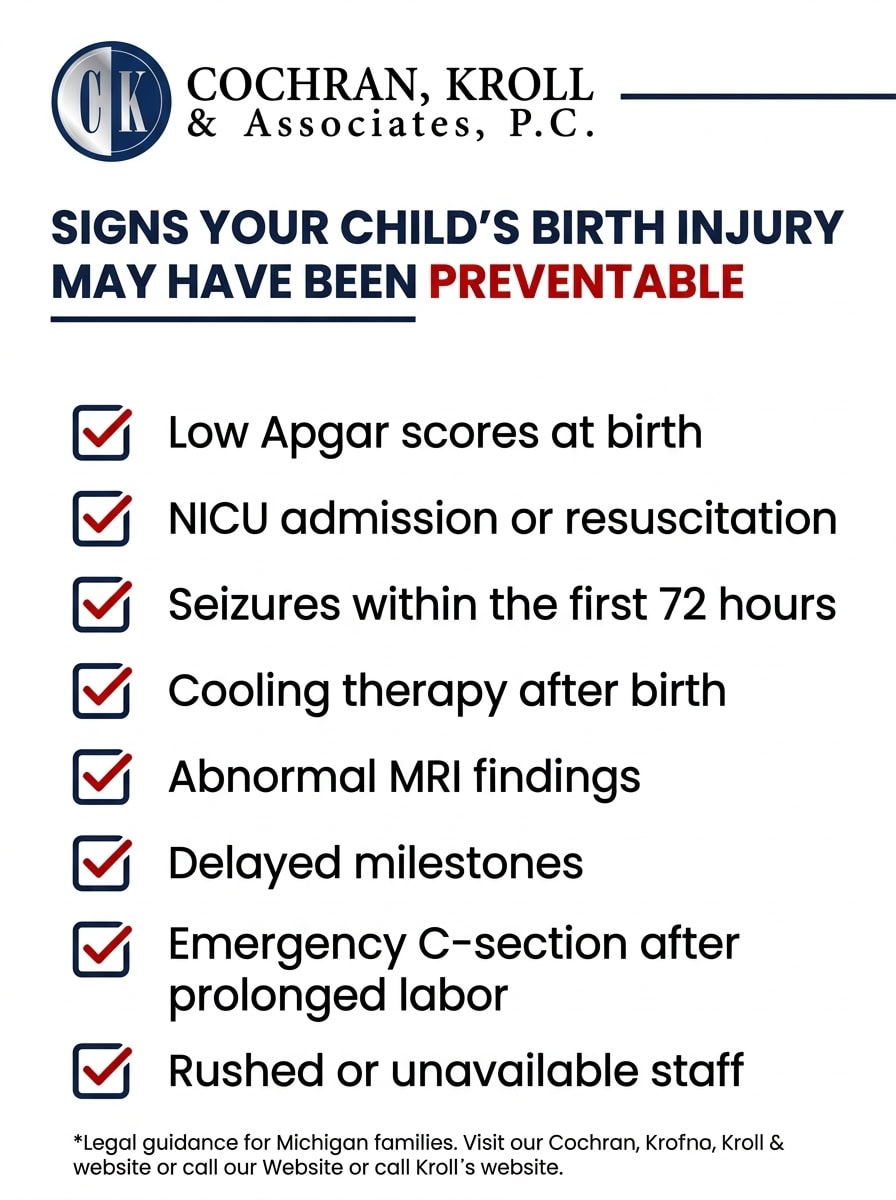
You may suspect something went wrong, but not know whether the injury was preventable. These signs often indicate a case worth reviewing:
- Low Apgar scores at birth
- Immediate need for resuscitation or NICU admission
- Seizures within the first 72 hours of life
- Cooling therapy after birth
- Abnormal MRI findings
- Delayed milestones – not sitting, standing, or walking at expected ages
- A sudden emergency C-section after a prolonged labor
- Nurses or doctors who seemed rushed or unavailable during delivery
Parents are often told, “These things just happen.” That isn’t always true. If any of the above sounds familiar, it’s worth a call.
Grand Rapids Birth Injury Lawyers: Michigan Laws in Grand Rapids
Michigan gives most families two years from the date of the malpractice or until the child’s 10th birthday – whichever comes later. This is controlled by MCL 600.5838, 600.5838a, and 600.5851. Waiting until the child turns 18 is, in most cases, waiting too long.
Michigan also caps non-economic damages – pain and suffering, emotional distress – in medical malpractice cases under MCL 600.1483. The specific cap depends on the year of the injury. Economic damages aren’t capped, and in serious birth injury cases, they make up most of any recovery: lifetime medical care, therapy, equipment, home modifications, lost earning capacity.
Expert testimony requirements are also strict. If the defendant is an OB, the expert witness must be an OB. Cases also require causation experts – pediatric neurologists, neonatologists, life care planners, and economists. That’s set by MCL 600.2169. Getting the right experts early is part of building a viable case.
How Much Compensation Can Be Recovered For a Grand Rapids Birth Injury?
Economic damages cover the financial impact: past and future medical expenses, ongoing therapy, assistive equipment, in-home care, home and vehicle modifications, specialized education, and lost earning capacity for the child. Parents who reduced work hours to become caregivers can also recover lost wages.
Non-economic damages – pain and suffering, emotional distress, loss of enjoyment of life – are subject to Michigan’s statutory cap but still represent a meaningful part of a recovery.
In cases where the baby died, Michigan wrongful death claims cover the loss of the child, the family’s grief, and funeral costs.
Contact Our Grand Rapids Birth Injury Lawyer

If a child suffered complications during pregnancy, labor, or delivery, a Grand Rapids birth injury lawyer can review medical records, treatment timelines, and expert opinions to understand what may have happened. Early legal guidance can help families understand their options and the next steps for pursuing a claim.
Contact us at Cochran, Kroll & Associates, P.C. for a free consultation. We’ll review your case, explain your options, and map out the strongest path forward. Remember, we don’t get paid unless you win.
Call us at 1-866-MICH-LAW anytime, 24/7, to schedule a free case evaluation.
Frequently Asked Questions
How long do I have to file in Michigan?
Generally, until the child’s 10th birthday, not age 18. Many families lose their window waiting on the wrong assumption. Call sooner rather than later.
What does it cost?
Nothing upfront. We work on contingency, and we advance all litigation costs – expert fees, court filings, everything. You pay nothing unless we recover.
Can I sue the hospital, not just the doctor?
Yes. Hospitals can be held liable for their employees’ negligence and for systemic problems like understaffing or communication failures.
I'm not sure whether it was negligence. Should I still call?
Yes. You don’t need to have the answer before reaching out – that’s exactly what a case review is for. If warning signs are there, let us look.
Which Grand Rapids hospitals have been involved in birth injury cases?
We’ve represented clients who delivered at Spectrum Health Butterworth, Mercy Health Saint Mary’s, Metro Health, and other area hospitals. The hospital matters less than whether the standard of care was met.