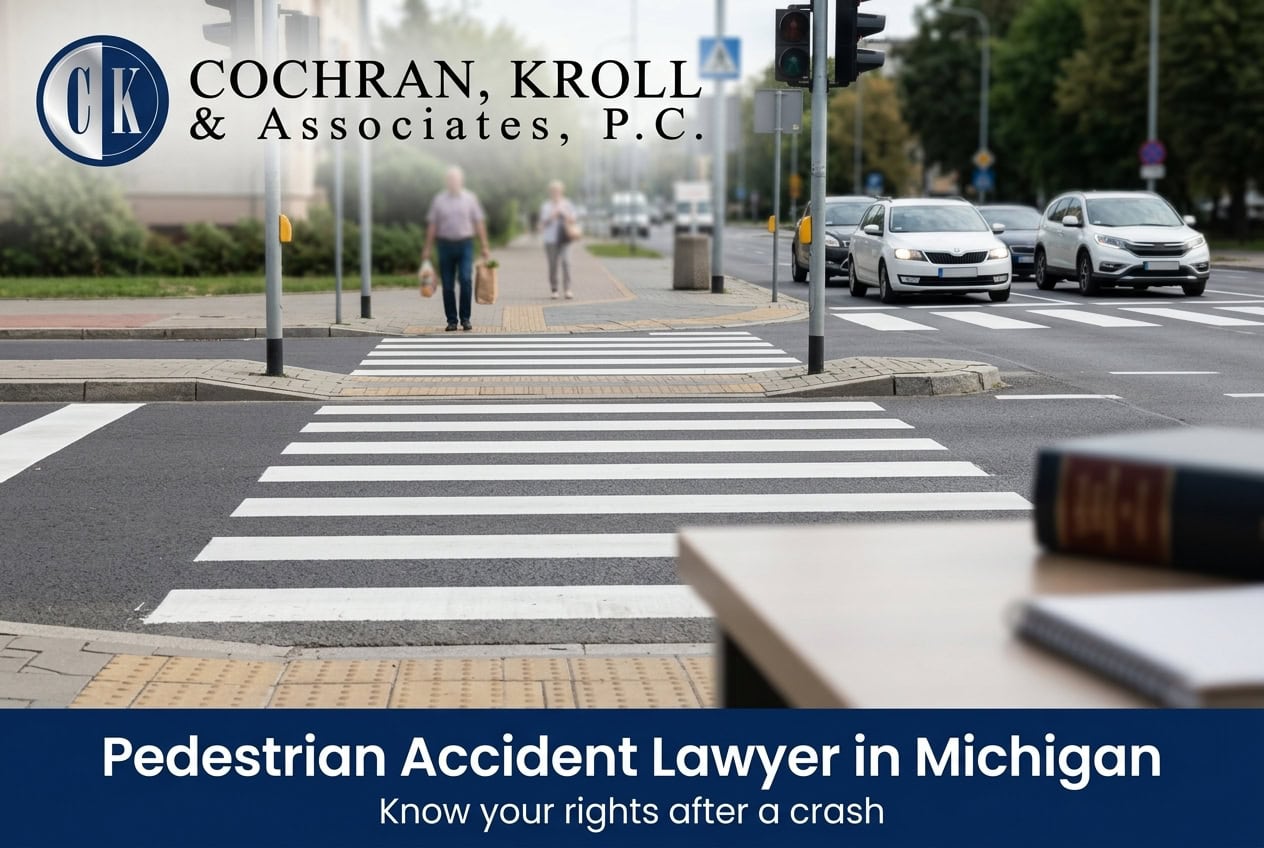
A pedestrian accident lawyer in Michigan helps an injured walker protect two paths to recovery: no-fault benefits for medical bills and wage loss, and a claim against the at-fault driver for pain and suffering when the injuries are serious enough. Early medical care, a police report, and a quick legal review matter because deadlines can be short.
The first hours matter. So do the first conversations you have with police, doctors, and insurers.
You may be:
Hit while walking in a crosswalk, parking lot, neighborhood street, school zone, or roadside
Your families dealing with a severe injury or a fatal pedestrian crash
Trying to understand no-fault benefits, pain and suffering claims, or a hit-and-run case
It is not a substitute for emergency care. If the crash just happened and there is any doubt about the severity of the injury, call 911 first.
How Serious Can Pedestrian Crashes Be in Michigan?
Pedestrians are exposed. They do not have seat belts, airbags, or a steel frame around them.
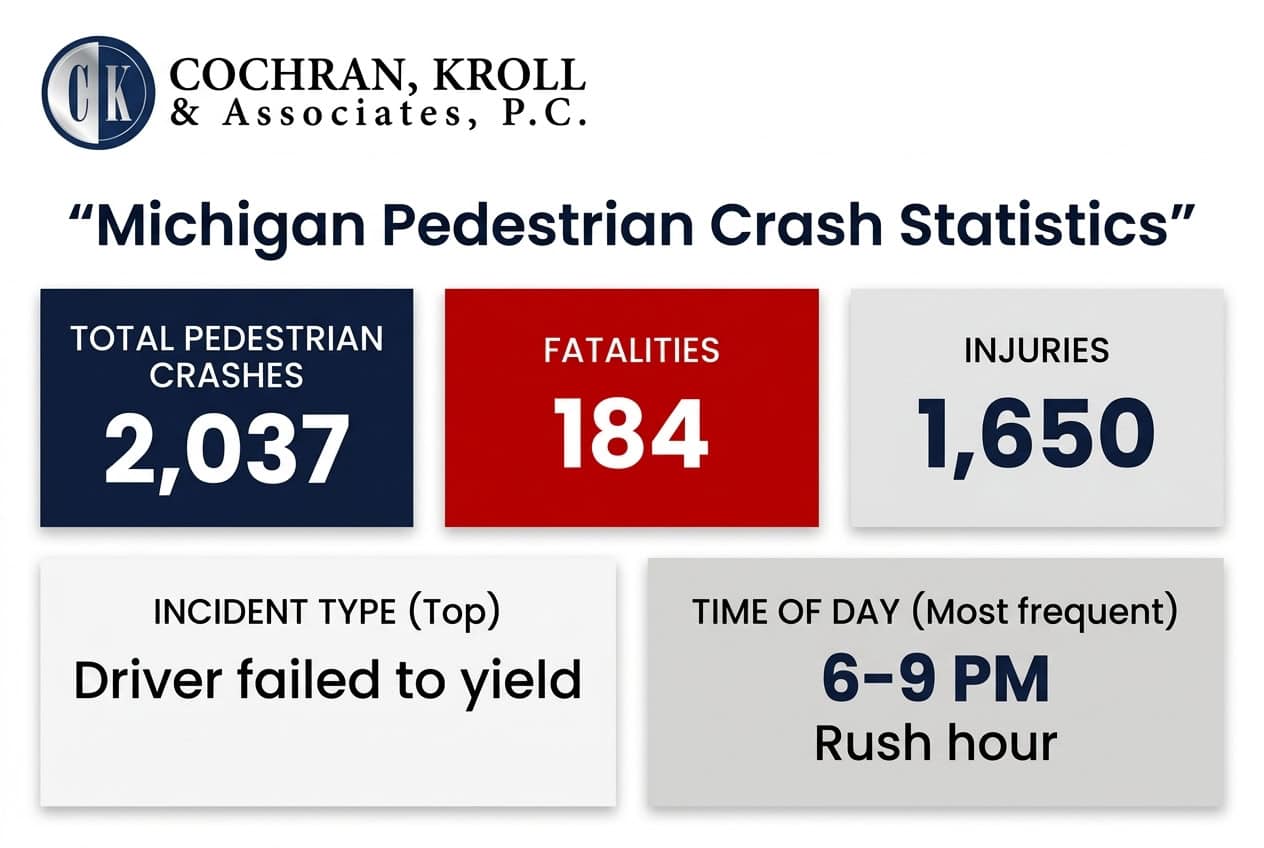
Michigan had 2,131 pedestrian-involved crashes in 2024, with 1,809 injuries and 156 deaths. The highest-risk hour was 6:00 p.m. to 6:59 p.m., and October was the highest-risk month.
A few common reason of the accidents:
Crossing at intersections and crossing outside intersections both show up often in crash data
Alcohol involvement remains a factor in fatal pedestrian cases
Larger vehicles, especially SUVs and trucks, can increase impact severity and reduce driver visibility
Evening visibility problems, hurried turns, and distracted driving still show up again and again
These numbers do not tell you what your case is worth. They do show why insurers and defense teams often move fast to shape the story before the full medical picture is clear.
What Usually Causes Pedestrian Crashes in Michigan?
Most of these cases come back to driver negligence. The facts may change, but the pattern is familiar.
When Drivers Fail to Notice People On Foot
Distracted driving still causes drivers to miss walkers in crosswalks, on corners, and near parked cars. That includes texting, app use, GPS changes, and quick glances away from the road.
Turning drivers also creates danger. A driver may focus on traffic and never check the crosswalk before turning.
When Speed and Impairment Make the Crash Worse
Speed cuts reaction time and makes it harder to survive. That is why crashes in school zones, parking lots, neighborhoods, and multilane roads can be so serious.
Impaired driving can also change everything. Alcohol and drug use affect judgment, braking, and awareness.
When Commercial Pressure or Backing Maneuvers Are Involved
Delivery vans, food delivery drivers, rideshare vehicles, and company cars often operate under tight time pressure. That can lead to rushed turns, hurried parking-lot driving, and poor backing decisions.
Backing crashes deserve close attention. These cases often happen in parking lots, driveways, and loading areas where drivers say they “never saw” the pedestrian.
When the Road Itself Is Added to the Danger
Some crashes are not just about the driver. Poor lighting, worn crosswalk markings, broken signals, missing sidewalks, and unsafe lot design can matter too.
When a city, county, or state agency shares responsibility, the rules can change fast. Those cases may involve shorter notice requirements than a standard injury claim.
What injuries can change the course of a claim?
A pedestrian does not need a “catastrophic” label for a case to be serious. But many of these crashes do cause life-changing harm.
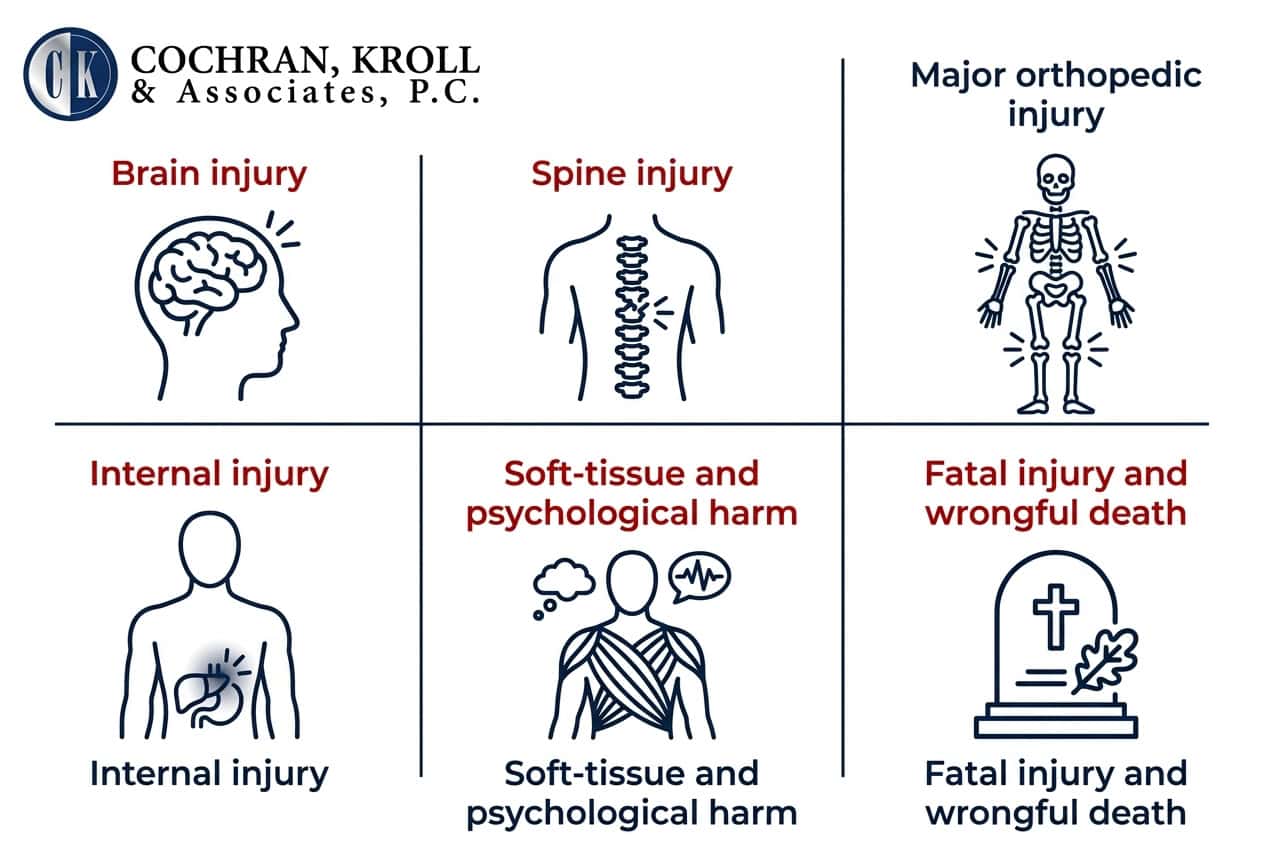
Brain, Spine, and Major Orthopedic Injuries
A person on foot can be thrown onto a hood, windshield, pavement, curb, or another vehicle. That is why traumatic brain injuries, spinal injuries, pelvic fractures, leg fractures, and severe shoulder damage are common claim drivers.
These injuries can also change work, memory, mobility, sleep, and independence. That is a big reason medical records and future care planning matter so much.
Internal, Soft-tissue, and Psychological Harm
Internal bleeding, organ injury, collapsed lung, deep bruising, ligament damage, and road rash may not look dramatic at first. They can still lead to long recovery periods, surgery, and chronic pain.
Pedestrian crashes can also leave people with anxiety, depression, panic, and trauma symptoms. Those losses are real, and they often affect daily life long after the fractures heal.
Fatal Injuries and Wrongful Death Claims
Some families never get the chance to help their loved one recover. When a pedestrian dies from crash injuries, the surviving family may need to pursue a wrongful death claim for financial and emotional losses tied to that death.
How Does Michigan’s No-fault Law Apply to Pedestrians?
Michigan’s no-fault law is one of the hardest parts of these cases for injured people to sort out. A walker may still have coverage options even without owning a vehicle.
Which Insurance Usually Pays First?
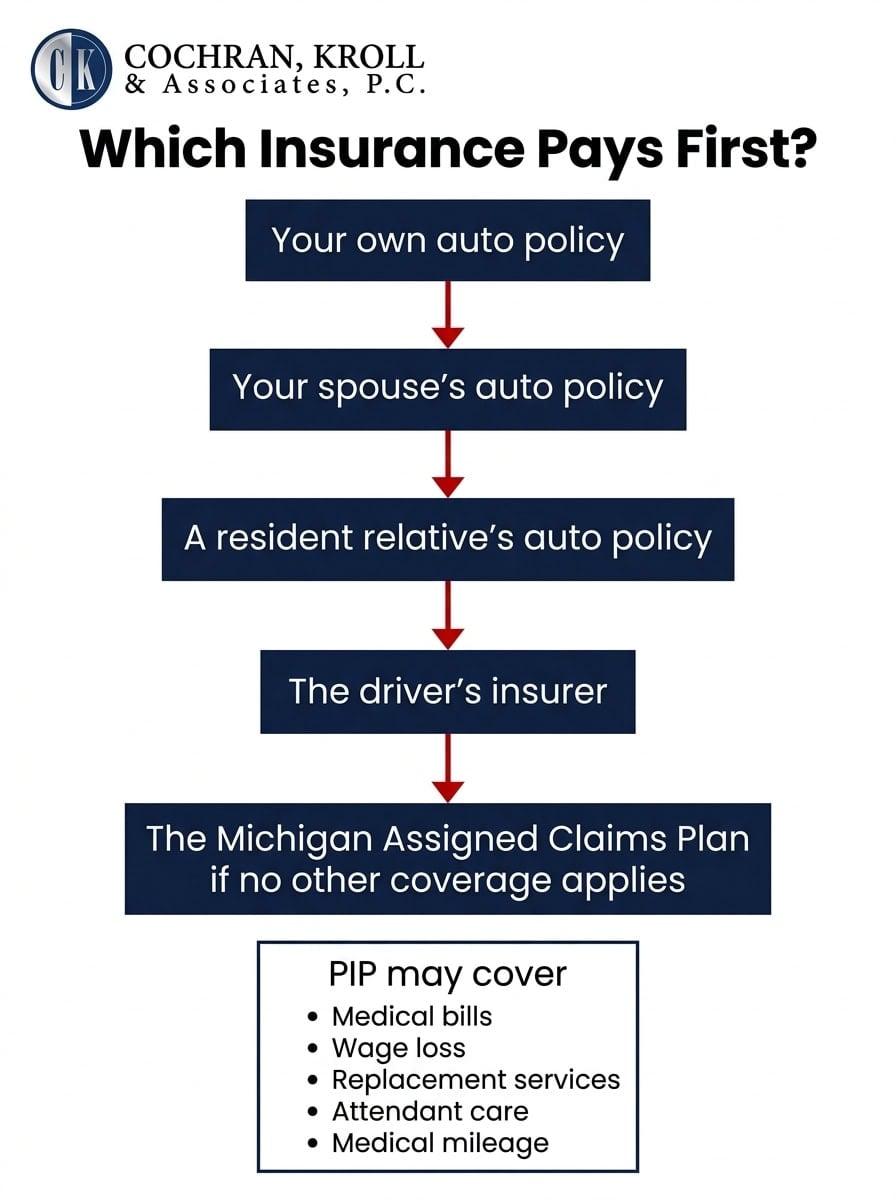
The order can matter. It often starts with:
Your own auto policy
Your spouse’s auto policy
A resident relative’s auto policy
The driver’s insurer
The Michigan Assigned Claims Plan if no other coverage applies
That order is one reason early case review helps. A claim can be delayed or underpaid when the wrong carrier is contacted first.
What Can PIP Benefits Cover?
No-fault PIP benefits can include:
Medical bills up to the available coverage limit
Wage loss benefits, subject to Michigan rules and limits
Replacement services for household help
Attendant care in the right case
Medical mileage and related out-of-pocket items
Survivor’s loss benefits in a fatal case
The current wage-loss maximum is $7,201 per month through September 2026.
When Can You Sue the Driver?
No-fault is not the whole case. A pedestrian may also sue the at-fault driver for pain and suffering and certain excess losses when the injuries meet Michigan’s legal threshold.
That usually means the injury caused a serious impairment, permanent serious disfigurement, or death. Because pedestrian crashes often involve fractures, brain injuries, or lasting disability, that threshold may be met more often than in lower-impact vehicle claims.
What If It Were a Hit-and-run or There Is a Fault Dispute?
A driver fleeing the scene does not always end the case. A pedestrian may still have a no-fault path and, in some situations, an uninsured motorist path depending on the policy involved.
Shared fault is different. A pedestrian may still qualify for PIP benefits even if the defense argues the pedestrian crossed outside a crosswalk or misjudged traffic. Fault disputes usually matter more when the case moves into pain-and-suffering damages.
Do not ignore the deadlines. The PIP application generally has a 1-year deadline, and a third-party lawsuit generally has a 3-year deadline. Government-related claims can move even faster.
What Compensation Can Be Available for Pedestrian Accident Cases??
Pedestrian cases often involve more than one category of damage. That is why early settlement pressure can be risky.
No-fault benefits may cover
Medical treatment
Wage loss
Replacement services
Attendant care
Medical travel and related costs
Survivor’s loss in a fatal claim
A claim against the driver may include
Pain and suffering
Disability and loss of normal life
Emotional distress tied to the injuries
Excess medical costs above no-fault limits
Excess wage loss beyond the no-fault period or cap
Permanent scarring or disfigurement
A wrongful death claim may include
Funeral and burial costs
Lost financial support
Lost companionship and guidance
The losses tied to a loved one’s final injury period
What Are the Factors That Affect the Value of a Case?
Value usually turns on facts, not labels. The most common drivers include:
How severe the injuries are
Whether surgery, long rehab, or future treatment is expected
How much work time was lost
Whether symptoms are permanent
How much insurance is available
Whether the fault is disputed
Whether a commercial or government vehicle is involved
The strongest cases are often the best-documented cases. That means clean medical records, strong witness proof, and a clear damages story.
What Should You Do in the Hours and Days After The Crash?
You do not need to do everything at once. You do need to protect the basics.
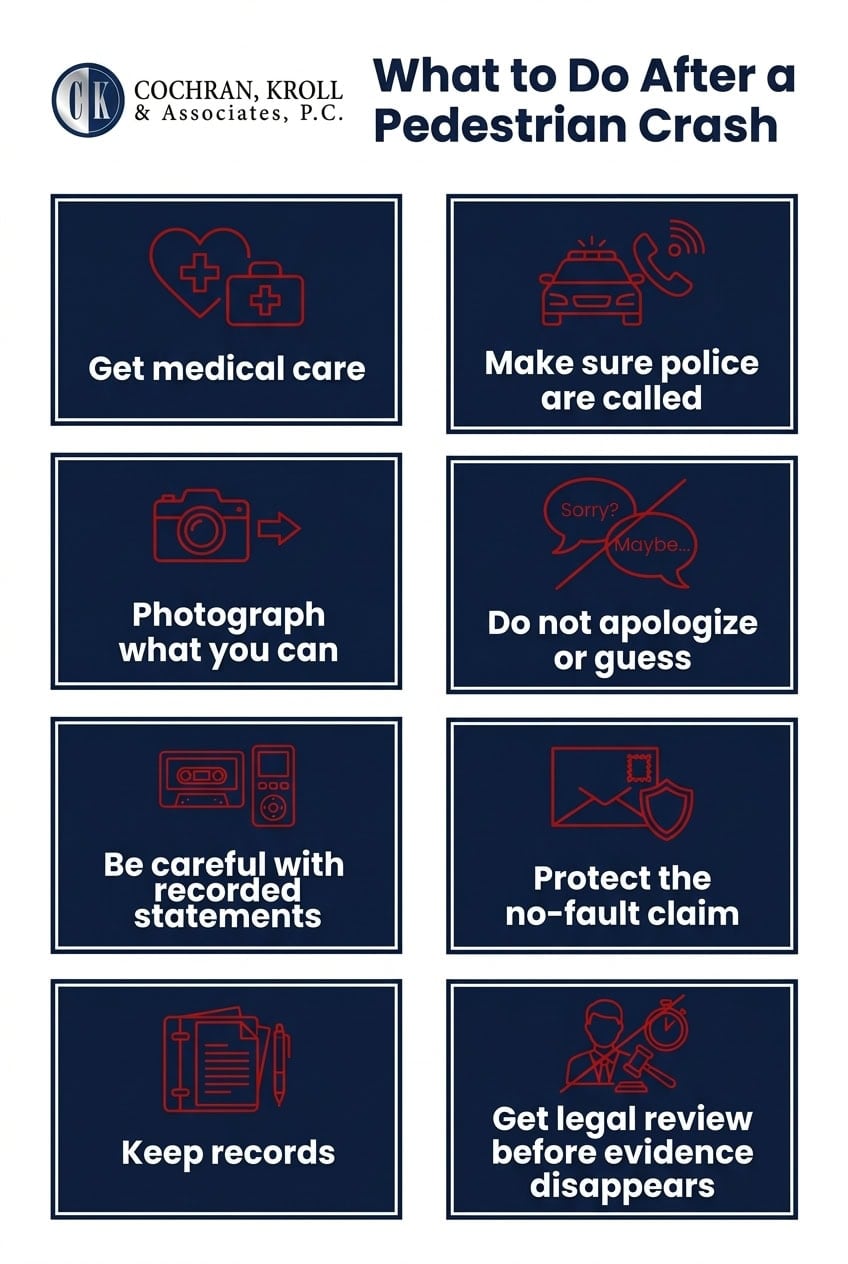
1) Get medical care right away
Even when adrenaline is high, internal injuries, concussion symptoms, and spinal problems may not show up clearly at the scene.
2) Make sure police are called
A police report can help identify the driver, the location, witness names, and the initial account of events.
3) Photograph what you can
If you are physically able, save images of the vehicle, impact area, your injuries, the crosswalk or roadway, skid marks, lighting, and traffic controls.
4) Do not apologize or guess
Simple, calm facts are enough. Avoid speculation about speed, fault, or what you “should have done.”
5) Be careful with recorded statements
Insurers may ask for one early. That request can come before you know the full medical picture.
6) Protect the no-fault claim
If a PIP application needs to be filed, timing matters. Waiting too long can damage a good case.
7) Keep records
Save bills, discharge papers, prescriptions, travel receipts, photos, and a simple daily pain journal.
8) Get a legal review before the evidence disappears
Witnesses forget, video gets erased, and insurers move fast. Early investigation can make a major difference.
How Do Special Situations Change a Pedestrian Claim?
Some fact patterns require broader investigation from day one.
Children hit by vehicles
Children may be harder for drivers to see. School-zone crashes, driveway backovers, and neighborhood turns often need close review.
Older adults
Recovery can take longer. Insurers sometimes try to blame slower walking speed or pre-existing health issues rather than acknowledging the full harm caused by the crash.
Parking lot crashes
These cases may involve backing vehicles, poor lighting, unclear pedestrian lanes, or property design problems.
Delivery, rideshare, and work-related vehicles
A delivery driver or rideshare driver may trigger additional insurance layers. Employer responsibility may matter too.
Government vehicles or unsafe public conditions
A city bus, county vehicle, or road-design issue can change both the evidence plan and the notice rules. Those cases should be reviewed quickly.
Why Do Injured Pedestrians in Michigan Choose Our Team?
At Cochran, Kroll & Associates, P.C., we know these cases are not just about one crash report. They are about treatment, income, independence, and what life looks like months from now.
Our team offers:
Michigan-focused representation for injury claims across the state
A firm with offices in Livonia and Flint
A free, no-obligation consultation
A contingency fee basis, which means no fee unless we recover compensation
24-hour toll-free intake
Eileen Kroll, R.N., J.D., adds an extra layer of value in serious injury cases. That clinical background helps when records need careful review, future care needs need to be understood, or insurers try to downplay the medical impact of a crash. That same detailed review mindset also supports work handled by our medical malpractice lawyer in Michigan team.
How Much Does it Cost to Hire a Pedestrian Accident Lawyer in Michigan?
You do not pay us up front to start. Our firm works on a contingency fee basis.
That means:
No upfront attorney fee to open the case
No fee unless we recover compensation for you
A clear conversation about the process before you move forward
That fee structure matters after a pedestrian crash. Most people are already dealing with treatment, missed work, and everyday pressure.
Contact Our Pedestrian Accident Lawyer in Michigan
If you were injured while walking due to a driver’s negligence, a Michigan pedestrian accident lawyer can help review the crash details, medical records, and available evidence. Early legal guidance can help you understand your options and the next steps for pursuing compensation.
Contact us at Cochran, Kroll & Associates, P.C. for a free consultation. We’ll review your case, explain your options, and map out the strongest path forward. Remember, we don’t get paid unless you win.
Call us at 1-866-MICH-LAW anytime, 24/7, to schedule a free case evaluation.
Frequently Asked Questions
What should I do if I am hit by a car as a pedestrian in Michigan?
Start with medical care and a police report. After that, preserve photos, records, and witness details, and be careful about early insurer calls until you understand the claim path.
How long do I have to file a pedestrian accident lawsuit in Michigan?
A pedestrian accident lawsuit generally has a 3-year deadline, while the PIP application has a much shorter 1-year deadline. Waiting can damage both.
What if I were partially at fault for the pedestrian accident?
You may still have rights. PIP benefits can remain available even when fault is disputed, while a claim for pain and suffering may be reduced or barred depending on the fault finding.
Who pays my medical bills after a pedestrian crash in Michigan?
That usually depends on Michigan’s no-fault priority rules. The correct insurer may be your own, your spouse’s, a resident relative’s, the driver’s insurer, or the Assigned Claims Plan.
Can I sue the driver who hit me if I was not in a crosswalk?
Possibly, yes. Being outside a crosswalk does not automatically defeat the case, but it can create a fault dispute that must be handled carefully.
What if the driver who hit me was working at the time?
A work-related crash may open additional insurance coverage. That can matter in delivery, rideshare, commercial fleet, and company vehicle cases.
What if the driver fled the scene?
A hit-and-run does not always leave you without options. No-fault benefits may still be available, and some policies may also offer uninsured motorist coverage.
How much is a pedestrian accident case worth?
There is no honest flat number. Case value depends on injury severity, future treatment, wage loss, fault issues, and the insurance coverage available.
Can I recover pain and suffering after a pedestrian crash?
In many cases, yes. That part of the claim usually depends on whether the injuries meet Michigan’s legal threshold for a serious injury case.
You can also explore our broader legal FAQs, but these are the questions we hear most often after a pedestrian crash.
RESULTS-DRIVEN TRACK RECORD
$15.8 Million
Medical Malpractice / Birth Injury
Monroe, Michigan
WHAT HAPPENED:
A young couple from Monroe, Michigan, was awarded a $15.8 million verdict as the result of their baby son, Jason, being inflicted with Cerebral Palsy as the result of an error during the final stages of a labor.
Result: $15.8 Million
$1 Million
Medical Malpractice/Wrongful Death
Oakland County, Michigan
What Happened:
While in the hospital a mother of three was not properly treated for a closed-head injury causing her untimely death.
Result: $1 Million
$1.4 Million
Accidents & Injuries/Brain Injury
Livonia, Michigan
What Happened:
A Livonia pedestrian recovered $1.4 million when he was struck by a commercial van resulting in a traumatic brain injury in Redford, Michigan.
Result: $1.4 Million
$9 Million
Medical Malpractice / Misdiagnosis
Wayne County, Michigan
WHAT HAPPENED:
Patient suffered cardiac arrest and brain damage when a hospital failed to recognize internal bleeding and treatment was delayed for more than 14 hours.
Result: $9 Million
$3.3 Million
Accidents & Injuries/Auto Accident
Tuscola County, Michigan
WHAT HAPPENED:
A Tuscola County jury awarded $3.3 million to a severely brain injured motorist as the result of a defective Michigan highway.
Result: $3.3 Million
$1.25 Million
Accidents & Injuries/Construction Site Injury
Flint, Michigan
WHAT HAPPENED:
A seventeen-year-old construction worker suffered a traumatic brain injury resulting from a fall in Flint, Michigan, and was awarded $1.25 million.
Result: $1.25 Million
$1.9 Million
Medical Malpractice
Wayne County, Michigan
What Happened:
Middle-aged woman suffered severe disfiguring facial burns from a simple surgical procedure.
Result: $1.9 Million
$3.8 Million
Medical Malpractice / Birth Trauma
Southern Michigan
What Happened:
Child developed cerebral palsy with developmental delays due to lack of oxygen and brain injury during labor and delivery.
A Westland construction worker recovered $1.5 million after sustaining a traumatic brain injury while on a construction site in Detroit, Michigan.
Result: $1.5 Million
$1.3 Million
Accidents & Injuries/Truck Accident
Marlette, Michigan
What Happened:
A Marlette, Michigan, family reached a $1.3 million settlement in the traffic death of their 5-year-old son when they were struck by a semi truck.
Result: $1.3 Million
$225,000
Medical Malpractice/Cancer Misdiagnosis
Redford, Michigan
What Happened:
The misdiagnosis of breast cancer resulted in a Redford, Michigan, woman recovering $225,000.
Result: $225,000
$125,000
Workers Compensation
Detroit, Michigan
What Happened:
A construction worker redeemed his worker’s compensation case for $125,000 in Detroit, Michigan.
Result: $125,000
$400,000
Accidents & Injuries/Auto Accident
Monroe, Michigan
What Happened:
A paraplegic woman from Monroe, Michigan, recovered Michigan no-fault benefits including the purchase of a new home and attendant care in excess of $400,000.
Result: $125,000
$2.2 Million
Medical Malpractice/Birth Injury
Brighton, Michigan; Detroit, Michigan
What Happened:
A Brighton family recovered $1.3 million and a Detroit family recovered $900,000 as the result of birth injuries and medical malpractice to their children.
Result: $2.2
$80,000
Accidents & Injuries/Auto Accident
Bay City, Michigan
What Happened:
A Bay City grandmother was awarded $80,000 following an auto accident resulting in a broken leg.
Result: $80,000
FREE CONSULTATION NO FEES UNTIL WE WIN
There is no obligation for a case evaluation & no fee is charged unless a recovery is made.
Your privacy is important to us. Cochran, Kroll & Associates, P.C. does not share, sell, rent, or trade personally identifiable or confidential information with third parties for any purpose.