Cerebral Palsy Lawyer in Livonia, Michigan
Cochran, Kroll & Associates, P.C. is headquartered at 32398 Five Mile Road in Livonia. This is not a remote office. It is where Eileen E. Kroll, a registered nurse and Michigan-licensed attorney, sits down with families whose children were diagnosed with cerebral palsy after a difficult delivery. It is also where Terry L. Cochran prepared the case that produced a $15.8 million birth injury verdict for a Michigan family. Our Cerebral Palsy Lawyer Livonia practice exists for parents who are tired of being told to wait and see. Call 1-866-MICH-LAW or request a free case review when you are ready to review the records.
Key Takeaways
- Cerebral palsy linked to labor-related oxygen deprivation is one of the most frequently litigated forms of medical malpractice in Michigan.
- Our primary office in Livonia allows families to consult with their legal counsel in person without traveling to downtown Detroit.
- Clinical assessments of NICU charts, fetal monitoring strips, and labor records are conducted personally by Eileen Kroll from a medical perspective.
- Compensation can fund a lifetime of medical care, therapy, special education, adaptive equipment, and lost future earnings.
- Initial consultations are free, and the firm charges no attorney fees unless we recover for your child.
What Is Cerebral Palsy and When Is It Caused by Medical Negligence?
Cerebral palsy is a group of motor disorders caused by damage to the developing brain before, during, or shortly after birth. The damage itself is not progressive. The effects on muscle tone, movement, and coordination can vary widely from one child to the next.
Not every case of cerebral palsy is the result of medical negligence. Some have genetic causes, some are linked to prenatal infection, and some arise from circumstances that no clinician could have predicted or prevented. But a measurable percentage of cerebral palsy cases trace back to events during labor and delivery that a careful obstetric team should have managed differently.
The legal question is whether the labor and delivery team met the accepted standard of care, and whether any deviation caused the brain injury that led to your child’s diagnosis. That question is answered by reading the chart, not by guessing.
Types of Cerebral Palsy
Spastic cerebral palsy is the most common form. Children with spastic CP have stiff muscles and exaggerated reflexes. Spastic CP is further classified by which limbs are affected.
Dyskinetic cerebral palsy involves uncontrolled, involuntary movements. Children with dyskinetic CP may have trouble holding a posture or coordinating fine motor tasks. Ataxic cerebral palsy affects balance and coordinated movement; children with ataxic CP often appear unsteady. Mixed cerebral palsy combines features of multiple types.
Medical Errors That Can Lead to Cerebral Palsy
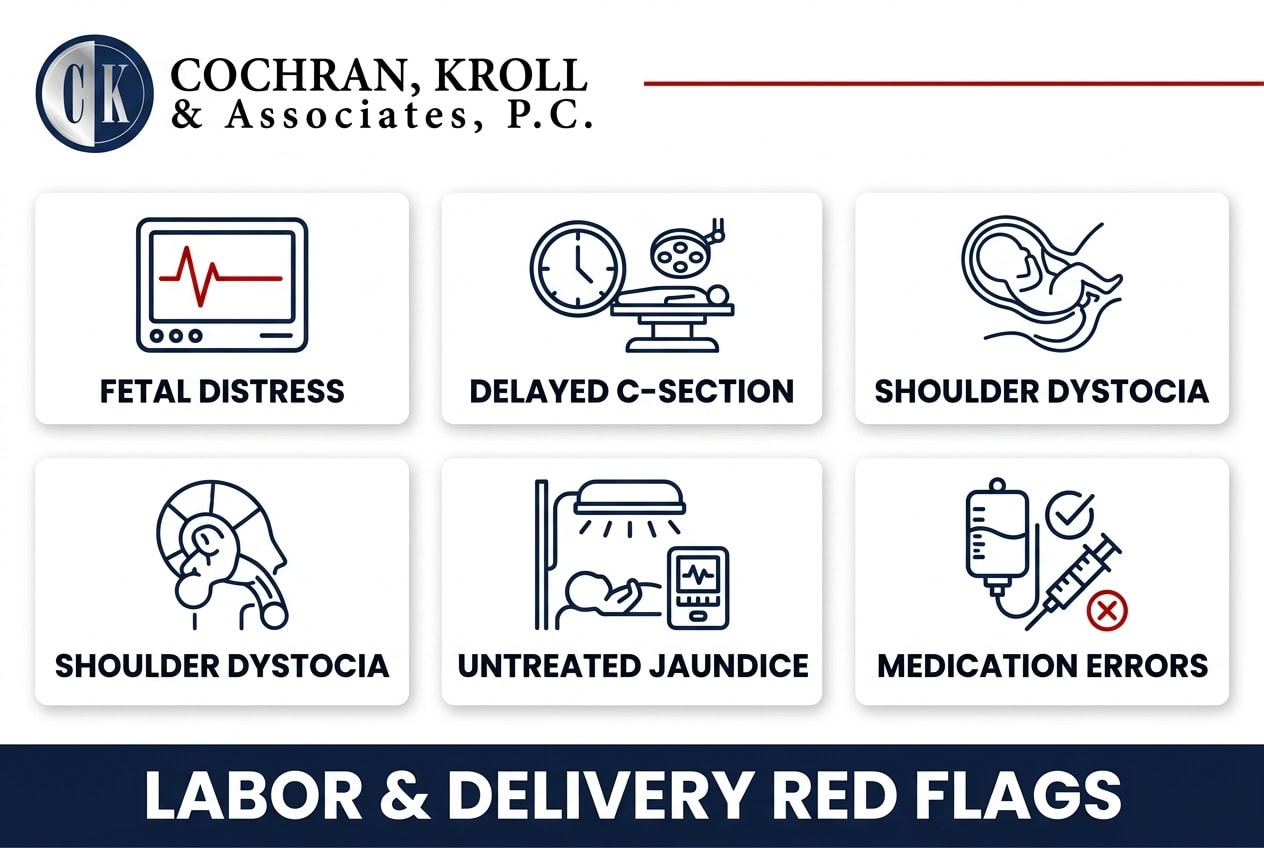
Medical negligence cases involving cerebral palsy frequently follow several common patterns. We often see instances where medical staff fail to identify or act upon signs of fetal distress shown on heart monitors, or where a cesarean section is delayed despite non-reassuring tracings. Other frequent errors include the mismanagement of shoulder dystocia, failing to treat jaundice before it develops into kernicterus, the introduction of infections during the labor process, and the incorrect use of medications to induce labor.
Each pattern leaves a documentary fingerprint inside the labor and delivery chart. Our review focuses on identifying that fingerprint before any outside expert is retained.
Why Livonia Families Choose Our Five Mile Road Office for CP Cases
Cerebral palsy litigation is some of the most clinically dense work the firm does. Our home office in Livonia means the attorney handling your case is the attorney you meet at intake and the attorney who sits at the counsel table during depositions. There is no referral network and no handoff.
Eileen Kroll’s nurse training shapes every case review. The firm has invested decades in building the medical literacy required to litigate these matters effectively. Our $15.8 million verdict in a Michigan cerebral palsy case is one of the largest displayed results in the practice area, and while past results do not guarantee future outcomes, they reflect the kind of preparation we bring.
Families who prefer to meet in person are welcome at the office. Families who cannot travel because of caregiving demands can meet by video or phone. We adjust to the family, not the other way around.
Compensation for Cerebral Palsy in Michigan
Cerebral palsy is a lifelong condition, and a successful malpractice claim is designed to fund the entire arc of a child’s needs. Damages can include medical expenses across the lifetime, physical and occupational therapy, speech therapy, adaptive equipment such as wheelchairs and communication devices, special education costs, paid caregiving, home modifications including ramps and lifts, and lost future earning capacity.
Non-economic damages compensate for pain, lost developmental milestones, and the family impact of the diagnosis. Michigan caps non-economic harms, with a higher cap for catastrophic injuries that include permanent neurological damage. Financial compensation for economic losses is not restricted by the state-mandated cap. Past results from the firm represent the range these cases can reach.
How a Cerebral Palsy Lawyer Livonia Reviews Your Child’s Medical Records
Eileen Kroll’s review of a cerebral palsy case is methodical. She reads the prenatal records to understand baseline risk factors. She reads the labor admission note and the contraction pattern. She reads the fetal heart strip line by line, tracking baseline, variability, accelerations, and decelerations against the time the staff was actually in the room.
She compares the nursing flowsheet against the physician’s progress notes. She reads the NICU admission note, the cooling protocol records if hypothermia therapy was used, the neonatal seizure documentation, and the discharge summary. The pattern that emerges from that review tells us whether to file.
Our review work is shared with the family. We do not hide the chart behind technical language. If the records support a claim, we explain why. If they do not, we explain that just as clearly during the free consultation.
Filing a Cerebral Palsy Lawsuit in Michigan: What You Need to Know
Michigan extends the statute of limitations for minors injured by medical malpractice, but the practical timeline matters more than the calendar limit. Records must be gathered, the Notice of Intent must be served at least 182 days before suit is filed, and an Affidavit of Merit from a same-specialty obstetric expert must accompany the complaint.
After the complaint is filed, discovery follows: written interrogatories, depositions of the labor team, and expert disclosures. Most cerebral palsy cases involve a life care planner who builds the projected lifetime needs into the damages model. More general malpractice FAQs are on the firm’s site, and we will walk you through the specifics during intake.
Signs Your Child’s Cerebral Palsy May Have Been Preventable
Some labor histories raise the question of preventability long before a formal diagnosis is in hand. Patterns to look at include an emergency during labor, a documented decision to proceed to cesarean section that did not happen for an extended period, low Apgar scores at one and five minutes, an unplanned NICU stay, neonatal seizures within the first 24 hours of life, abnormal cord blood gases, and MRI findings consistent with hypoxic-ischemic injury.
None of these markers proves malpractice on their own. Together, in the right combination, they invite a closer look at what the labor team actually did with the information available to them. Bringing the records to a nurse-attorney consultation is the fastest way to find out.
How CP Cases Move Through the Wayne County Courts
Most of our cerebral palsy filings end up in Wayne County circuit court because the firm is headquartered there. After the Notice of Intent period, we file the complaint and the Affidavit of Merit. Discovery typically runs 9 to 15 months. Mediation usually follows discovery and produces a settlement in the majority of cases.
Cases that do not settle proceed to trial. The firm’s approximate 95% settlement rate reflects the level of preparation we bring before any negotiation begins. We treat trial as the default. Settlement is what happens when the defense recognizes that we are ready for it.
Contact Our Cerebral Palsy Lawyers in Livonia
If your child was diagnosed with cerebral palsy following a difficult birth, medical negligence may be to blame. Families in Livonia deserve to know the truth about what happened and to secure the resources their child needs for a lifetime of care.
Contact us at Cochran, Kroll & Associates, P.C. for a free consultation. We’ll review your case, explain your options, and map out the strongest path forward. Remember, we don’t get paid unless you win.
Call us at 1-866-MICH-LAW anytime, 24/7, to schedule a free case evaluation.
Frequently Asked Questions About Cerebral Palsy Lawsuits in Livonia
How do I know whether my child's cerebral palsy was caused by medical malpractice?
You will rarely know from medical records alone. The labor and delivery chart needs to be read against the accepted obstetric standard of care, and the imaging needs to be reviewed against what a careful clinician would have done with the information available at the time. Our nurse-attorney review answers that question after the records are gathered.
What is the statute of limitations for a cerebral palsy case in Michigan?
Michigan extends the deadline for cases involving minors, but the practical window is shorter than the calendar suggests. Notice of Intent must still be served at least 182 days before filing. Coming in early gives the investigation room to breathe and protects evidence that gets harder to retrieve over time.
How much does it cost my family to bring a cerebral palsy lawsuit?
Nothing upfront. Our firm works on contingency. You pay no attorney fees during the case and only a percentage of the recovery if we win. Litigation costs, including expert review and life care planning, are advanced by the firm during the case.
What compensation can a CP lawsuit recover for my child's lifetime needs?
Compensation can fund medical care, therapy, special education, adaptive equipment, home modifications, paid caregiving, and lost future earnings. A life care planner builds the projected lifetime cost into the damages model. Specific values depend on the severity of the disability and proof strength, not formulas.
How long does a cerebral palsy lawsuit usually take?
Most Michigan CP cases run 18 to 30 months from Notice of Intent through resolution. Complex cases that proceed to trial or that involve a structured settlement of future damages can take longer. We give realistic timelines at intake.
Can I still file a lawsuit years after my child was born?
Often, yes, because Michigan extends the statute for minor plaintiffs. Many cerebral palsy diagnoses are not formally confirmed until the child has missed multiple developmental milestones. The extended timeline exists for that reality. Bring the records you have, even if they go back years, and we will walk you through them.