Long Term Disability Lawyer in Ann Arbor
A long-term disability lawyer handles denied, delayed, or terminated LTD insurance claims. In Ann Arbor, most employer-provided LTD plans fall under the federal ERISA statute, which has strict rules and deadlines. Also, an experienced LTD attorney reviews your policy, builds your record, files appeals on time, and litigates in federal court if needed. Furthermore, Michigan’s ban on discretionary clauses gives claimants a real advantage in ERISA cases.
At Cochran, Kroll & Associates, P.C., we represent Ann Arbor workers whose LTD claims have been denied, delayed, or terminated. Attorney Eileen Kroll brings a registered nursing background to every case, allowing her to evaluate the medical evidence insurers try to use against you. Your consultation is free, and you pay nothing unless we recover your benefits.
Call 1-866-MICH-LAW any time, 24 hours a day, or submit a free case evaluation online.
How Long-Term Disability Insurance Works in Michigan
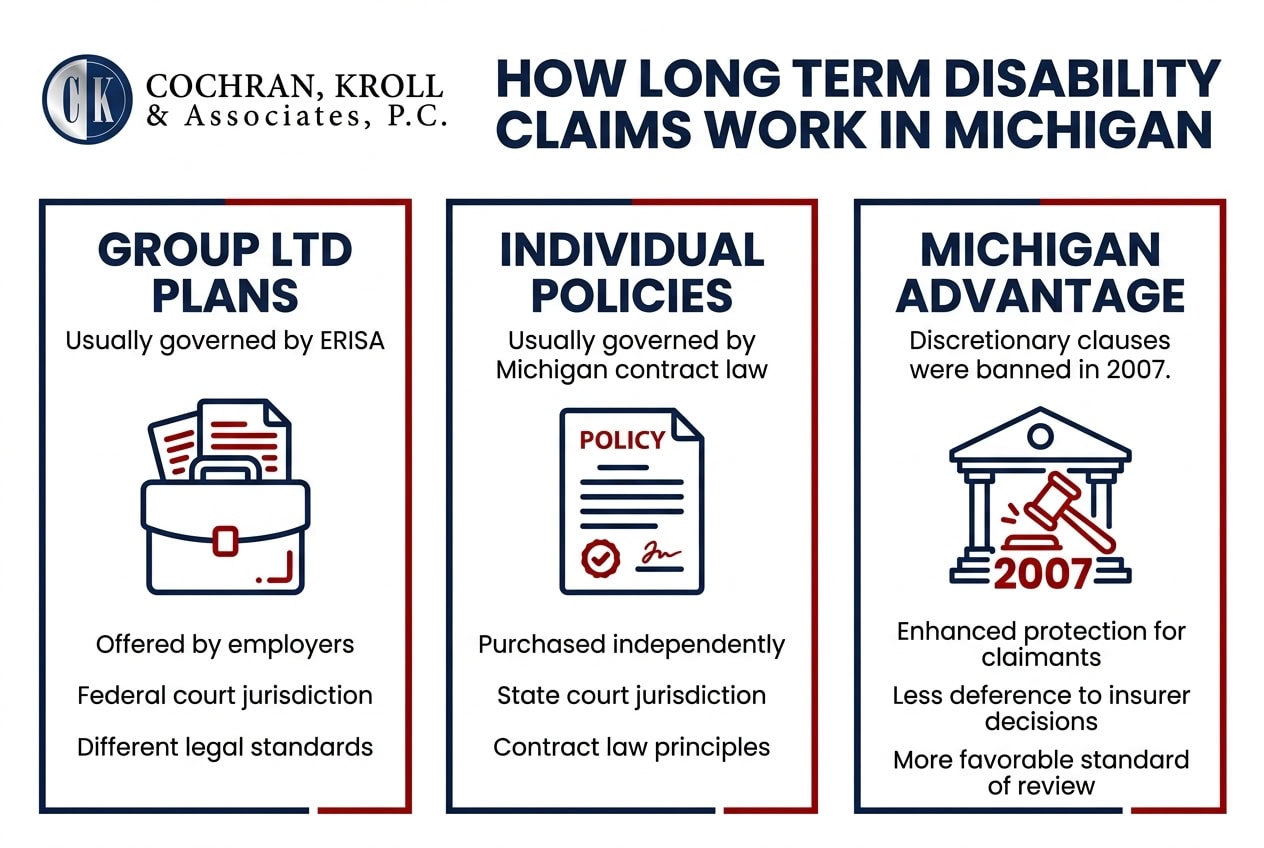
Group LTD Plans (ERISA) vs. Individual Disability Policies
This distinction drives your entire legal strategy. If you received your LTD coverage through an employer, your plan is almost certainly governed by ERISA, the Employee Retirement Income Security Act. ERISA is a federal statute, which means your case will be heard in federal court with a specific set of procedural rules that differ significantly from state court litigation.
Individually purchased disability policies are governed by Michigan state contract law instead. These cases generally allow broader evidence presentation and follow traditional state court procedures.
Knowing which type of policy you hold is the first thing we determine during your free case evaluation. It affects everything from appeal deadlines to courtroom strategy.
The ‘Own Occupation’ to ‘Any Occupation’ Shift
Most LTD policies pay benefits for the first 24 months based on whether you can perform your own occupation, meaning the specific job you held before your disability. After those 24 months, the policy definition typically changes to any occupation, meaning you must prove you cannot perform any job in the national economy.
This transition is when the majority of LTD benefit terminations occur. The insurer will hire vocational experts who claim you can work some type of sedentary or light-duty position, even if no employer would realistically hire you given your medical limitations. We know how to challenge these vocational analyses because we have seen how they are constructed and where they break down.
Michigan’s 2007 Ban on Discretionary Clauses: A Real Advantage
Here is something most competitors barely mention, and it matters. In 2007, Michigan banned discretionary clauses in disability insurance policies. What does that mean in practice?
In most states, federal judges defer to the insurance company’s original decision when reviewing an ERISA denial. The judge only checks whether the denial was “reasonable,” even if they disagree with it. In Michigan, judges review the case de novo, meaning from scratch, with no deference to the insurer’s conclusion.
This gives Ann Arbor claimants a significantly better chance of winning in federal court compared to claimants in states where the insurer’s decision gets automatic respect. We use this advantage in every ERISA case we handle.
Why Do Insurance Companies Deny LTD Claims?
Denial letters tend to follow predictable patterns. Understanding the insurer’s playbook helps you see why each denial can be challenged.
| Denial Reason |
How We Challenge It |
| Insufficient medical evidence |
We gather comprehensive documentation from treating physicians, request updated functional assessments, and identify gaps that the insurer exploited |
| Biased IME reports |
We challenge the credibility and methodology of the examining physician, including their history of insurer-favorable opinions |
| Pre-existing condition exclusion |
We review policy language closely for misapplication and argue that the condition qualifies under proper interpretation |
| Own-occupation to any-occupation transition |
We counter vocational analyses with real-world evidence about your actual functional limitations |
| Mental health condition limitations |
We address the 24-month cap found in many policies and present evidence of ongoing, disabling symptoms |
| Surveillance evidence |
We contextualize surveillance footage to show it does not disprove disability |
| Missed policy deadlines |
We ensure all deadlines are met from the moment you hire us and address prior missed deadlines when possible |
| Insurer claims claimant can do sedentary work |
We present medical evidence showing that even sedentary work exceeds your functional capacity |
Attorney Eileen Kroll’s nursing background is particularly valuable here. She can evaluate medical records, identify where an IME physician’s conclusions contradict the clinical evidence, and help your treating doctors provide stronger supportive documentation. Our disability lawyers in Michigan bring this medical-legal combination to every case.
Medical Conditions That Support LTD Claims
Long-term disability claims arise from a wide range of medical conditions. We have handled claims involving each of the following:
- Musculoskeletal disorders: chronic back pain, degenerative disc disease, severe arthritis, failed back surgeries, and joint deterioration that prevents sustained physical activity.
- Neurological conditions: multiple sclerosis, Parkinson’s disease, peripheral neuropathy, epilepsy, and post-stroke impairments affecting mobility, cognition, or both.
- Autoimmune disorders: lupus, Crohn’s disease, rheumatoid arthritis, and fibromyalgia, all of which produce unpredictable flares that make consistent employment impossible.
- Cardiac conditions: heart failure, post-bypass complications, and arrhythmias that limit exertion and require ongoing monitoring.
- Cancer and treatment side effects: both the disease itself and the cognitive, physical, and emotional effects of chemotherapy, radiation, and surgery.
- Mental health conditions: major depressive disorder, severe anxiety disorders, PTSD, and bipolar disorder. Many LTD policies cap mental health benefits at 24 months, a limitation we know how to address.
- Cognitive impairments: traumatic brain injuries, early-onset dementia, and cognitive dysfunction from chronic illness or treatment.
Eileen Kroll’s clinical nursing experience means she understands the functional limitations each condition produces, not just the diagnosis codes. That clinical perspective translates directly into stronger medical evidence for your claim. Learn more about how our firm approaches personal injury cases across Michigan.
What Does It Cost to Hire a Long Term Disability Lawyer in Ann Arbor?
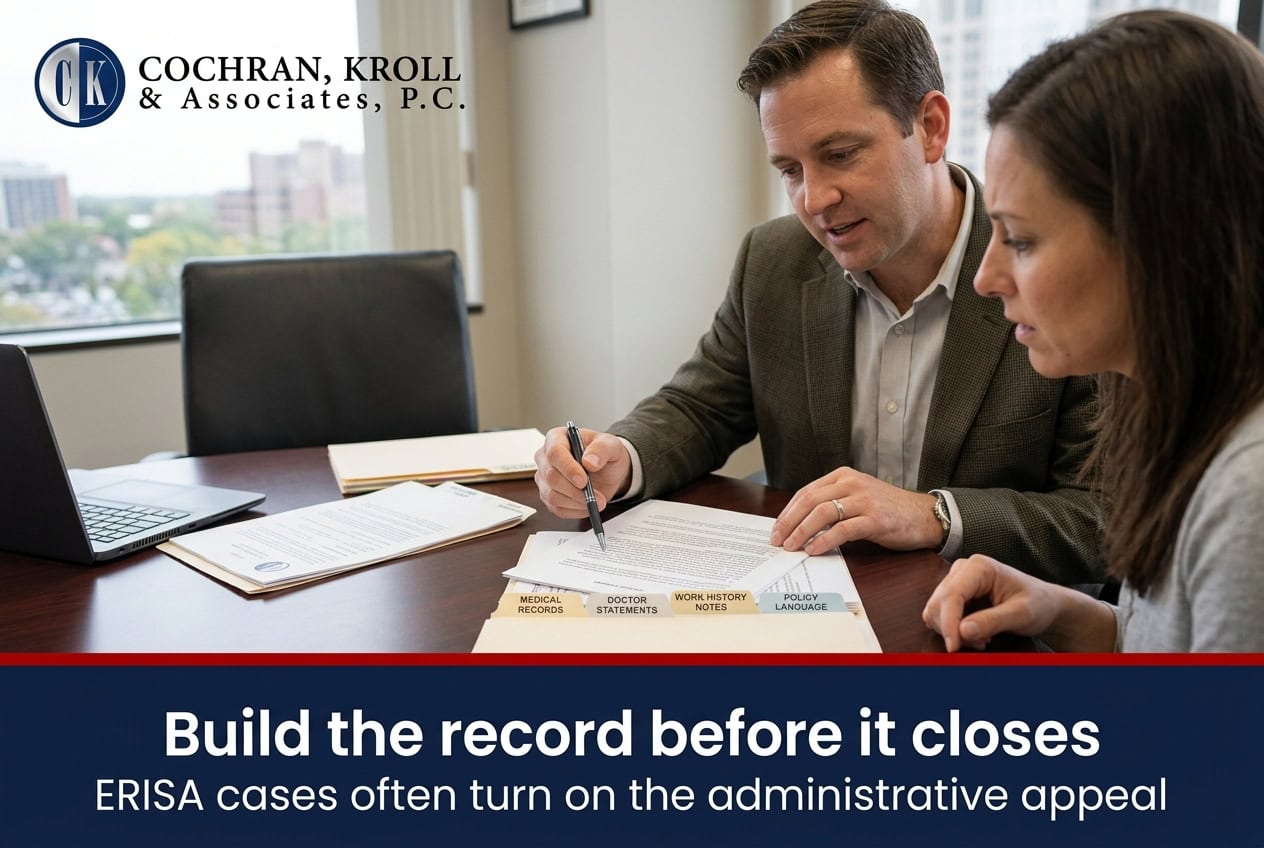
We handle every LTD case on a contingency fee basis, meaning we only collect a fee if we recover benefits for you. There are no hourly bills, no retainer payments, and no financial risk to get started.
We cover all case expenses during the process. Your free consultation comes with no obligation, and you will never receive an invoice unless your case succeeds.
Our position is straightforward: our skill and judgment justify our fee, not a bill sent before we have delivered results. Review our case results to see the outcomes we have achieved for Michigan clients.
Contact Our Long-Term Disability Lawyers in Ann Arbor
If your long term disability claim has been denied or delayed, you don’t have to accept that decision. Insurance companies routinely deny valid claims, and the right attorney can help you fight back.
Contact us at Cochran, Kroll & Associates, P.C. for a free consultation. We’ll review your case, explain your options, and map out the strongest path forward. Remember, we don’t get paid unless you win.
Call us at 1-866-MICH-LAW anytime, 24/7, to schedule a free case evaluation.
Frequently Asked Questions About LTD Claims in Ann Arbor
How long do I have to appeal a denied LTD claim in Michigan?
Under ERISA, you typically have 180 days from the date of denial to file an administrative appeal. Missing this deadline can permanently waive your right to challenge the denial. Individual policies may have different timeframes specified in the contract. Contact an attorney as soon as you receive a denial to protect your rights.
What separates an ERISA disability claim from a non-ERISA claim?
ERISA governs employer-sponsored group benefit plans. These cases are heard in federal court, the administrative record is usually the only evidence a judge reviews, and strict procedural rules apply. Non-ERISA claims involve individually purchased policies and are litigated under Michigan state contract law, which allows more flexibility in presenting evidence and arguments.
My doctor says I am disabled, so why was my LTD claim denied?
Insurance companies often prioritize their own medical reviewers over your treating physician. They may order an independent medical examination with a doctor who has a pattern of concluding that claimants can work. They may also selectively cite portions of your medical records that suggest improvement while ignoring the overall picture. An experienced LTD attorney helps bridge this gap by strengthening the record with detailed functional assessments from your treating providers.
What happens when my policy shifts from 'own occupation' to 'any occupation'?
After the initial benefit period (usually 24 months), most LTD policies require you to prove you cannot perform any occupation in the national economy, not just your previous job. Insurers use vocational experts to identify theoretical jobs you could supposedly perform. We counter these analyses by demonstrating that your actual functional limitations, medication side effects, and symptom variability make sustained employment unrealistic.
Are LTD benefits available for mental health conditions in Michigan?
Yes, but many LTD policies limit mental health benefits to 24 months. After that period, the insurer may terminate benefits even if your condition remains disabling. We review the specific policy language and, where possible, argue that co-existing physical conditions entitle you to continued benefits beyond the mental health cap.
How long does it typically take to resolve an LTD case?
Timelines vary significantly. An administrative appeal under ERISA may take several months. If the appeal fails and litigation is necessary, a federal court case can take a year or longer, depending on the complexity. We work to resolve claims as efficiently as possible, but we do not rush the process at the expense of building the strongest possible case.
Can I pursue LTD benefits if my employer pressured me to take a different position?
Potentially, yes. If your employer pressured you into a different role before or during your claim, that context can be relevant. The key question remains whether your medical condition prevents you from performing the duties defined in your LTD policy. We evaluate how the employer’s actions affected your claim and whether they can be used to strengthen your appeal or litigation.