Medical Malpractice Lawyer in Ann Arbor, Michigan
Few situations feel as disorienting as walking into an Ann Arbor hospital expecting competent care and leaving with a worse problem than you arrived with. When that happens, the question is not just medical; it is legal. Cochran, Kroll & Associates, P.C. represents patients and families throughout Washtenaw County who have been harmed by surgical mistakes, delayed diagnoses, medication errors, and birth trauma have harmed. Our Medical Malpractice Lawyer in Ann Arbor team is led by Terry L. Cochran and nurse-attorney Eileen E. Kroll, whose dual clinical and legal training has helped us secure verdicts and settlements that include a $15.8 million birth injury result. Call 1-866-MICH-LAW for a free consultation, or request a case review online, and we will reach out the same day.
Key Takeaways
- Michigan generally gives you two years from the date of malpractice, or six months from when you reasonably should have discovered it, to file a claim.
- Every malpractice complaint must be supported by a Notice of Intent and an Affidavit of Merit signed by a qualified medical expert.
- Our nurse-attorney reviews fetal strips, anesthesia records, and operative notes the way a clinician would, before any expert is retained.
- Recoverable damages can include past and future medical care, lost wages, pain and suffering, and loss of consortium for your spouse.
- Consultations are always free, and we do not charge a fee unless we recover money for you.
Why Do Ann Arbor Patients Need a Medical Malpractice Attorney?
Ann Arbor is one of the busiest medical hubs in Michigan. With Michigan Medicine, St. Joseph Mercy Ann Arbor, the VA Ann Arbor Healthcare System, and dozens of IHA and Trinity Health clinics inside the same city, patients here see more specialists per capita than almost anywhere else in the state. That density is usually a strength. When something goes wrong, it can also mean blurred handoffs, rushed residents, and a paper trail spread across multiple institutions.
Suing a hospital in Michigan is not the same as filing a routine personal injury claim. The Legislature has built in pre-suit steps designed to weed out weak cases, and missing any one of them can sink a strong case. That is why working with a Michigan medical negligence firm from day one matters more than it does in most other tort areas.
We act as the equalizer. Hospitals retain panels of in-house counsel and well-funded defense insurers. Our role is to apply the same level of preparation on the patient side, so the playing field is level by the time mediation or trial begins.
Understanding Michigan Medical Malpractice Laws
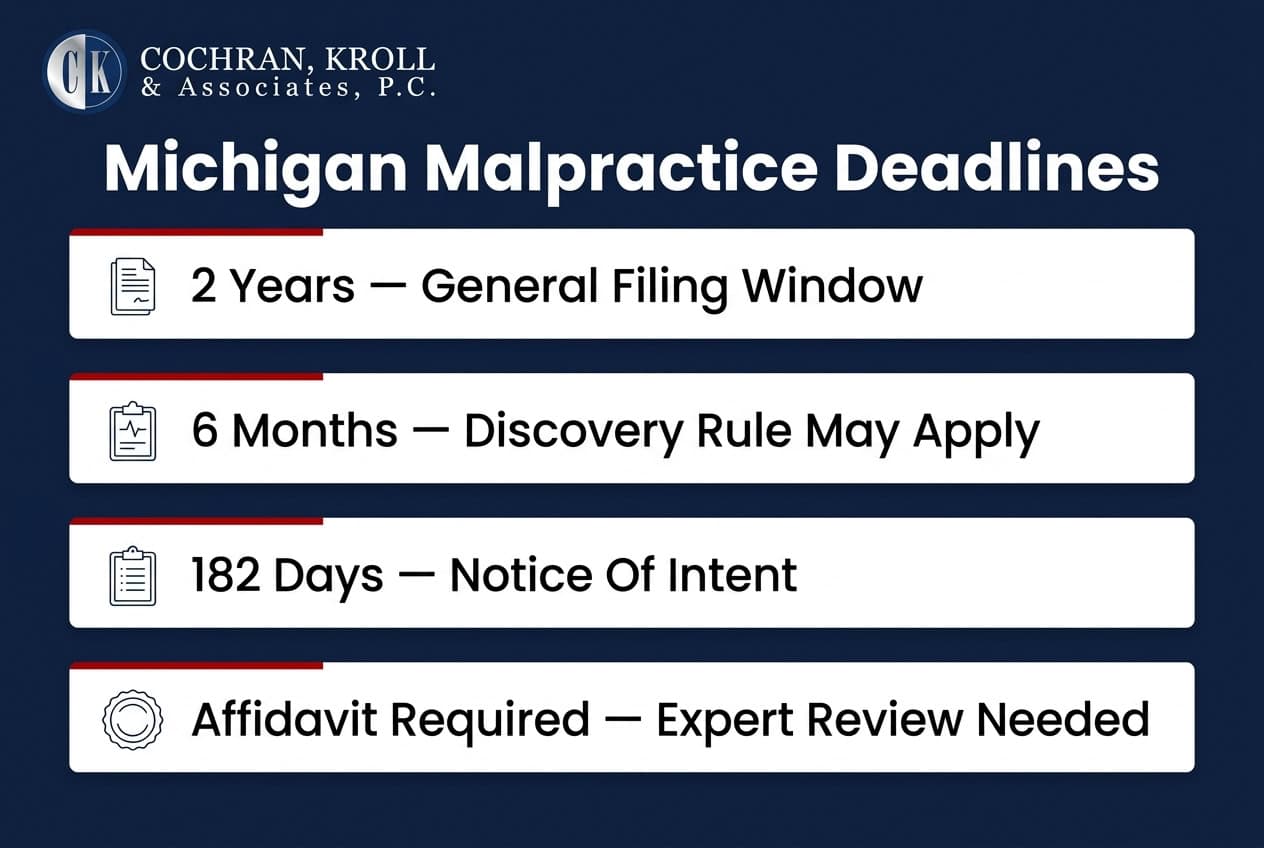
Michigan’s statute of limitations for medical malpractice is generally two years from the act or omission, with a discovery rule that can extend the deadline by up to six months from when a patient reasonably should have learned of the injury. Different timelines apply to minors and some wrongful death claims.
Before a complaint can be filed, the plaintiff must serve a Notice of Intent on each defendant at least 182 days in advance. The notice describes the standard of care, the alleged breach, the resulting injury, and the proximate cause. Cutting corners on the notice can lead to dismissal even when the underlying claim is strong.
An Affidavit of Merit must accompany the complaint. It is signed by a qualified expert in the same specialty as the defendant and confirms that the care provided fell below accepted standards. Michigan also caps non-economic damages, with the higher cap reserved for catastrophic injuries such as paralysis, brain damage, or reproductive loss.
What Types of Cases Do We Handle for Medical Malpractice Lawyer in Ann Arbor?
Our case files reflect the range of care delivered in Washtenaw County: complex academic surgical suites, emergency departments running near capacity, obstetric units, and outpatient diagnostic facilities. We accept cases that involve a clear breach of the standard of care and resulting harm that has changed your life or your family’s future.
Surgical Errors and Hospital Negligence
Surgical claims rarely turn on one obvious mistake. More often, they involve a chain of small decisions made under pressure: a missed pre-operative sign, an instrument count not reconciled, or a delayed response when a patient’s vitals shifted in recovery. We have handled cases involving retained sponges, wrong-site procedures, post-operative sepsis, and anesthesia awareness.
When the procedure took place at a teaching hospital, we looked closely at supervision logs and resident credentialing. Attending physicians cannot delegate responsibility for the standard of care simply because a learner was in the room.
Misdiagnosis and Delayed Diagnosis
Missed or delayed cancer diagnoses, untreated heart attacks in the emergency department, and incorrectly read imaging studies make up a large share of our docket. Our firm has recovered $9 million for a misdiagnosis client and $225,000 for a delayed cancer diagnosis, results that do not guarantee any future outcome but illustrate the kind of cases we take on.
The legal question is not whether the diagnosis was wrong, but whether a reasonably careful provider in the same specialty would have caught it. That is where clinical judgment meets legal proof.
How Does Eileen Kroll’s Nursing Background Strengthen Your Case?
Most plaintiff firms send medical records to an outside nurse consultant after intake. We start the clinical review on day one. Eileen E. Kroll is both a registered nurse and a Michigan-licensed attorney, and her training shapes how we look at every chart.
She reads fetal monitoring strips, anesthesia flow sheets, and nursing kardex entries the same way a clinician would. Patterns that an outside expert might overlook, such as a documented Category II tracing that quietly slid into a Category III, are flagged early. That early read often decides whether we accept a case and what theory we pursue.
Her dual perspective also helps families. Eileen can translate medical language into plain English at the kitchen table, then translate your story back into the technical proof a Washtenaw County jury needs to hear.
What Compensation Can You Recover in an Ann Arbor Medical Malpractice Claim?
Damages in a medical malpractice case fall into two broad categories. Economic damages reimburse you for objective financial losses tied to the negligence. Non-economic damages compensate for the harder-to-quantify ways the injury changed daily life.
Economic damages can include emergency and ongoing medical bills, future surgeries and therapies, prescription costs, lost income, diminished earning capacity, and home modifications when the injury changes how you move through your space. Non-economic damages cover pain, scarring, mental anguish, and the loss of partnership your spouse experiences when life looks different than it did before.
Approximately 95% of cases at our firm resolve through settlement rather than trial. We prepare every claim as if a Washtenaw County jury will hear it, which is what allows favorable settlement negotiations to happen. Past results, including our $15.8 million birth injury verdict, are summarized on our verdicts page and do not guarantee similar outcomes in any new matter.
How We Build a Winning Medical Malpractice Case
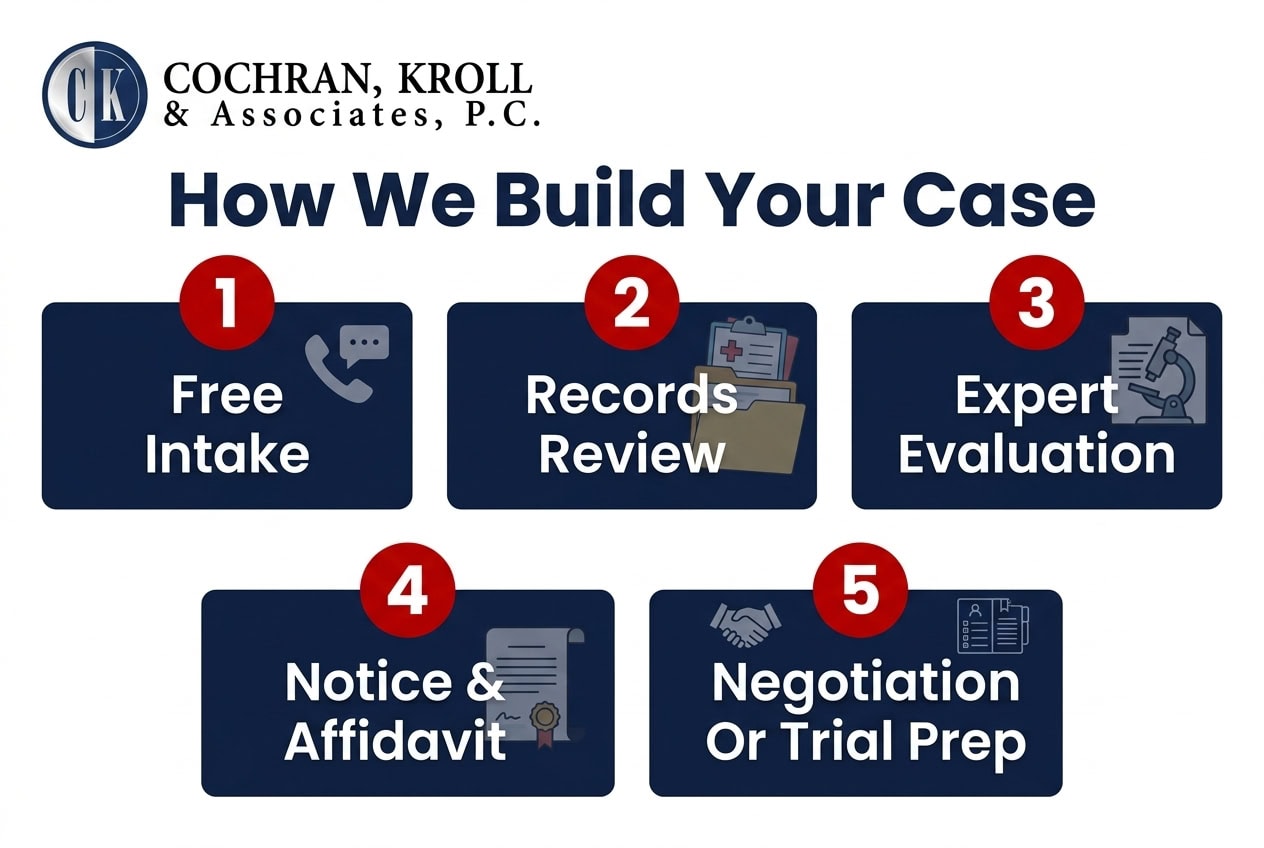
Our process is built around catching weak points before the defense does. The first step is a free intake conversation, either in person at our Livonia office, at your home in Ann Arbor, or by phone. We ask narrative questions and listen.
Next, we request and review complete records: hospital chart, imaging, lab values, billing details, and any device telemetry. Eileen Kroll personally reviews the clinical materials and notes deviations from the standard of care. We then retain a specialty-matched expert to evaluate liability and causation.
If the case has merit, we serve the Notice of Intent, prepare the Affidavit of Merit, and file it in the appropriate Michigan circuit court. Discovery, depositions, and mediation follow. By the time we sit across from the defense, the firm has invested months of clinical and legal work on your behalf. Most cases resolve in the 18 to 24 month range, although complex matters can take longer.
What Should You Do After Experiencing Medical Malpractice in Ann Arbor?

If you suspect that a recent treatment caused or worsened an injury, the first move is medical: get a second opinion from a provider unaffiliated with the original team. Untreated injuries get harder to compensate for the longer they go unaddressed.
Next, request your complete medical records. Hospitals are required to provide them, and federal and state law sets timelines for production. Keep a contemporaneous journal of your symptoms, missed work, and out-of-pocket expenses.
Avoid signing any release or settlement offer from the hospital’s risk management department before talking with an attorney. Those documents are written to limit your options. A free consultation costs nothing and protects the time you have left to file under the statute.
Contact Our Medical Malpractice Lawyers in Ann Arbor
If you or a loved one was harmed by a medical error, you deserve answers and accountability. Doctors and hospitals have powerful legal teams protecting them, and you need an experienced attorney fighting just as hard on your behalf.
Contact us at Cochran, Kroll & Associates, P.C. for a free consultation. We’ll review your case, explain your options, and map out the strongest path forward. Remember, we don’t get paid unless you win.
Call us at 1-866-MICH-LAW anytime, 24/7, to schedule a free case evaluation.
Frequently Asked Questions About Medical Malpractice in Ann Arbor
How long do I have to file a medical malpractice claim in Ann Arbor?
Michigan generally gives you two years from the date of the malpractice or six months from the date you reasonably should have discovered it, whichever is later. There are exceptions for minors and some wrongful death claims. Because the Notice of Intent must be served 182 days before suit is filed, the practical deadline to talk to a lawyer is often well before the two-year mark.
What is an Affidavit of Merit, and why does my case need one?
An Affidavit of Merit is a sworn statement from a qualified medical expert who has reviewed the records and concluded that the care provided fell below the accepted standard. Michigan requires it to be filed with the complaint. Without it, the lawsuit can be dismissed. We arrange the expert review during the pre-suit phase so the affidavit is ready when we file.
Can I afford a medical malpractice lawyer if I'm out of work?
Yes. Our firm works on a contingency fee. You pay no attorney fees up front, and if there is no recovery, you owe no attorney fees at all. Litigation costs such as expert fees are advanced by the firm during the case. That structure is designed so that an injury that already takes your income does not also cost you legal representation.
Is a bad outcome the same as medical malpractice?
No, and the distinction matters. Surgery carries risk, and disease progression sometimes outpaces treatment. Malpractice exists only when a provider fails to meet the accepted standard of care for someone in the same specialty, and that failure causes injury. Our intake process is designed to draw that line honestly before you commit to filing.
Can I sue a teaching hospital or resident physician in Ann Arbor?
You can pursue claims against teaching institutions and the residents, fellows, or attendings involved in your care. Cases against university-affiliated hospitals can involve additional notice requirements and procedural rules, depending on the entity’s structure. We confirm the correct defendants and notice paths during pre-suit investigation.
How long does a medical malpractice case usually take?
Most Michigan medical malpractice cases resolve in 18 to 24 months from the Notice of Intent. Cases that require multiple specialty experts, involve newborn injuries, or proceed all the way to a Washtenaw County jury can take longer. We give you a realistic timeline at intake, not a sales pitch.