Detroit Rideshare Accident Lawyer
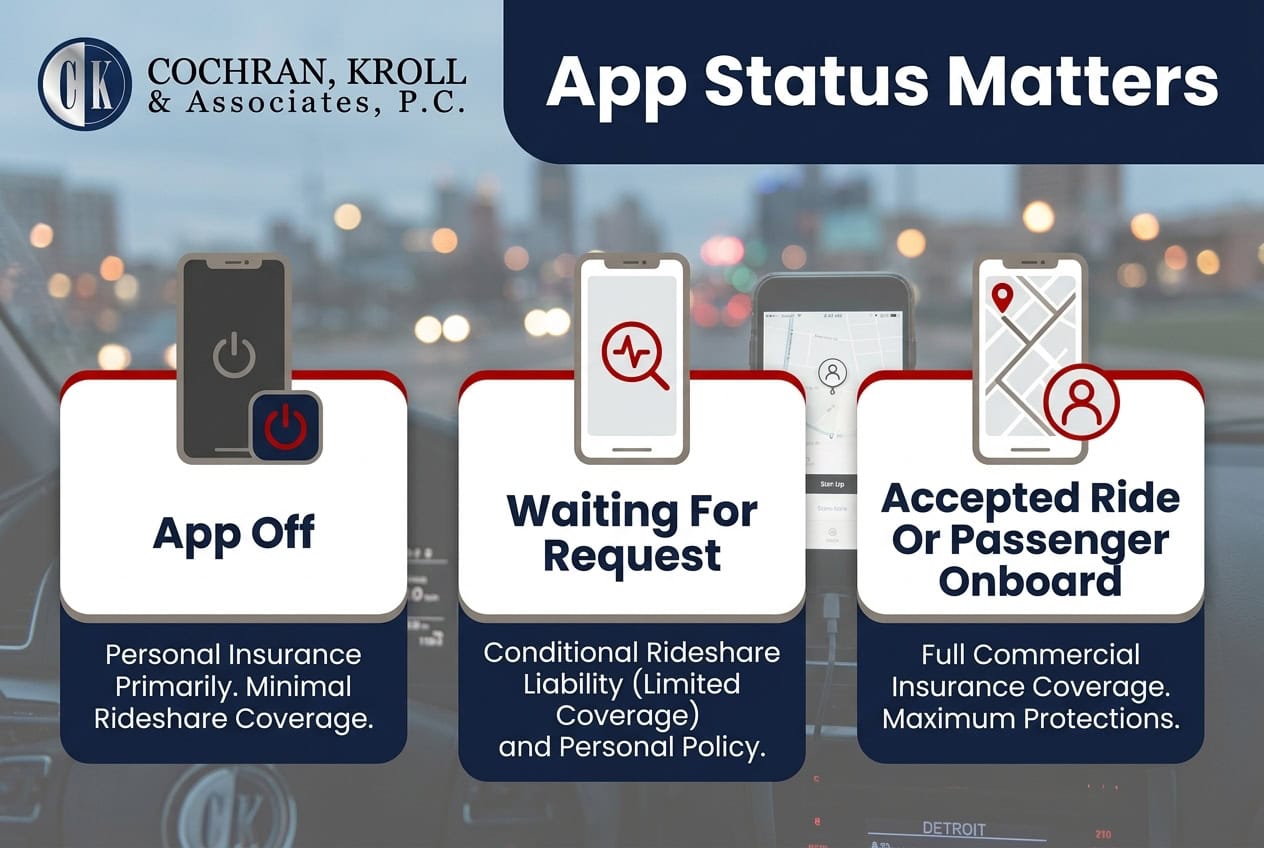
If you were hurt in a rideshare accident in Detroit, you may be entitled to compensation through Michigan’s no-fault insurance system and the rideshare company’s commercial policy. Coverage depends on the driver’s app status at the time of the crash, with up to $1 million available during active rides. A rideshare accident lawyer can identify every applicable insurance layer, meet critical filing deadlines, and pursue the maximum recovery on your behalf.
You requested a ride on your phone, got in the car, and expected to arrive safely. Instead, you ended up in an emergency room. Now you’re dealing with medical bills, missed paychecks, and a tangle of insurance policies that nobody seems willing to explain.
Rideshare accidents in Detroit are not handled like standard car crashes. Uber and Lyft each maintain layered insurance structures that shift depending on what the driver was doing at the exact moment of the collision. Stack Michigan’s no-fault rules on top of that, and you have a situation where even experienced adjusters look for ways to pass responsibility to someone else.
At Cochran, Kroll & Associates, P.C., we have spent decades helping Michigan residents cut through that confusion. Our personal injury attorneys know how rideshare insurance layers interact with Michigan’s no-fault system, and we know how to hold every responsible party accountable.
If a rideshare accident in Detroit left you injured, call 1-866-MICH-LAW for a free, no-obligation consultation. We only get paid if we win your case.
Michigan’s No-Fault Insurance Rules and Your Rideshare Claim
Michigan is one of a handful of states that runs a no-fault auto insurance system. That system gives rideshare accident victims certain guaranteed benefits, but it also creates procedural traps that can derail your recovery if you miss them.
What PIP Benefits Cover After a Rideshare Crash
Regardless of who was at fault, you can receive personal injury protection benefits that include coverage for all reasonable and necessary medical expenses, wage replacement at up to 85% of your gross income, payment for household tasks you can no longer perform (called replacement services), and attendant care if you need ongoing help with daily activities. These benefits exist to keep you financially stable while you recover.
The PIP Priority Order for Rideshare Passengers
Here is something most people never hear about until it’s too late. Michigan law assigns a specific order for which insurer pays your PIP benefits.
For rideshare passengers, that order is: first, your own auto insurance policy; second, a policy held by a spouse or resident relative; third, the rideshare company’s commercial policy; and fourth, the Michigan Assigned Claims Plan if no other coverage exists. Getting this order wrong means filing with the wrong company and watching your claim stall. We identify the correct priority insurer and file with the right party from day one.
The One-Year Written Notice Deadline You Cannot Afford to Miss
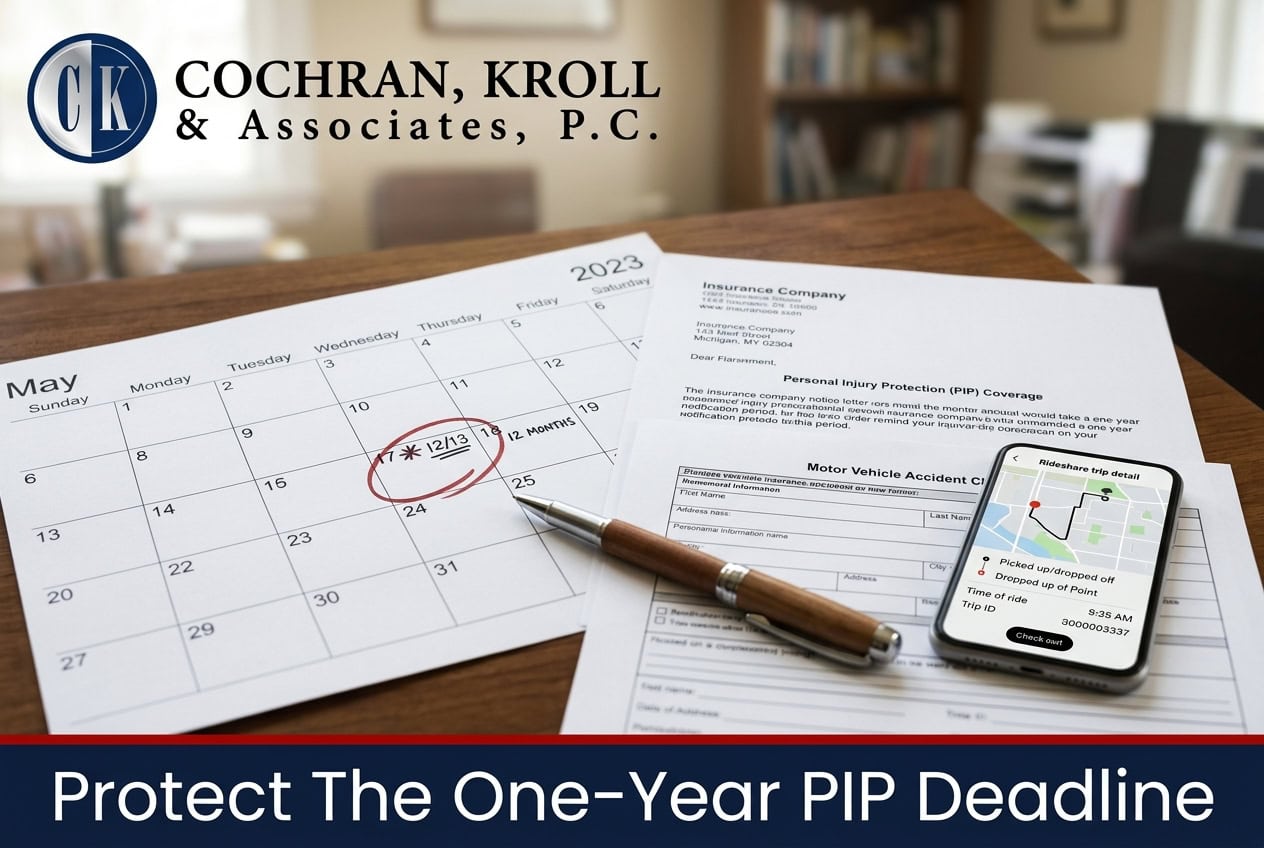
Michigan requires you to send written notice to the responsible insurance company within one year of incurring your first medical expense or wage loss. Miss that window, and you can permanently lose your right to PIP benefits.
This is one of the most common and costly mistakes rideshare accident victims make, especially when multiple insurers are involved, and nobody is sure who should receive the notice. Our firm tracks every deadline and sends notice to the correct insurer well before time runs out.
When You Can Pursue Pain and Suffering Damages
Michigan’s no-fault system limits your ability to sue for pain and suffering. To recover those damages, your injury must meet the serious impairment of body function threshold, result in permanent serious disfigurement, or result in death. That means your injury needs to affect your general ability to lead a normal life. Soft tissue strains that heal fully may not qualify, but conditions like traumatic brain injuries, herniated discs requiring surgery, or spinal cord damage often do. We evaluate whether your injuries clear this bar and build the medical evidence to prove it.
What Should You Do Immediately After a Rideshare Crash in Detroit?
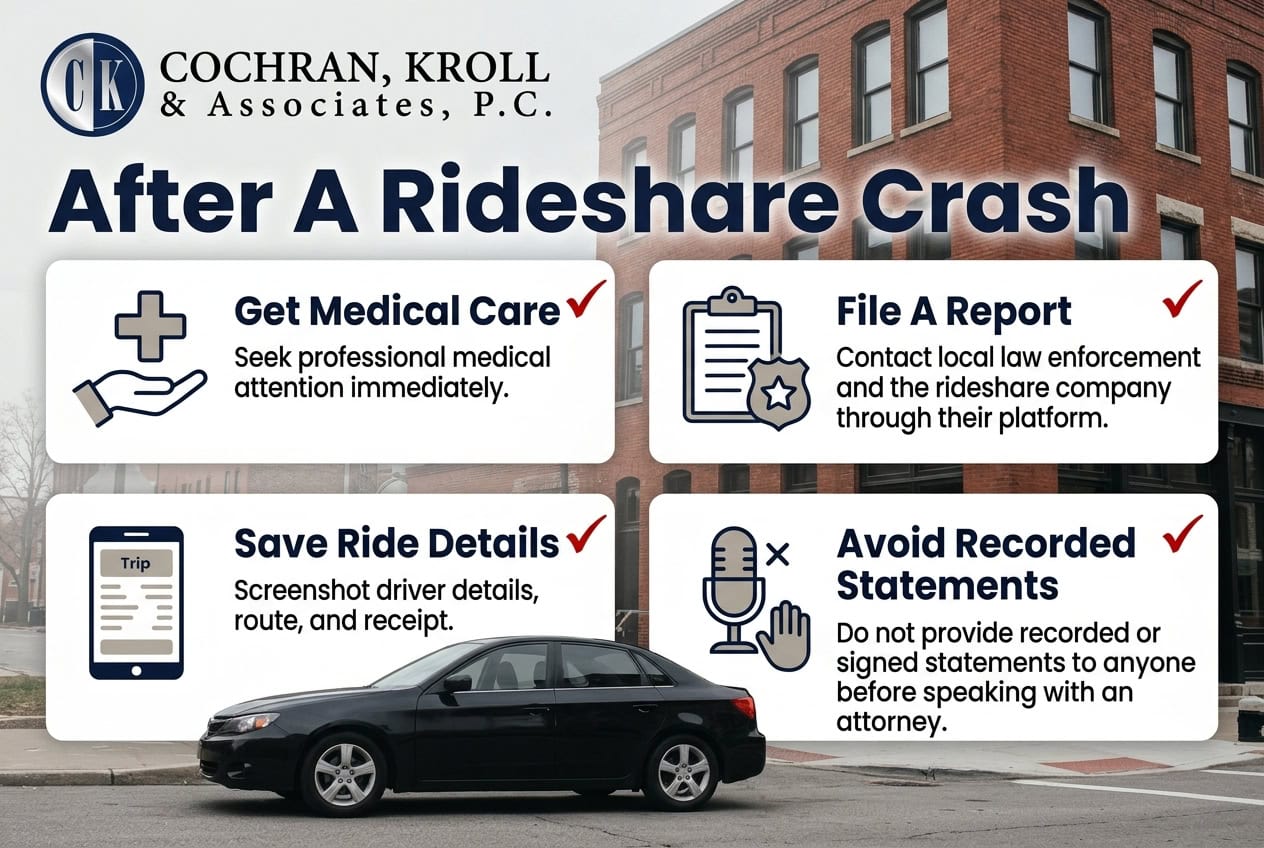
Get to a Doctor Within 24 Hours
Adrenaline masks pain. Injuries like whiplash, concussions, and internal bleeding may not produce symptoms for hours or days. Seek treatment at a Detroit-area hospital such as DMC Detroit Receiving Hospital, Henry Ford Hospital, or Beaumont Dearborn. That visit creates the medical paper trail your claim needs.
File a Police Report and Report Through the App
Call 911 or the local precinct to file a police report. Then open the Uber or Lyft app and use the “I was in an accident” feature. This creates a digital timestamp in the company’s system and triggers their insurance process. Both reports matter.
Capture and Preserve Your Evidence
Take a screenshot of your ride history, receipt, and trip details from the app before they become unavailable. Take photos of the scene, vehicle damage, road conditions, and any visible injuries. Collect contact information from the driver and any witnesses. This evidence disappears fast.
Do Not Give a Recorded Statement Without Legal Counsel
Insurance adjusters will contact you, sometimes within 48 hours. They are trained to get statements they can use to reduce or deny your claim. Do not provide a recorded statement until you have spoken with a lawyer. Call 1-866-MICH-LAW before responding.
What Compensation Can You Recover After a Rideshare Accident in Detroit?
Recovery after a rideshare crash in Detroit can come from two directions: no-fault PIP benefits and third-party negligence claims.
No-fault PIP benefits cover your medical expenses, wage loss (up to 85% of gross income), replacement services for household tasks you can no longer perform, and attendant care if you need ongoing assistance. These benefits apply regardless of fault.
If your injuries meet Michigan’s serious impairment threshold, you can also pursue a third-party claim for pain and suffering, emotional distress, loss of enjoyment of life, and future medical expenses. Vehicle damage and property loss are recoverable separately.
With up to $1 million in commercial coverage available during active-ride crashes, significant recoveries are possible. Our firm has secured results like a $3.3 million auto accident verdict in Tuscola County and a $1.4 million recovery for a pedestrian brain injury. We work to maximize every avenue of compensation available to you.
Where Do Rideshare Accidents Happen Most Often in Detroit?

Detroit’s rideshare demand runs heaviest in neighborhoods and corridors where nightlife, events, and airport traffic converge. Downtown, Midtown, and Corktown see constant Uber and Lyft activity, especially on weekends. Airport runs to and from DTW (Detroit Metropolitan Airport) generate long-distance trips on I-94 and I-275, where highway-speed collisions carry severe consequences.
Sporting events at Comerica Park, Ford Field, and Little Caesars Arena create surge-pricing zones where drivers rush to pick up and drop off passengers in congested areas. Entertainment districts like Greektown and the Foxtown area see rideshare vehicles double-parked, making U-turns, and navigating pedestrian-heavy streets.
High-traffic corridors where rideshare accidents are most common include I-94, I-75, the M-10 Lodge Freeway, Woodward Avenue, and Michigan Avenue. Lawsuits arising from these crashes are typically filed in Wayne County Circuit Court (3rd Circuit Court).
What Makes Cochran, Kroll & Associates Different for Rideshare Cases?
Eileen Kroll: A Registered Nurse Who Became an Attorney
Before she went to law school, Eileen Kroll worked as a registered nurse. That clinical training makes a measurable difference in rideshare accident cases. She can assess crash injuries like whiplash, traumatic brain injuries, spinal disc herniations, and soft tissue damage with a medical eye, not just a legal one. She knows when treatment records are incomplete, when an insurance company is minimizing a diagnosis, and when an injury is likely to require long-term care that adjusters conveniently ignore.
Decades Handling Michigan Auto Accident Claims
Our firm has handled vehicle accident cases across Michigan for decades. We understand how Michigan’s no-fault system interacts with rideshare insurance layers, and we know how to build third-party negligence claims that survive summary judgment motions. When insurance companies see our firm’s name on the demand letter, they know we prepare every case as though it is going to trial.
Contact Our Rideshare Accident Lawyers in Detroit
If you were injured in an Uber or Lyft accident, navigating the insurance claims process can be confusing and frustrating. Multiple parties may be involved, and having the right attorney in your corner makes all the difference.
Contact us at Cochran, Kroll & Associates, P.C. for a free consultation. We’ll review your case, explain your options, and map out the strongest path forward. Remember, we don’t get paid unless you win.
Call us at 1-866-MICH-LAW anytime, 24/7, to schedule a free case evaluation.
Frequently Asked Questions About Rideshare Accidents in Detroit
Can I sue Uber or Lyft directly after an accident in Detroit?
In most cases, injury claims are filed against the rideshare company’s insurance policy rather than against Uber or Lyft as a corporate entity. Because these companies classify drivers as independent contractors, direct lawsuits face significant legal barriers. However, their commercial insurance policies, which carry up to $1 million during active rides, are the primary recovery source in most claims.
What if I were a passenger and the Uber driver caused the crash?
As a passenger, you are in the strongest position of anyone involved. You were not driving and bear no fault. The Uber driver’s commercial coverage of up to $1 million applies, and you can also pursue PIP benefits under your own auto insurance (or through the priority order if you don’t have a policy). Our firm ensures you access every available source of recovery.
What is the statute of limitations for a rideshare accident in Michigan?
For personal injury claims, you generally have three years from the date of the accident to file a third-party lawsuit. However, the deadline for PIP benefits is different: you must provide written notice to the correct insurer within one year of your first medical expense or wage loss. Missing the PIP deadline can permanently eliminate a major part of your compensation.
What happens if the rideshare driver's personal insurance denies my claim?
This is common. Many personal auto policies exclude coverage when a driver is using their vehicle for commercial purposes, like rideshare work. When this denial occurs, the claim shifts to Uber’s or Lyft’s insurance policy based on the driver’s app status. Our attorneys determine which policy applies and pursue the claim against the correct insurer.
I was hit by an Uber driver while walking in Detroit. Do I have a claim?
Yes. Pedestrians struck by rideshare vehicles can pursue both PIP benefits and a third-party negligence claim. If the driver’s app was active, Uber’s or Lyft’s commercial insurance may apply. Michigan law also provides specific protections for pedestrians, including the presumption of no-fault PIP coverage regardless of which vehicle’s policy is in play.
What if I were a rideshare driver injured by another motorist?
As a rideshare driver, your claim path depends on your app status at the time. If you were on an active ride or heading to a pickup, Uber’s or Lyft’s commercial coverage may supplement your personal policy. If your app is off, your personal auto insurance is your primary source. Either way, you can pursue a third-party claim against the at-fault driver for pain and suffering if your injuries qualify.
How long do rideshare accident cases typically take to resolve in Wayne County?
Timelines vary. Straightforward claims with clear liability and documented injuries may settle within several months. Cases involving disputed coverage phases, serious injuries requiring ongoing treatment, or litigation in Wayne County Circuit Court can take one to two years or longer. We push for the fastest resolution possible without sacrificing the value of your claim.
What if both the rideshare driver and another motorist share fault for my crash?
Michigan’s modified comparative fault rules may apply to the third-party portion of your claim. If multiple parties share fault, liability, and damages are allocated accordingly. For your PIP benefits, fault does not matter at all because they are no-fault by design. Our attorneys investigate every party’s role and pursue compensation from all responsible sources.