Clinton Township Truck Accident Attorney
A collision with an 80,000-pound semi on Hall Road or Gratiot Avenue can change a Macomb County family’s life in seconds. A Clinton Township truck accident attorney at Cochran, Kroll & Associates, P.C. investigates the wreck, preserves evidence before it disappears, and pursues full compensation from every party at fault – with no fees until we win your case.
Call Toll-Free 24/7: 1-866-MICH-LAW | Get a Free Consultation
Why Truck Crashes Near Clinton Township Cause Such Severe Harm
A fully loaded tractor-trailer can weigh up to 80,000 pounds. The average passenger car weighs around 4,000 pounds. When those two meet on M-59, Groesbeck Highway, or the I-94 corridor that feeds freight into Macomb County, physics decides the outcome – and it is rarely kind to the smaller vehicle. Clinton Township sits in the middle of heavy commercial traffic: delivery routes off Hall Road, warehouses and distribution centers near Metro Parkway, and trucks moving constantly between the I-696 and I-94 interchanges.
Heavy trucks make up a small slice of registered vehicles, yet they account for a disproportionate share of Michigan’s fatal crashes, according to Michigan Traffic Crash Facts. The injuries we see in these cases reflect that force. Many of our clients arrive with traumatic brain injuries, spinal cord damage, crushed limbs, internal bleeding, or burns that demand months of treatment and rehabilitation.
Who Can Be Held Responsible After a Macomb County Truck Wreck

A car crash usually involves one other driver. A truck crash rarely does. Liability often reaches well beyond the person behind the wheel, and identifying every responsible party is what turns a modest claim into a full recovery. Depending on what our investigation uncovers, any of the following may share fault:
- The truck driver – for fatigue, speeding, distraction, or impaired driving.
- The trucking company – which can be vicariously liable for its driver and directly liable for poor hiring, training, or scheduling that pushes drivers past safe limits.
- The cargo loader or shipper – when an unbalanced or overweight load causes a rollover or jackknife.
- A maintenance contractor – if worn brakes, bald tires, or skipped inspections contributed to the crash.
- A parts manufacturer – when a defective component fails.
Trucking companies and their insurers know these layers exist, which is why they send investigators to the scene quickly. We build the same map of responsibility on your behalf, then hold each liable party to account.
How Michigan No-Fault Law Shapes Your Truck Accident Claim
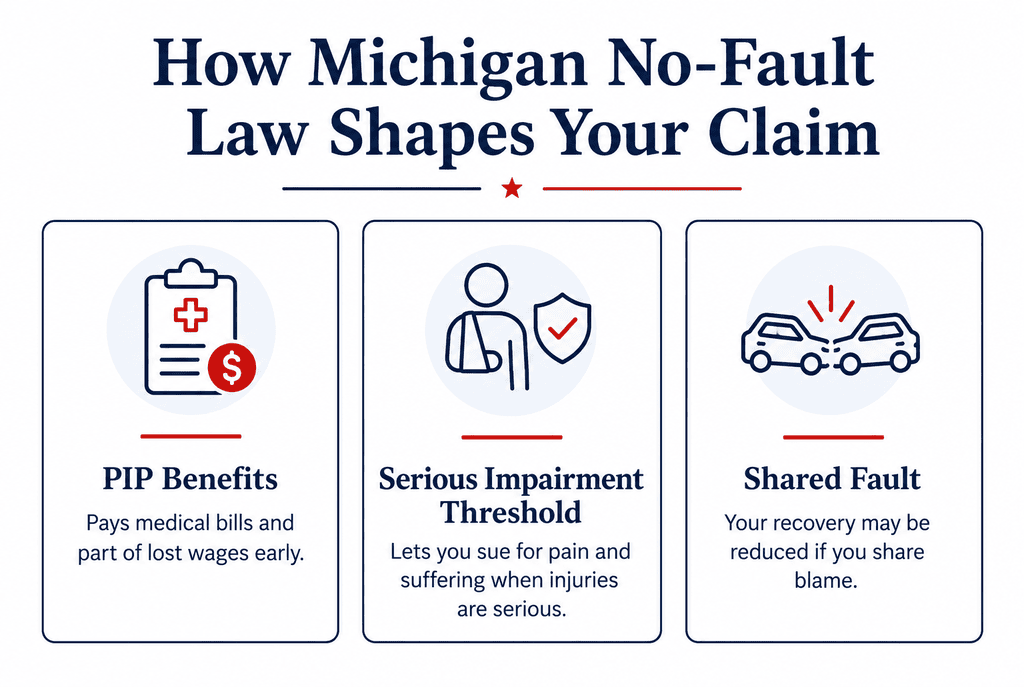
Michigan’s no-fault system is unlike almost any other state’s, and it changes how a truck accident claim works from day one. Understanding two statutes – and one rule about shared blame – helps you see what your claim is really worth.
PIP Benefits Pay Your Early Bills
Under Michigan no-fault, your own Personal Injury Protection (PIP) coverage pays reasonable and necessary medical expenses and a portion of lost wages regardless of who caused the crash. That coverage matters most in the chaotic weeks right after a serious truck collision, when bills arrive before any fault is sorted out. We make sure those benefits are opened correctly and not quietly cut off by an insurer looking to limit payouts.
The Serious Impairment Threshold That Lets You Sue
No-fault does not block you from suing the at-fault truck driver and company. When your injuries meet Michigan’s “serious impairment of body function” threshold under MCL 500.3135, you can pursue pain and suffering and other non-economic damages on top of your PIP benefits. The catastrophic injuries common in truck crashes frequently clear that bar, which is exactly why the trucking company’s defense team works hard to downplay how badly you were hurt.
How Shared Fault Affects Your Recovery
Michigan follows modified comparative fault. If you are found partly to blame, your award drops by your percentage of fault, and being more than 50 percent at fault for non-economic damages bars that portion of the recovery. Insurers lean on this rule constantly, arguing you were speeding or distracted to shrink what they owe. Careful evidence work is the best answer to that tactic.
The Crash Causes We Dig Into During Every Investigation
Most truck wrecks trace back to a preventable failure somewhere in the chain. Pinpointing the cause is what proves negligence. These are the patterns we look for, and the proof that tends to expose each one:
| Common Cause |
What We Look For |
| Driver fatigue |
Logbooks and electronic logging device records showing hours behind the wheel beyond federal limits |
| Hours-of-service violations |
Trip records compared against FMCSA driving-time and rest-break rules |
| Speeding or unsafe following |
Engine control module data, dashcam footage, and skid mark measurements |
| Improper or overweight loading |
Cargo manifests, weigh-station tickets, and loading records |
| Poor maintenance |
Brake, tire, and inspection histories from the carrier |
| Distracted or impaired driving |
Phone records, toxicology results, and post-crash citations |
Federal Hours of Service regulations limit most truckers to 11 hours of driving within a 14-hour window and require rest breaks, rules detailed in 49 CFR Part 395. When a driver or carrier ignores them, that violation becomes powerful evidence of negligence in your claim.
Evidence That Vanishes Fast – and How We Lock It Down
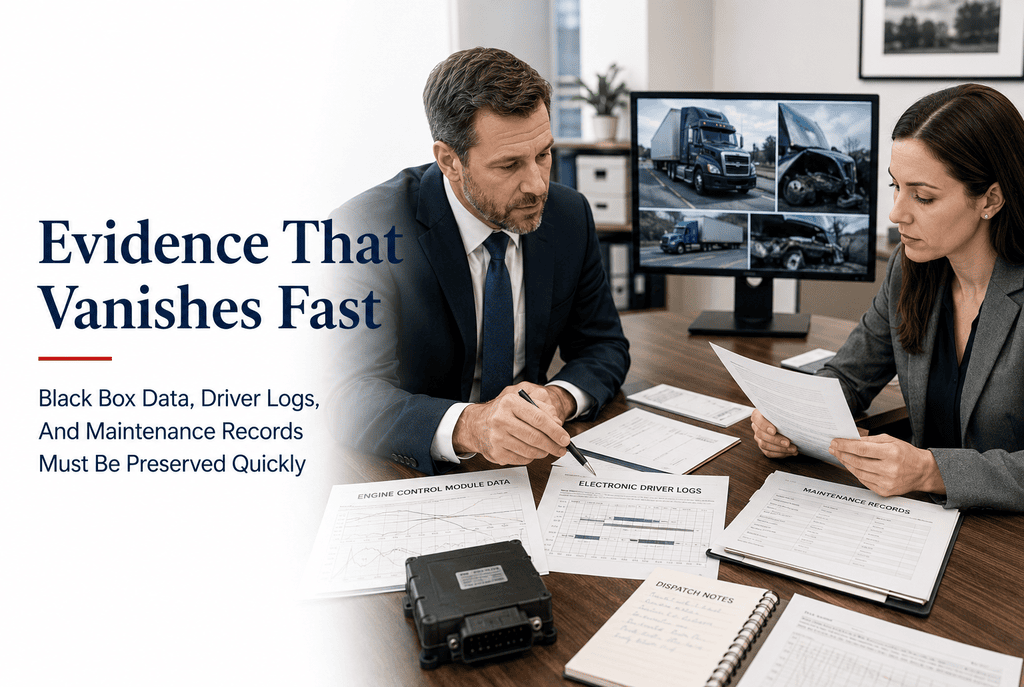
The most valuable proof in a truck case lives inside the truck and the company’s files, and much of it can legally be overwritten or destroyed within days. A semi’s engine control module records speed, braking, and throttle in the moments before impact.
Electronic logs, driver qualification files, dispatch records, and maintenance logs all tell part of the story. Once a routine retention period passes, that data can be gone.
We move quickly to send a spoliation letter – a formal legal hold demanding the carrier preserve everything relevant. The sooner we are involved after a Clinton Township crash, the more of this evidence survives to support your case. Waiting weeks to call a lawyer can quietly cost you the proof you need most.
Why You Should Not Speak to the Trucking Company’s Insurer Alone
Within hours of a serious crash, an adjuster for the trucking company may call sounding sympathetic and ready to help. Their job is to close your claim cheaply before you know the full extent of your injuries. A quick settlement offer often arrives before you have finished diagnosis, let alone learned what long-term care will cost.
Do not sign anything or give a recorded statement until you have spoken with an attorney who handles vehicle accident cases like yours. You may also be juggling a workers’ compensation claim if you were driving for work, or facing lost wages that strain your whole household. We deal with the insurers so you can focus on healing.
Compensation You May Recover in a Clinton Township Truck Claim
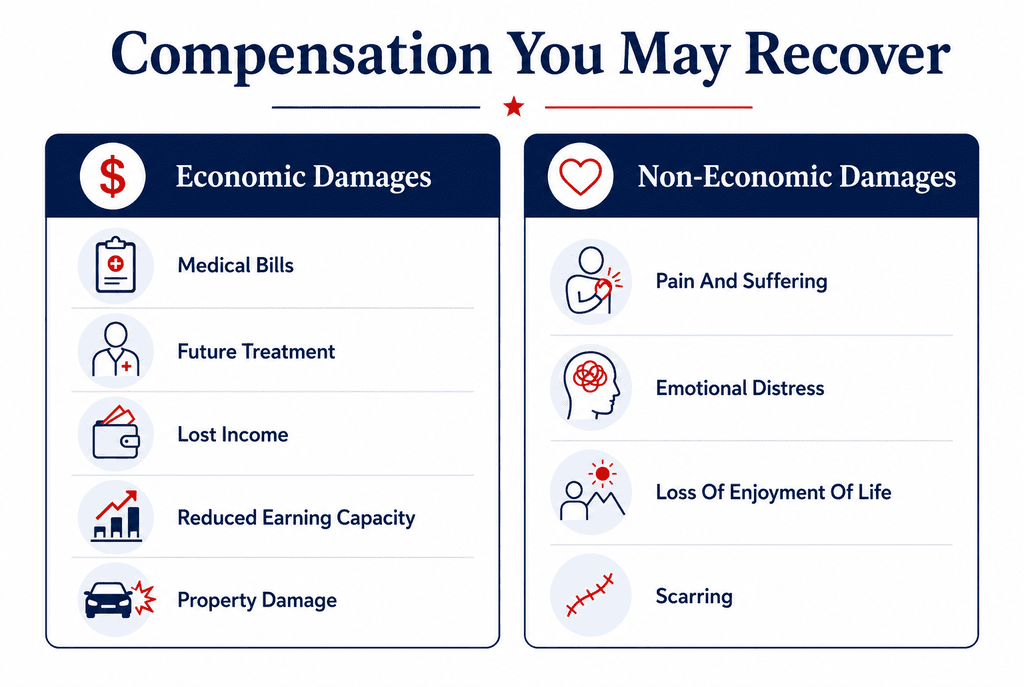
Every case is different, but a strong truck accident claim can pursue both economic and non-economic damages. Economic damages cover the hard numbers: medical bills, future treatment, lost income, reduced earning capacity, and property damage. Non-economic damages address the human cost – physical pain, emotional suffering, scarring, and the loss of activities you once enjoyed.
Our firm has secured meaningful results for crash victims across Michigan, including a $1.3 million settlement for a family whose child was killed by a semi. Past outcomes never guarantee future ones, but they reflect the seriousness we bring to each case. You can review more of our verdicts and settlements to see the range of cases we take on.
Losing a Loved One: Wrongful Death Claims
When a truck crash takes a life, Michigan law lets the family pursue a wrongful death claim. The personal representative of the deceased person’s estate files the claim and must notify family members within a set period after filing. This is a civil action, separate from any criminal case, and it seeks financial accountability for the loss. We handle these matters with the care they deserve while protecting the family’s legal rights.
Why Macomb County Families Trust Cochran, Kroll & Associates
Choosing the right firm shapes the outcome of your case. Since 1990, we have represented injured Michiganders against insurance companies and corporate defendants, and a few things set our work apart:
- A nurse-attorney on your side. Co-founder Eileen Kroll is both a registered nurse and a lawyer, giving our team an uncommon grasp of medical records, injuries, and treatment plans.
- No fees until we win. We work on contingency. There is no charge for your consultation and no fee unless we recover for you.
- A real results record. Decades of experience and multi-million dollar recoveries, with 95% of our cases resolved through settlement rather than a drawn-out trial.
- Available around the clock. Our toll-free line answers 24 hours a day, and we will meet you at home or in the hospital when travel is hard.
You can meet our attorneys and read more about why injured clients choose us before you ever pick up the phone.
Starting Your Case Is Simple
You do not need paperwork or a perfect memory of the crash to begin. Call our toll-free line or submit our contact form, tell us what happened, and we will explain your options at no cost. If we take your case, we start preserving evidence and handling the insurers right away. Whether your collision involved a semi, a delivery truck, or another commercial vehicle, the same principles that guide our Michigan truck accident and car accident work apply to your claim in Clinton Township.
Contact Our Truck Accident Attorneys in Clinton Township
If you were injured in a truck accident in Clinton Township, the recovery process can be long and the legal process even longer. You need an attorney who will go up against trucking companies and their insurers to get you the compensation you deserve.
Contact us at Cochran, Kroll & Associates, P.C. for a free consultation. We’ll review your case, explain your options, and map out the strongest path forward. Remember, we don’t get paid unless you win.
Call us at 1-866-MICH-LAW anytime, 24/7, to schedule a free case evaluation.
Frequently Asked Questions
How much does a Clinton Township truck accident attorney cost?
Nothing upfront. We work on a contingency fee, so there is no charge for your consultation and no fee unless we recover money for you. Our payment comes from the settlement or award at the end, not from your pocket along the way.
How long do I have to file a truck accident lawsuit in Michigan?
Michigan sets legal deadlines, known as the statute of limitations, for filing injury claims, and missing one can end your case before it starts. Deadlines vary by the type of claim and the parties involved, so the safest step is to speak with an attorney soon after the crash while evidence and witnesses are still available.
The trucking company's insurer already offered me money - should I take it?
Be cautious. Early offers usually arrive before the full cost of your injuries is known and tend to fall short of what your claim is worth. Once you accept and sign a release, you generally cannot reopen the claim. Have an attorney review any offer first, so you understand what you may be giving up.
Do you handle truck accident cases throughout Macomb County?
Yes. We represent injured clients across Macomb County and the wider Metro Detroit area, including crashes along Hall Road, Gratiot Avenue, Groesbeck Highway, and the I-94 and I-696 corridors that run through and around Clinton Township.
Why are truck accident claims harder than ordinary car accident claims?
Truck cases involve federal trucking regulations, multiple potentially liable parties, and specialized evidence such as engine data and driver logs that must be preserved quickly. The carrier’s insurer and defense team get involved fast, so these claims demand experienced handling from the very beginning.
Can I still recover if a loved one died in the crash?
Yes. Michigan law allows the personal representative of the estate to bring a wrongful death claim on behalf of surviving family members. It is a civil action that seeks financial accountability for the loss, and we guide families through each step with sensitivity and care.