Workplace Injury Lawyer in Sterling Heights, Michigan
Sterling Heights is one of Michigan’s largest manufacturing cities. Stellantis Sterling Heights Assembly, Ford, BAE Systems, and dozens of automotive suppliers all draw on a skilled workforce that takes real physical risk to keep the line moving. When that risk becomes an injury, the worker is usually the last person in the room thinking about both workers’ compensation benefits and a possible third-party lawsuit. Cochran, Kroll & Associates, P.C. handles both. Our Work Injury Lawyer Sterling Heights practice pairs decades of personal injury and workers’ comp experience with case results that include a $1.5 million construction injury recovery. Call 1-866-MICH-LAW for a free conversation about what happened on your shift.
Key Takeaways
- Workers’ compensation covers medical bills and partial wage replacement regardless of fault, but does not cover pain and suffering.
- A third-party claim against a non-employer party, such as a machine manufacturer or subcontractor, can run alongside the comp claim and add non-economic damages.
- Michigan requires injured workers to report an injury to the employer promptly; missing the reporting window can jeopardize benefits.
- Our firm investigates both paths during the free consultation, so you do not lose money by going down only one.
- We work on contingency for third-party claims and a statutorily limited percentage for comp matters. No upfront fees in either path.
Common Workplace Injuries Across Sterling Heights Industries
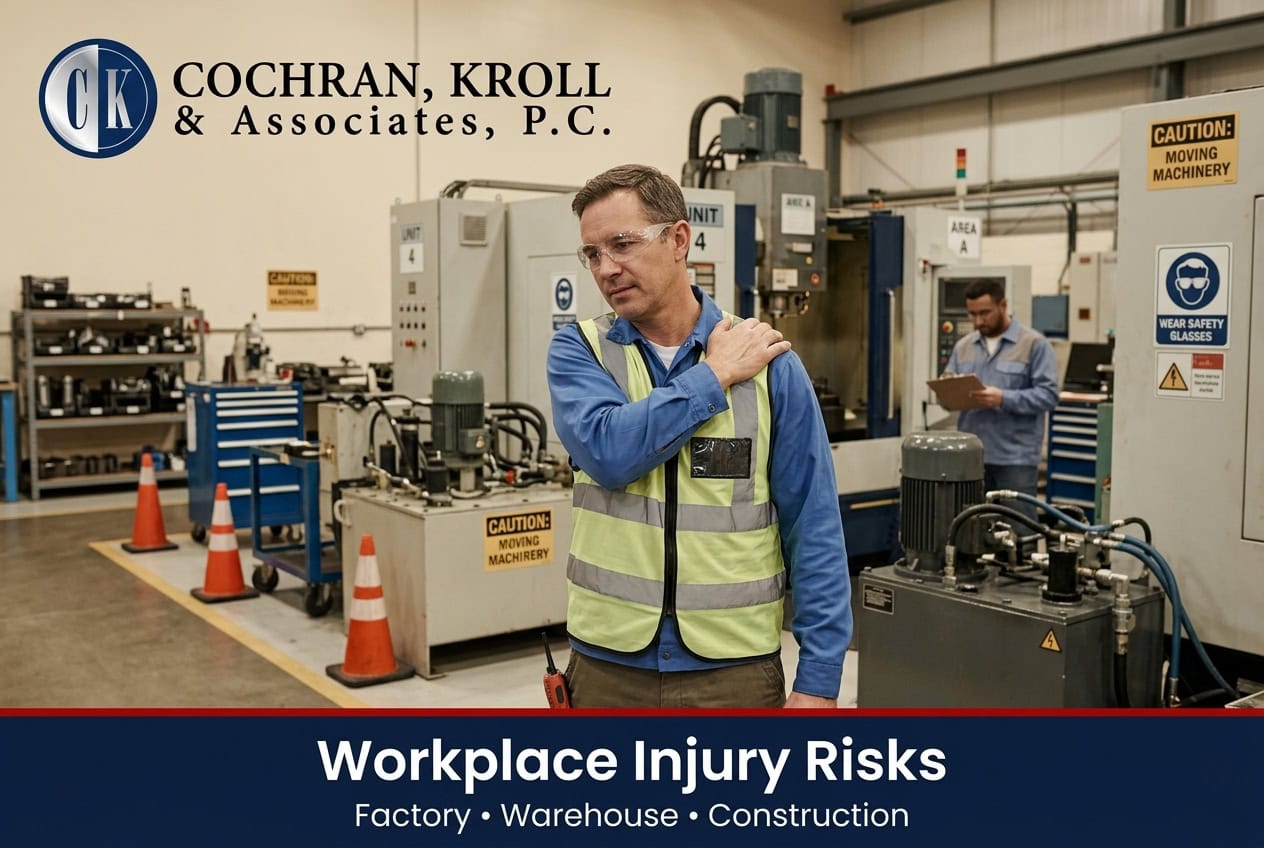
Sterling Heights’ industrial base produces a predictable injury mix. Automotive assembly workers face crush injuries from press equipment, lacerations from sharp metal, repetitive strain injuries to the shoulders and wrists, and acute hearing loss from prolonged exposure to high-decibel processes. Robotic cell incidents, while rare, tend to be severe when they happen.
Defense manufacturing workers can face hazardous material exposure, equipment malfunction, and burn injuries from welding and metalwork. Healthcare workers in Sterling Heights’ clinics and post-acute facilities face back and shoulder injuries from patient lifting, needle sticks, and exposure to infectious agents. Construction workers on residential and commercial sites face falls from height, struck-by injuries, and electrocution risk. Warehouse and logistics workers face forklift incidents, slip and falls on dock surfaces, and lifting injuries.
Each industry has its own pattern of who is responsible when something goes wrong, and that is where the dual-track comp and third-party analysis pays off.
Workers’ Compensation vs. Third-Party Injury Claims: What Sterling Heights Workers Should Know
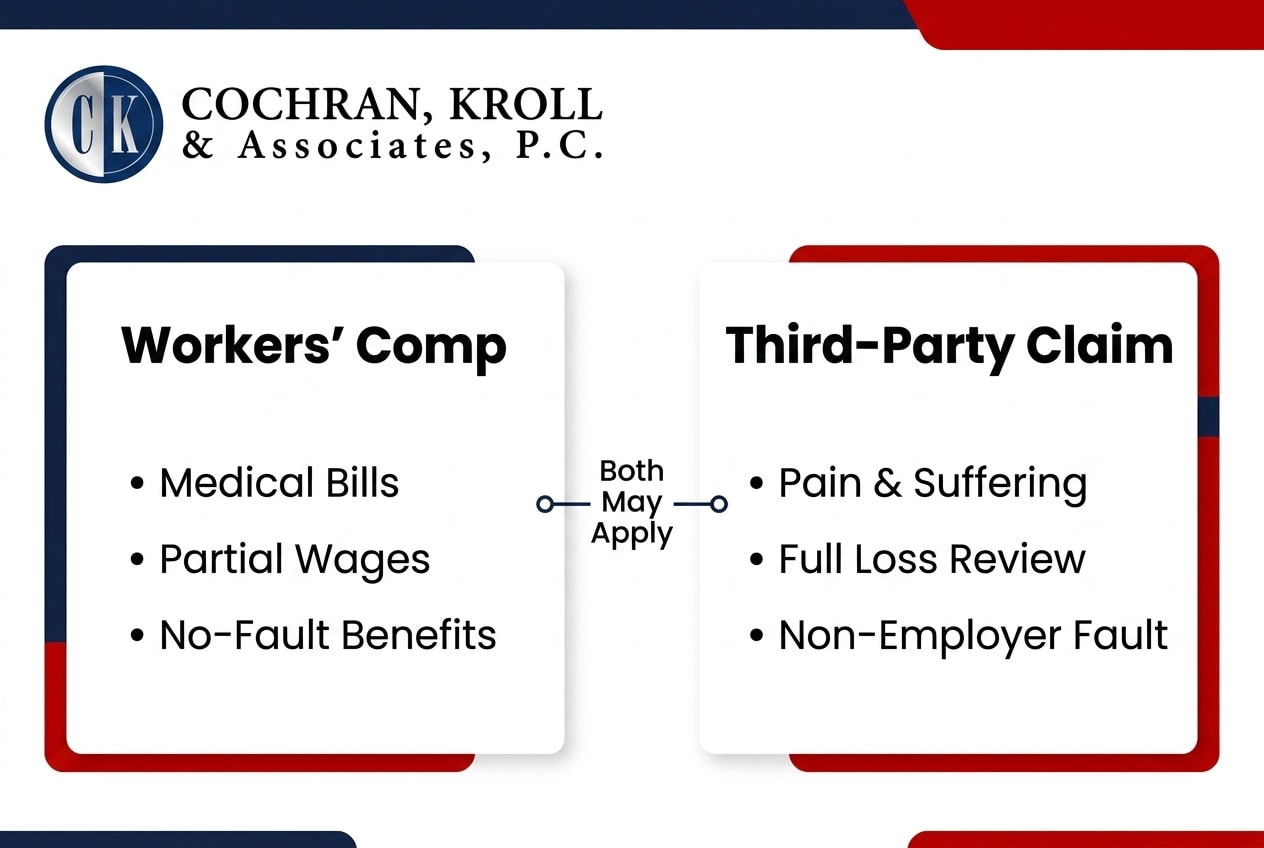
Michigan workers’ compensation is a no-fault system. Your employer’s comp insurer pays your medical bills and a portion of your lost wages, whether or not anyone was at fault for the injury.In return for these benefits, you are typically barred from pursuing a lawsuit against your employer for the accident.
Comp does not pay for pain, suffering, or loss of enjoyment of life. It pays bills and wages, period.
A third-party claim is a separate lawsuit against a party that is not your employer. The classic examples are a defective piece of equipment, a subcontractor working on the same jobsite, a property owner whose negligence contributed to the incident, or a delivery driver who hit you while you were working. Third-party claims allow recovery for pain and suffering and the full economic loss that Comp does not cover.
When You Can File a Third-Party Claim Beyond Workers’ Comp
The most common third-party paths we pursue for Sterling Heights workers involve defective machinery, unsafe conditions created by a subcontractor on a shared jobsite, vehicle crashes that happen during working hours, and toxic exposure to products manufactured by a non-employer. Michigan workers’ compensation and a third-party suit can run in parallel.
Coordinating both is not optional. Subrogation rules mean the comp insurer has a right to be reimbursed from any third-party recovery, but the math still leaves money for the worker when handled correctly. Doing only one and missing the other is a common reason that injured workers end up under-compensated.
Your Rights as an Injured Worker in Michigan
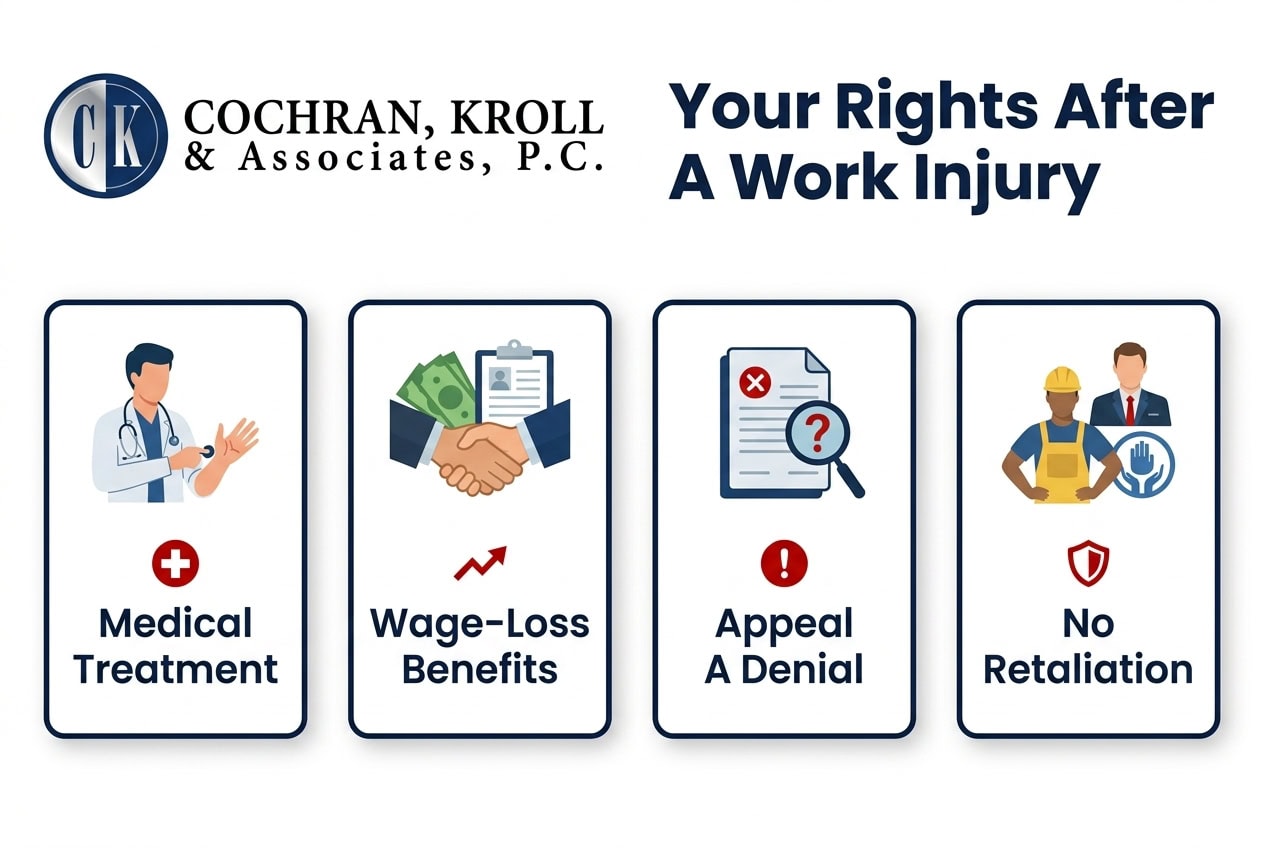
Michigan law gives injured workers important rights that employers and adjusters do not always advertise. You have the right to medical treatment for the work injury, paid for by the employer’s comp insurer. After an initial period of employer-directed care, you have the right to choose your own treating physician.
You have the right to wage-loss benefits when the injury prevents you from earning your prior wage. You have the right to vocational rehabilitation when the injury prevents you from returning to your prior job.If your claim is rejected, you maintain the legal right to pursue an appeal.
And you have the right to be free from retaliation by your employer for filing a claim. Retaliation is a separate cause of action with its own remedies.
Benefits Available Through Michigan Workers’ Compensation
Medical benefits cover reasonable and necessary care for the work injury, including emergency treatment, surgery, physical therapy, prescription medication, and assistive devices. Wage-loss benefits are calculated as 80% of the after-tax average weekly wage, capped at a maximum that adjusts annually.
Specific-loss benefits apply when a body part is permanently impaired, with statutory schedules for the loss of a hand, foot, finger, eye, or hearing. Vocational rehabilitation benefits cover retraining when the worker can no longer perform the prior job. Death benefits are available for surviving dependents when a workplace injury is fatal.
Our firm walks Sterling Heights workers through each category at intake. Most injured workers underuse the benefits they are entitled to because nobody at the comp insurer explained them.
How a Work Injury Lawyer Sterling Heights Builds Your Workplace Injury Case

We start with the worker’s account of the incident, the documents the worker still has, and any photographs from the scene. We request OSHA inspection reports if any have been opened, employer incident reports, witness statements, and the full medical record. Eileen Kroll’s nurse-attorney training shapes how we read the medical documentation, particularly in injuries involving spinal cord damage, repetitive strain, or chronic pain conditions.
From there, we identify any third-party defendants, file claims in the appropriate venues, and coordinate the comp benefits track. Most claims that move into litigation reach mediation or settlement within 12 to 24 months. Our track record of multi-million dollar workplace recoveries reflects the level of preparation we bring to even routine comp matters.
How a Denied or Underpaid Workers’ Comp Claim Gets Reopened
Comp insurers deny valid claims for several common reasons. The injury was characterized as a pre-existing condition. The reporting was deemed late. A surveillance investigator claimed to see the worker doing something inconsistent with the injury. None of those reasons is an automatic case-killer.
We file applications for hearing before the Michigan Workers’ Compensation Board of Magistrates, present medical evidence and witness testimony, and negotiate redemption agreements when a lump-sum settlement makes sense. If your benefits were cut off, reduced, or never started, the appeal process exists for a reason. Bring whatever paperwork you have to a free consultation.
What to Do in the First 72 Hours After a Sterling Heights Work Injury
Report the injury to your supervisor in writing as soon as it is safe to do so. Verbal reports get forgotten. A written report, even a text message, creates a record. Michigan law sets reporting windows that affect benefit eligibility.
Get medical care, even if the injury seems minor. Workplace injuries often look worse 48 hours later than they did at the time, particularly soft-tissue and head injuries. A documented urgent care or emergency department visit anchors the injury to the workplace event.
Take photographs of the equipment, the area where the injury happened, and any visible damage to your clothing or body. Get the names of any coworkers who saw what happened. Do not give a recorded statement to the comp insurer before talking to a lawyer.
Contact Our Work Injury Lawyers in Sterling Heights
If you were hurt on the job in Sterling Heights, your employer and their insurance company may not have your best interests in mind. A work injury attorney can help protect your rights and pursue every dollar of compensation you’re entitled to.
Contact us at Cochran, Kroll & Associates, P.C. for a free consultation. We’ll review your case, explain your options, and map out the strongest path forward. Remember, we don’t get paid unless you win.
Call us at 1-866-MICH-LAW anytime, 24/7, to schedule a free case evaluation.
Frequently Asked Questions About Workplace Injuries in Sterling Heights
What should I do immediately after a workplace injury in Sterling Heights?
Report the injury to your supervisor in writing, get medical care, and document the scene with photographs and witness names. Do not sign anything from the comp insurer before consulting a lawyer. A free consultation can be scheduled the same day in most cases.
Can my employer fire me for filing a workers' comp claim?
No. Retaliating against an employee for filing a workers’ compensation claim is unlawful in Michigan, and the wrongfully terminated worker has a separate cause of action. If you have been disciplined or terminated after filing, bring the documentation to a free consultation.
How long do I have to report a workplace injury in Michigan?
Michigan requires prompt notice to the employer, generally within 90 days, with shorter practical windows because adjusters use late reporting as a basis to deny claims. The sooner you report, the stronger the claim. Talk to a lawyer immediately if you have already missed an internal deadline.
Can I sue my employer for a workplace injury in Sterling Heights?
Generally, no, because workers’ comp is the exclusive remedy against the employer for most workplace injuries. You can pursue a third-party lawsuit against a non-employer whose conduct contributed to the injury, such as a manufacturer of defective equipment or a negligent subcontractor.
What happens if my workers' comp claim is denied?
A denial is not the end. You have the right to file an application for a hearing before the Workers’ Compensation Board of Magistrates. We handle those hearings routinely. Bring the denial letter, your medical records, and any correspondence to a free consultation.
How much does a workplace injury lawyer cost?
For workers’ comp matters, attorney fees are set by statute and paid out of the recovery, not out of your pocket. For third-party claims, we work on contingency. You pay no attorney fees up front, and only a percentage of the recovery if we win.