Detroit Workplace Injury Lawyer
A Detroit workplace injury lawyer helps injured employees get wage replacement, medical benefits, and other compensation after a work-related accident or illness. If your employer or insurer denied, delayed, or cut off your benefits, an attorney can challenge that decision and file an appeal. They can also represent you at every stage of the process. Furthermore, Cochran, Kroll & Associates offers a free case evaluation with no fees unless we recover compensation for you. If you have been hurt on the job, call 1-866-MICH-LAW for a free, no-obligation case evaluation.
Key Takeaways
- 90-day notification deadline: You must notify your employer within 90 days of your injury and file a formal claim within 2 years, or you risk losing your right to benefits.
- 80% wage replacement: Michigan law entitles most injured workers to 80% of their after-tax average weekly wage while they cannot return to work.
- A lawyer does what you cannot do alone: Attorneys negotiate with insurers, challenge IME doctor findings, independently calculate your true wage loss, and build the evidentiary record for an appeal.
- No upfront cost: Cochran, Kroll & Associates works on a contingency fee basis. You pay nothing unless we recover compensation for you.
- Two paths may be available: In some cases, you can pursue both a workers’ compensation claim AND a personal injury lawsuit, recovering damages that workers’ comp alone does not pay.
Who Files Workers’ Compensation Claims in Detroit?
Detroit’s economy makes it one of Michigan’s highest-risk metros for on-the-job injuries. Automotive manufacturing plants operated by Ford, GM, and Stellantis, large construction projects across Wayne County, warehousing and logistics operations, and healthcare settings all see significant numbers of work-related accidents every year. Wayne County consistently produces some of the highest volumes of workers’ compensation claims in Michigan, particularly in manufacturing and construction.
Workers’ comp covers full-time and part-time employees. What matters is not your job title or your hours, only that the injury was work-related. Delivery drivers hurt on the road, office workers who develop repetitive stress injuries, and warehouse employees caught in forklift accidents all may qualify.
Common Workplace Injuries We See in Detroit Cases
- Back and spinal injuries: from lifting, falls, or vehicle accidents
- Shoulder and rotator cuff injuries: from overhead or repetitive work
- Knee injuries: from kneeling, falls, or overexertion
- Carpal tunnel and repetitive stress injuries: common in assembly line and office work
- Traumatic brain injuries: falls from heights or struck-by incidents
- Burns and electrocution injuries: construction and industrial settings
- Occupational diseases: asbestos exposure, chemical exposure, and mesothelioma
- Hearing loss: long-term noise exposure in manufacturing
- Fractures and crush injuries: heavy machinery and falls
- Wrongful death claims: for surviving family members when a worker dies from a work-related injury or illness
Michigan Workers’ Compensation Benefits: What Are You Entitled To?
Wage Replacement Benefits
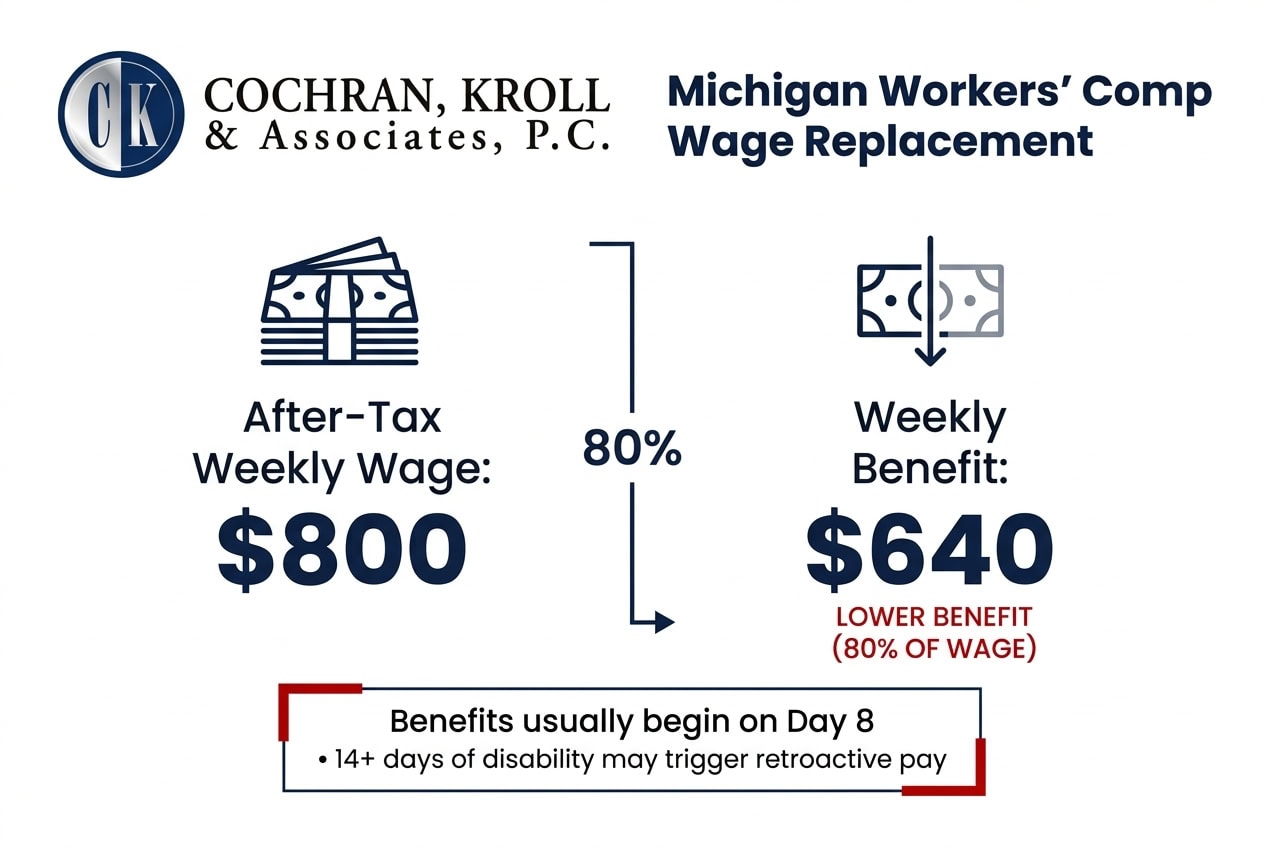
Michigan workers’ compensation pays 80% of your after-tax average weekly wage while you are unable to work. All the benefits start on the eighth day of disability. If you are out for 14 or more consecutive days, those benefits are paid retroactively from day one.
Here is a straightforward example: if your after-tax weekly income was $800, you may be entitled to $640 per week in wage replacement. Benefit amounts are calculated from the 39 highest-earning weeks in the 52 weeks before your injury, and are capped at 90% of Michigan’s state average weekly wage for the year prior to the injury. In cases of permanent disability, wage loss benefits may continue for a lifetime.
Medical Benefits
Your employer’s insurance carrier is responsible for covering all reasonable and necessary medical treatment related to your work injury. This includes surgeries, prescriptions, physical therapy, diagnostic imaging, transportation to medical appointments, and assistive devices.
One thing many Detroit workers do not know: your employer controls which doctor you see for the first 28 days after your injury. After that, you have the right to select your own treating physician, as long as you notify your employer. For severe injuries, attendant care coverage can provide up to 56 hours per week of care from a family member, or 24-hour nursing care when needed.
Vocational Rehabilitation Benefits
If your injury prevents a return to your previous job, Michigan workers’ compensation may fund vocational rehabilitation, including job training, educational programs, and employment counseling.
Death Benefits for Surviving Families
When a worker dies from a work-related injury or illness, surviving dependents may receive weekly death benefits for up to 500 weeks, along with burial expense coverage up to $6,000. If your family has lost a loved one in a workplace accident, our attorneys can explain your options for a wrongful death claim.
How a Detroit Workers’ Compensation Lawyer Fights for You
Filing Your Claim Correctly From the Start
Michigan workers’ compensation has two separate deadlines that often catch injured workers off guard:
- Notify your employer within 90 days of the injury date.
- File a formal claim within 2 years of the injury.
Missing the 90-day notification can result in a benefit denial even if the two-year filing window is still open. Your employer is also required to file Form WC-100, the Employer’s Basic Report of Injury, with the Michigan Workers’ Compensation Agency. An attorney monitors this process to make sure nothing falls through. Many injured workers try to handle their own claims and run into problems they never saw coming. Insurers have teams committed to minimizing payouts. You deserve someone in your corner doing the same.
Calculating What Your Claim Is Actually Worth
Insurance companies frequently undercount average weekly wages, overlooking overtime, bonuses, and earned income that belong in your calculation. That error reduces your benefit payments from the first check forward. At Cochran, Kroll & Associates, P.C., senior partner Eileen Kroll brings both medical and legal training to every case. She can personally review medical imaging, interpret treatment records, and work alongside expert medical witnesses to accurately connect your injury to the workplace accident. When the insurer disputes the severity or cause of your injury, that background changes the outcome.
Dealing With Independent Medical Examinations (IMEs)
If you receive a letter scheduling you for an independent medical examination, understand this: that doctor is paid by the insurance carrier.
IMEs are supposed to be neutral assessments of your injury. In practice, IME doctors frequently conclude that you are not disabled or that you can return to work, often after a single brief examination, and that opinion leads to an abrupt cutoff of your benefits. A workers’ compensation lawyer prepares you for the IME, challenges the IME doctor’s findings when they contradict your treating physician’s records, and introduces counter-evidence to protect your claim. This section of the process trips up more claimants than almost anything else.
Appealing a Denied Claim in Michigan
A denial is not the end of the road. Michigan workers’ compensation appeals are handled through the Michigan Workers’ Compensation Agency. Detroit’s hearing office handles claims for Wayne County. The appeal process begins with a Petition for Hearing, which may lead to mediation or a formal hearing before a magistrate.
Your attorney builds the evidentiary record needed to reverse the denial: medical documentation, employment history, witness testimony, and anything else that supports your case. Appeals succeed regularly. The key is building the right record from the start.
Protecting You from Employer Retaliation
Michigan law (MCL 418.301) prohibits employers from firing, demoting, or threatening workers who file a workers’ compensation claim. If your employer retaliates after you file, you may have additional legal remedies beyond your workers’ comp benefits. Talk to an attorney immediately if this happens.
Pursuing a Third-Party Liability Claim
Workers’ compensation generally bars direct lawsuits against your employer. However, if a third party’s negligence contributed to your injury, such as defective equipment, a negligent subcontractor on a job site, or a property owner’s hazard, you can file a separate personal injury lawsuit alongside your workers’ comp claim. That lawsuit can recover damages that workers’ compensation does not pay, including pain and suffering, emotional distress, and full wage replacement above the workers’ comp cap.
Cochran, Kroll & Associates handles both claims simultaneously. For workers hurt on job sites, ask about construction site injury claims and how a third-party claim might apply to your situation.
When Workers’ Compensation Is Not Enough: Filing a Personal Injury Lawsuit
Workers’ compensation in Michigan does not cover pain and suffering. A personal injury lawsuit can, depending on the facts of your case. Situations where a lawsuit may be appropriate alongside a workers’ comp claim include:
- A defective piece of equipment caused your injury (product liability)
- A negligent third-party contractor was responsible on a construction site
- You were injured in a vehicle accident while driving for work
Economic damages available through a personal injury lawsuit may include medical bills, lost wages, attendant care costs, and property damage. Non-economic damages may include pain and suffering, emotional distress, and loss of enjoyment of life. Eileen Kroll’s medical background allows her to accurately document and quantify the full impact of your injuries, which matters when non-economic damages are part of the claim.
Steps to Take After a Workplace Injury in Detroit
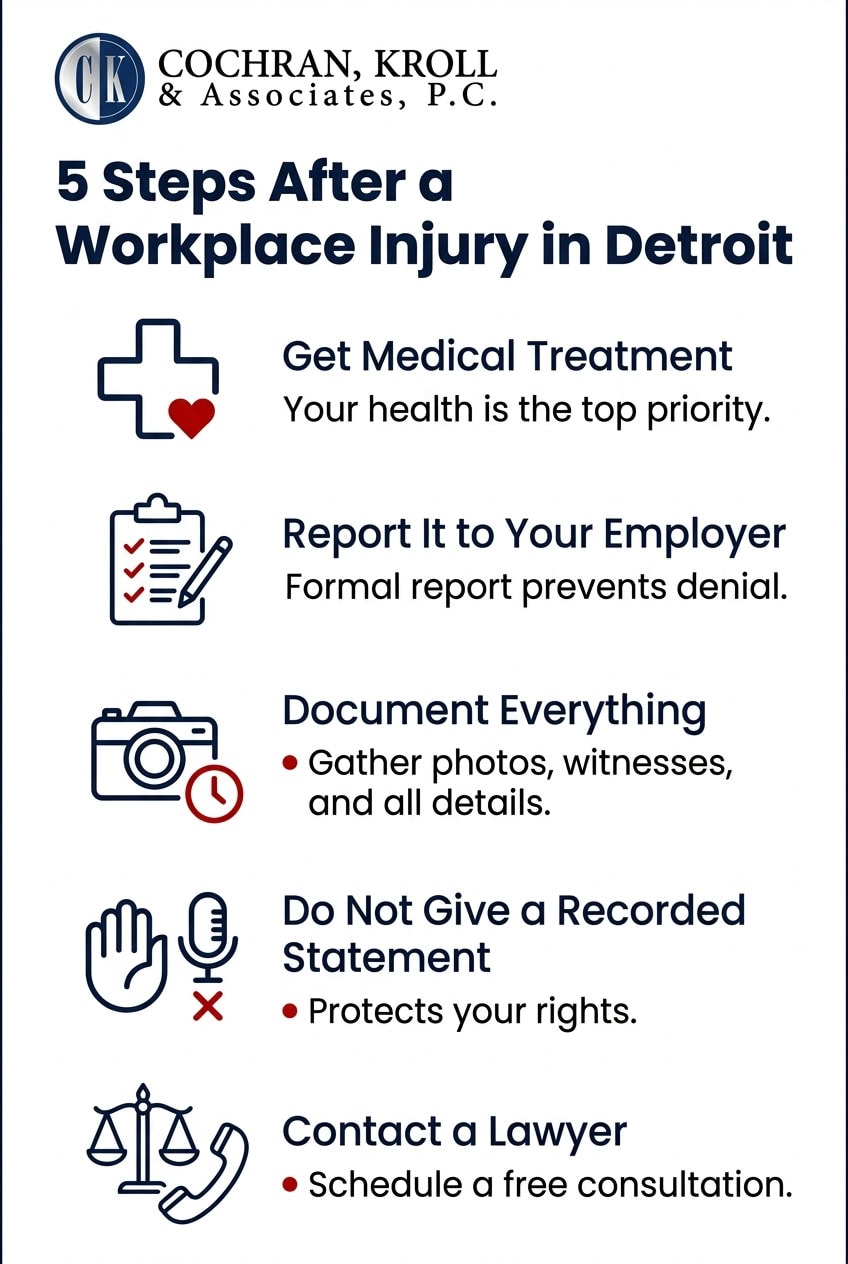
Step 1 – Get Medical Treatment Immediately
Your health comes first. In the first 28 days, your employer may direct which doctor you see. Follow that process, but know you have the right to choose your own physician after 28 days.
Step 2 – Report Your Injury to Your Employer
Do this as soon as possible and in writing. You must notify your employer within 90 days of the injury or risk losing your right to benefits.
Step 3 – Document Everything
Keep copies of all medical records, accident reports, prescriptions, and any communication with your employer or their insurance carrier.
Step 4 – Do Not Give a Recorded Statement Without a Lawyer
Insurance adjusters are trained to limit payouts. Anything you say can and will be used against your claim.
Step 5 – Contact a Detroit Workers’ Compensation Attorney
A lawyer can evaluate your case at no cost, make sure your claim is filed correctly, and begin building your case before evidence disappears.
Why Detroit Workers Choose Cochran, Kroll & Associates, P.C.
Medical and Legal Expertise in One Firm
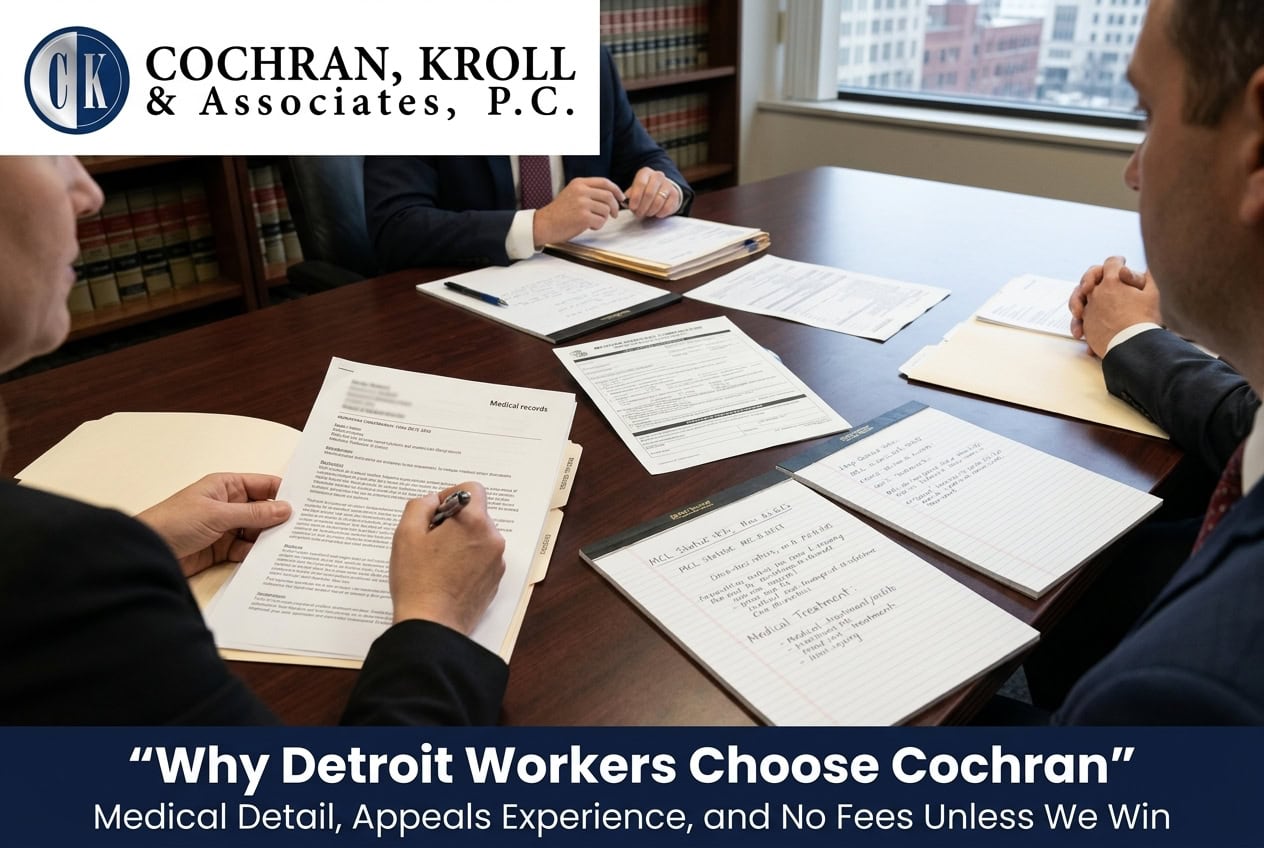
This is the headline difference. Senior partner Eileen Kroll is both an attorney and a former registered nurse. She can personally review medical imaging, interpret treatment records, and work directly with expert medical witnesses. When an insurance company argues your injury is less severe than your treating doctor says, or claims the injury was not work-related, Eileen challenges that from both the medical and legal sides of the evidence.
Eileen Kroll holds Martindale Preeminent and Martindale Client Champion designations. Terry Cochran is Super Lawyers listed, Avvo rated, and Martindale Preeminent. Together, they have helped Michigan workers recover over $44 million in verdicts and settlements. Read client stories in their own words on our client reviews page.
Proven Results for Detroit-Area Clients
- $1.5 million recovery for a construction site workplace injury in Westland, Michigan
- $1.25 million recovery for a construction site injury in Flint, Michigan
- $125,000 workers’ compensation settlement in Detroit, Michigan
View our full case results for additional examples of what we have recovered for injured Michigan workers.
Contact Our Workplace Injury Lawyers in Detroit
If you were hurt on the job, you have rights that your employer and their insurance company may not volunteer to tell you about. Getting the right legal guidance early can protect your claim and your future.
Contact us at Cochran, Kroll & Associates, P.C. for a free consultation. We’ll review your case, explain your options, and map out the strongest path forward. Remember, we don’t get paid unless you win.
Call us at 1-866-MICH-LAW anytime, 24/7, to schedule a free case evaluation.
Frequently Asked Questions About Workers' Comp in Detroit
How much does a workers' compensation lawyer cost in Detroit?
At Cochran, Kroll & Associates, there is no upfront cost. The firm works on a contingency fee basis, which means you pay nothing unless we recover compensation for you. Your initial case evaluation is free and carries no obligation.
What is the deadline to file a workers' comp claim in Michigan?
You must notify your employer within 90 days of your injury and file a formal claim with the Michigan Workers’ Compensation Agency within 2 years. Missing the 90-day notification can jeopardize your entire claim, even if the two-year filing window is technically still open.
Can my employer fire me for filing a workers' compensation claim in Michigan?
Michigan law (MCL 418.301) prohibits employers from retaliating against workers who file a workers’ comp claim. If your employer fires, demotes, or threatens you after you file, you may have additional legal remedies. Contact an attorney immediately if this occurs.
What happens if my workers' comp claim is denied?
A denial is not final. You can appeal through the Michigan Workers’ Compensation Agency. The process starts with a Petition for Hearing, which may proceed to mediation or a formal hearing before a magistrate. An attorney builds the evidentiary record needed to reverse the denial.
Can I sue my employer in addition to filing a workers' comp claim?
Generally, workers’ compensation bars direct lawsuits against your employer. However, if a third party’s negligence contributed to your injury, such as a defective product, a negligent contractor, or a property owner’s hazard, you may file a separate personal injury lawsuit while also pursuing workers’ comp benefits. Some workers qualify for both.
Do I really need a lawyer to file a workers' comp claim in Detroit?
You are not legally required to have a lawyer. However, insurance companies have teams of adjusters and attorneys working to minimize your payout. Workers represented by an attorney typically receive higher benefit amounts and are far better positioned to challenge denials, IME findings, and improper benefit calculations. The consultation is free, so there is no cost to understanding your options.