Car Accident Attorney in Sterling Heights, MI
A car accident attorney in Sterling Heights, MI can protect your claim in the exact window most people lose it: the first 24 hours, before evidence disappears and an adjuster calls. At Cochran, Kroll & Associates, P.C., we help injured Michigan drivers understand their no-fault benefits, their deadlines, and who is actually responsible. Free 24/7 consultation. No fees until we win.
Call now: 1-866-MICH-LAW
Or get a free case evaluation. No fees until we win.
What to Do in the First 24 Hours After a Sterling Heights Car Accident
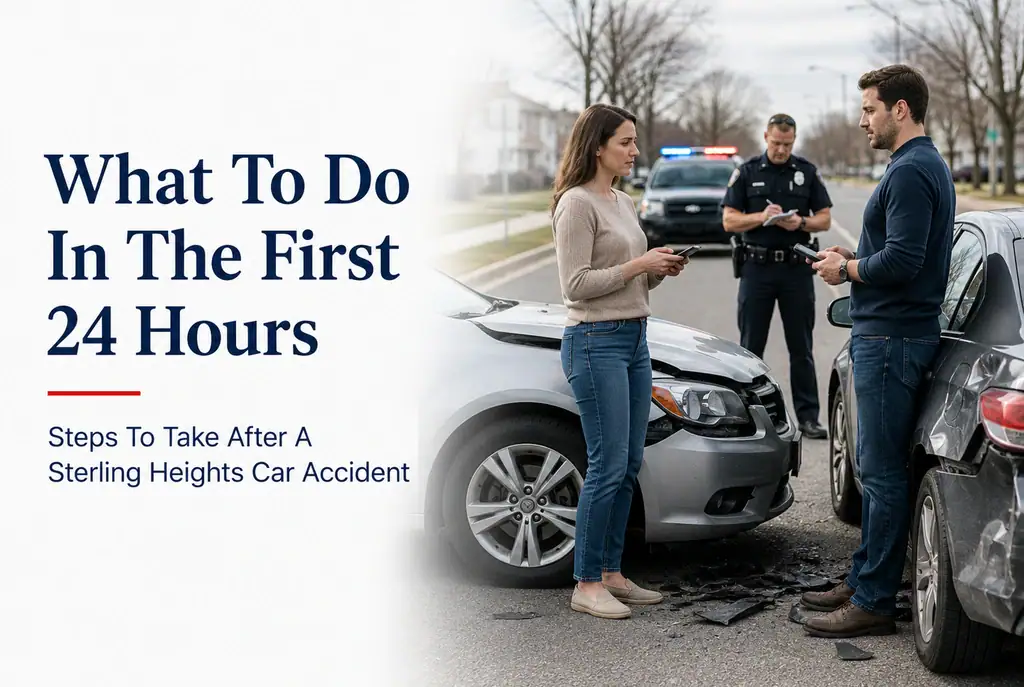
What you do in the first day shapes the rest of your claim. Work through these steps in order, and skip only the ones that are not safe or not possible.
At the scene:
- Call 911 if anyone is hurt or the road is blocked, and ask how to get the crash report number.
- Move to a safe spot, and turn on your hazards if the vehicles are still in traffic.
- Exchange names, license, insurance, and plate information with the other driver.
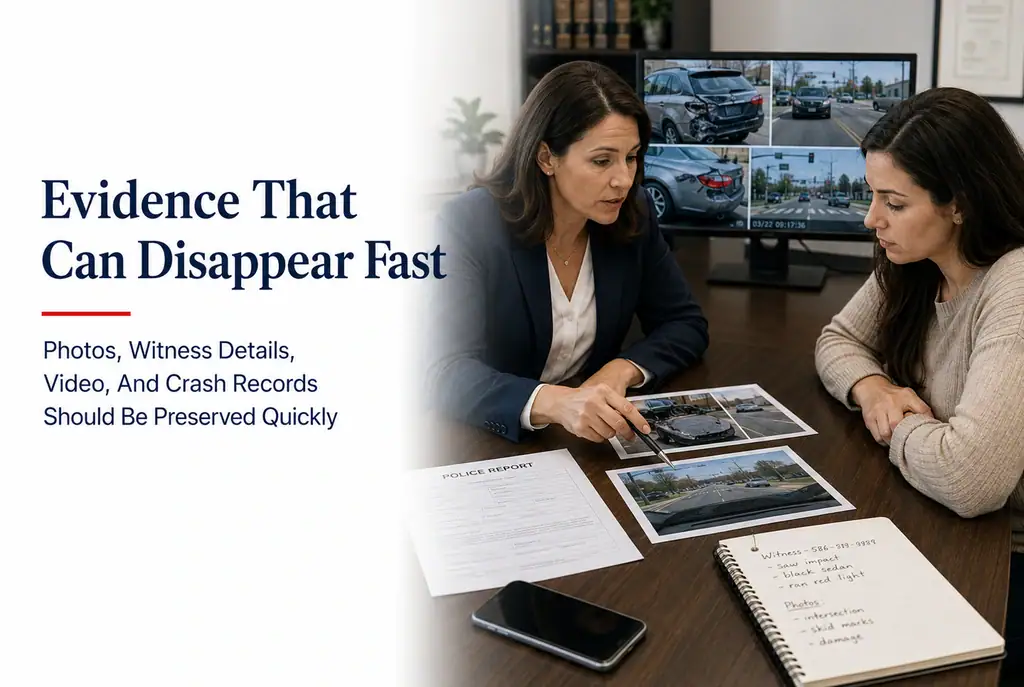
- Photograph vehicle positions, damage, skid marks, road conditions, and traffic signals.
- Get names and phone numbers from any witnesses before they leave.
Within the first few hours:
- Seek medical care even if you feel fine, since crash injuries often surface later.
- Notify your own auto insurer with the basic facts only, and avoid speculating about fault.
- Save the crash report number and the responding agency’s name.
Within 24 hours:
- Do not give a recorded statement to any adjuster, including the other driver’s, until you have advice.
- Write down everything you remember while it is fresh: direction of travel, speed, and what happened right before impact.
- Keep every document, from tow receipts to discharge papers, in one folder.
- Contact an attorney so evidence like nearby camera footage can be preserved before it is overwritten.
Types of Car Accidents That Happen in Sterling Heights
Sterling Heights’ mix of high-speed arterials, dense retail corridors, and the I-696 interchange produces distinct crash patterns, and each type carries its own typical injuries and its own liability questions.
- Rear-end collisions. Common at stops on Hall Road and Mound Road; often tied to distraction or tailgating.
- T-bone (side-impact) collisions. Frequent at intersections along Van Dyke and M-59, usually involving a right-of-way dispute.
- Head-on collisions. Less common but severe, often on undivided stretches or from a wrong-way entry.
- Sideswipe collisions. Lane-change and merge conflicts on M-59 and the I-696 ramps.
- Rollover crashes. More likely in taller SUVs during abrupt evasive maneuvers.
- Multi-vehicle pile-ups. Chain-reaction crashes in heavy interchange traffic, which raise complex questions of shared fault.
Common Sterling Heights Car Crash Locations and Why They Matter to Your Claim
Sterling Heights recorded 3,748 reported crashes in 2024, including 825 injury crashes, according to Michigan Traffic Crash Facts. Those crashes concentrate on a handful of corridors, and where your crash happened is not just background detail.
Crash location decides which police agency investigated, whether MDOT or business cameras captured the crash, and whether a road-design or signage problem contributed. It can also open a claim against a government body if a defect played a role, though those claims are limited and carry short deadlines, covered below.
How Michigan No-Fault Works After a Sterling Heights Crash
Michigan is a no-fault state, so after a crash, your own insurer pays Personal Injury Protection (PIP) benefits regardless of who caused it, subject to your coverage and the rules that apply. Since the 2019 reform (Public Acts 21 and 22 of 2019), drivers choose a PIP medical level rather than receiving unlimited coverage automatically.
| PIP medical option |
Who it is for |
| Unlimited |
Any driver; the most complete coverage |
| $500,000 per person, per accident |
Any driver |
| $250,000 per person, per accident |
Any driver |
| $50,000 per person, per accident |
Only if enrolled in Medicaid |
| PIP opt-out |
Only with Medicare Parts A and B |
| PIP exclusion |
Only with Qualified Health Coverage for the household |
PIP generally covers medical care, wage loss, and replacement services. It does not cover pain and suffering. Those fault-based damages come through a separate third-party claim, which Michigan allows only when the injury meets the serious impairment threshold under MCL 500.3135. You generally have one year to claim PIP benefits under MCL 500.3145, a deadline that catches many people mid-treatment.
Who Can Be Held Legally Responsible for Your Crash

“The other driver” is often only part of the answer. Identifying every responsible party can mean more available insurance and a fuller recovery for you.
- The at-fault driver, for negligent driving such as speeding, distraction, or failing to yield.
- The vehicle owner, if someone other than the owner was driving, under Michigan’s owner-liability statute (MCL 257.401).
- The driver’s employer, if the driver was working at the time, under respondeat superior.
- A commercial fleet operator, for negligent hiring, supervision, or maintenance.
- A government body, for a road or signage defect, though these claims are tightly limited by governmental immunity and require early notice.
- A bar or restaurant, under Michigan dram shop liability (MCL 436.1801), if it overserved a driver who was visibly intoxicated.
We have handled catastrophic vehicle cases before, including a $1.3 million settlement for a family whose child was killed by a semi-truck (past results do not predict future outcomes). See more on our verdicts and case results page.
The Deadlines That Can Silently Kill Your Sterling Heights Case
Two deadlines run at the same time after a crash, and they are not interchangeable. Missing one does not extend the other.
| Deadline |
Statute |
Trigger |
What happens if missed |
| 1 year – no-fault PIP benefits |
MCL 500.3145 |
Date of crash or date expense incurred |
You can lose benefits while still in treatment |
| 3 years – injury or wrongful death lawsuit |
MCL 600.5805 |
Date of crash or date of death |
The third-party claim is barred entirely |
| Often shorter – notice against a government body |
Governmental immunity notice rules |
Date of crash |
A road-defect claim can be lost before you even file |
What Compensation You Can Actually Recover
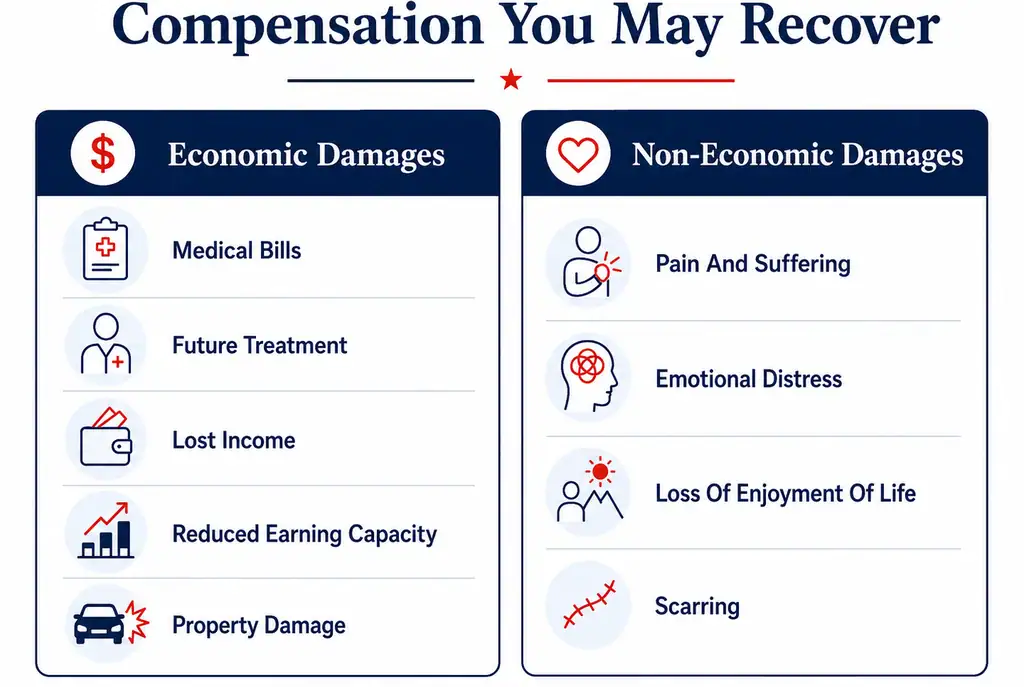
Michigan recognizes two categories of damages. Economic damages are available through no-fault and third-party claims; non-economic damages come only through a third-party claim that meets the serious impairment threshold. Severe outcomes such as a traumatic brain injury or spinal cord injury raise the value because future care is so costly.
| Economic damages |
Non-economic damages (third-party claim only) |
| Current and future medical care |
Pain and suffering |
| Lost wages and lost earning capacity |
Disfigurement and permanent scarring |
| Replacement services and out-of-pocket costs |
Loss of enjoyment of life |
| Property damage |
Loss of consortium |
The Insurance Tactics You Should Expect and How to Handle Them
Adjusters are trained to limit payouts. None of these tactics are personal, and each one has a simple response.
- The fast, friendly recorded-statement request. You are not required to give one; decline until you have advice.
- The quick lowball offer. Early offers rarely account for future care, so do not accept before your treatment is understood.
- The broad medical-records release. It is usually wider than needed; you can limit its scope.
- The recorded “how are you feeling?” call. A casual “I’m okay” can be used to minimize your injuries later.
- The delay-and-deny pattern. Keep dated records of every call and submission so gaps are on them, not you.
- The blame shift. Preserve photos and witness contacts, which often show the other driver failed to yield.
Why Cochran, Kroll & Associates for Your Sterling Heights Car Accident Claim

You want a firm that answers quickly, explains things plainly, and is ready to try a case if the insurer will not be fair. Our senior attorneys bring the credentials to back that up.
- Terry L. Cochran is recognized by Super Lawyers, rated AV Preeminent by Martindale-Hubbell, and highly rated on Avvo.
- Eileen E. Kroll is AV Preeminent and a Client Champion honoree, and a registered nurse as well as an attorney.
- Local access. Livonia and Flint offices, roughly 40 minutes from Sterling Heights, with home and hospital visits when you cannot travel.
- Language access. Arabic-speaking attorney Rula Aoun serves the broader metro area.
- No financial risk. A free 24/7 consultation and no fees until we win.
For related help, see our broader Michigan car accident practice.
Contact Our Car Accident Lawyers in Sterling Heights
If you were injured in a car accident in Sterling Heights, dealing with insurance companies while recovering from your injuries is the last thing you should have to worry about. An experienced attorney can handle the legal process while you focus on getting better.
Contact us at Cochran, Kroll & Associates, P.C. for a free consultation. We’ll review your case, explain your options, and map out the strongest path forward. Remember, we don’t get paid unless you win.
Call us at 1-866-MICH-LAW anytime, 24/7, to schedule a free case evaluation.
Frequently Asked Questions
I feel fine after my Sterling Heights crash. Do I still need to see a doctor?
Yes. Adrenaline can mask injuries for hours or days, and conditions like concussions and soft-tissue damage often show up late. A prompt medical visit protects your health and creates the record that ties your injuries to the crash, which matters for both PIP benefits and any third-party claim.
What if the other driver was uninsured or fled the scene?
You may still have coverage. Your own PIP benefits generally apply regardless of who caused the crash, and uninsured or underinsured motorist coverage may pay for injuries a hit-and-run or uninsured driver caused. Reporting the crash promptly and preserving evidence protects these options.
How does the 2019 Michigan No-Fault reform affect my case?
The reform lets drivers choose a PIP medical level instead of automatic unlimited coverage, so how much medical coverage you have depends on the option you selected. If your care exceeds that level, the excess may be recoverable from the at-fault driver. Reviewing your policy early tells us what coverage is actually in play.
Can I still recover damages if I was partly at fault?
Often yes. Under Michigan’s modified comparative fault rule (MCL 600.2959), your recovery is reduced by your share of fault, and you can still recover as long as you were 50 percent or less at fault. Above that, non-economic damages are barred, which is one reason a fault dispute is worth taking seriously.